
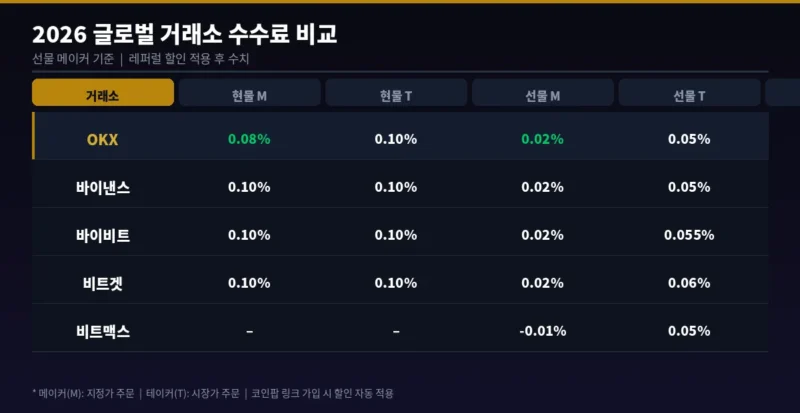
The cost that consistently impacts your actual returns when using OKX is the Trading Fee. While a 0.01% difference may seem small for one or two trades, the cumulative cost difference can become significant as the number of trades and trading volume increase.
In particular, since futures traders may incur fees both when entering and exiting a position, you should not just look at the “% per trade,” but rather calculate by distinguishing between Maker/Taker fees, VIP levels, funding fees, withdrawal costs, and referral benefits.
This article does not repeatedly explain the entire usage of the OKX exchange. It focuses on the 2026 OKX fee structure and methods to reduce actual trading costs.
Key Summary
- OKX fees vary depending on the product, such as spot, futures, and options.
- Maker and Taker fee rates are different.
- As trading volume or account assets increase, you can receive lower fee rates through VIP levels.
- OKX adjusted its VIP criteria and futures fee policies in 2026, so you should not rely solely on outdated fixed fee tables.
- If you sign up via a partner link, you can receive the invited user benefits set for that link, but it is safest to verify the final applicable benefits on the registration screen and in the account’s Fee Rules.
- COINPOP Referral Code: COINPOP
- Sign-up Link: Join OKX
According to official OKX documentation, the trading fee structure for regular users and VIP users differs, and VIP levels are determined based on trading volume and asset conditions. Additionally, the discount structure for spot, futures, perpetual futures, and options may vary.
1. What you need to know first when looking at OKX fees
When searching for OKX fees, you can often find tables listing only a single number.
However, actual trading costs are not that simple.
On OKX, you must distinguish between the following costs:
| Cost | When it occurs | Key verification points |
|---|---|---|
| Spot Trading Fee | When buying/selling coins | Maker / Taker |
| Futures Trading Fee | Entering/exiting futures positions | Maker / Taker, VIP |
| Funding Fee | Holding perpetual futures positions | Funding Rate per contract |
| Withdrawal Fee | Withdrawing to external wallets/exchanges | Varies by coin/network |
| Deposit Fee | Depositing crypto to OKX | Generally no OKX deposit fee |
| Other products (Options, etc.) | Trading those products | Check Fee Rules per product |
Official OKX help guides state that while there is no separate deposit fee for cryptocurrency deposits, withdrawal costs occur depending on the network and situation, and these amounts may fluctuate.
Therefore, a more accurate question than simply “What is the OKX fee %?” is as follows:
For the product I intend to trade, what is the Maker/Taker fee applied to my current account level?
2. The difference between Maker and Taker
To understand trading fees, you must first distinguish between Maker and Taker.
What is a Maker?
A Maker is generally an order that provides new liquidity to the order book.
For example, if Bitcoin is currently trading at 100,000 USDT and you place a limit buy order at 99,500 USDT and wait for it to be filled, that order has the potential to provide liquidity to the order book.
In this case, if the conditions are met, it is processed as a Maker.
What is a Taker?
A Taker is an order that immediately fills an order already existing in the order book.
Market orders are the most common example, but a limit order is not necessarily always a Maker.
If a limit order is filled immediately at the current market price, it can be processed as a Taker.
OKX also officially explains that while limit orders that remain in the order book and become Makers can receive lower Maker rates, even limit orders can be subject to Taker rates if they are filled immediately.
Therefore:
Limit Order = Always Maker
is not a correct assumption.
3. OKX Spot Fees
Spot is the standard trading method where you buy or sell actual cryptocurrencies like BTC, ETH, or SOL using USDT.
OKX spot fees can vary depending on the following conditions:
- Regular user or VIP user
- 30-day trading volume
- Account assets
- Trading pair
- Applicable product group
- Region where the account is located
- Promotions or special fee policies
Therefore, this article does not define specific fee rates as absolute values permanently applied to all OKX users.
OKX allows you to check the actual applicable fees in your account’s Fee Rules, and explains that official fee policies also vary depending on account level.
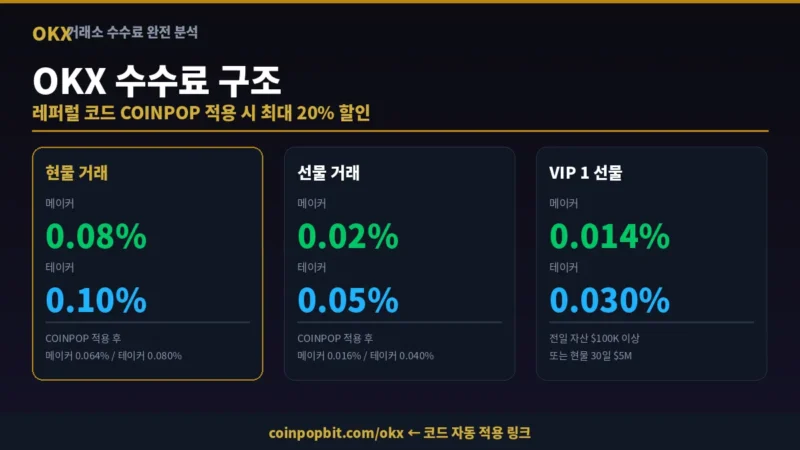
Example of widely used standard spot criteria
Taking a well-known representative spot fee structure for regular levels as an example:
| Order | Example Fee Rate |
|---|---|
| Spot Maker | 0.08% |
| Spot Taker | 0.10% |
Note: The numbers above are general examples to help understand cost calculation; you must re-verify the actual rates applied to your current account in the OKX Fee Rules. OKX may change fees and VIP conditions, and they implemented related policy adjustments in 2026 as well.
4. How big is a 0.01% difference really?
The difference between 0.08% and 0.10% is only 0.02 percentage points.
However, the story changes when the trading amount increases.
For example, for simple calculation:
- Maker 0.08%
- Taker 0.10%
Let’s assume.
Example of single-trade fee by trading amount
| Trading Amount | Maker 0.08% | Taker 0.10% | Difference |
|---|---|---|---|
| $1,000 | $0.80 | $1.00 | $0.20 |
| $10,000 | $8 | $10 | $2 |
| $100,000 | $80 | $100 | $20 |
| $1,000,000 | $800 | $1,000 | $200 |
It is not a big difference when looking at it just once.
However, for a trader whose monthly cumulative trading volume reaches millions of dollars, the choice between Maker/Taker and the difference in VIP levels can affect actual trading performance.
In particular, short-term traders repeat entries and exits, so the nominal trading amount can accumulate to be much larger than the actual assets held.
5. How are OKX futures fees calculated?
Futures or Perpetual Swaps use a different fee structure than spot.
The basic principles here are the same.
- Maker
- Taker
- VIP level
- Product group
The actual rates can vary depending on these.
Examples often presented for general OKX futures trading are:
| Order | Example Fee Rate |
|---|---|
| Futures Maker | 0.02% |
| Futures Taker | 0.05% |
However, OKX also changed VIP conditions and some futures fee rates in April 2026. Therefore, you should not assume the numbers above are fixed rates permanently applied to all accounts.
In the policy announced by OKX in 2026, they adjusted the VIP system, such as lowering some futures trading volume criteria for VIP 1 to VIP 3, and also adjusted some VIP futures fee rates.
6. Do fees increase if I increase leverage in futures?
This is a point where beginners often misunderstand.
Fees should generally not be thought of based only on the margin you put in.
The nominal value of the actual position is important.
For example:
- Margin: $1,000
- Leverage: 10x
- Position size: $10,000
If so, what is important in fee calculation is not $1,000, but the $10,000 position size.
For example, if we simply assume a Taker fee of 0.05%:
$10,000 × 0.05% = $5
If about $5 occurs upon entry and about $5 occurs under the same conditions upon exit, the round-trip trading cost becomes about $10.
If you operate a $20,000 position by increasing leverage to 20x, the absolute amount of trading cost will be larger even at the same rate.
Therefore, the higher the leverage you use:
Not only are returns magnified, but the absolute amount of trading costs also increases.
7. Trading Fee and Funding Fee are completely different costs
What is most often confused in futures trading is Trading Fee and Funding Fee.
The two are completely different.
| Classification | Trading Fee | Funding Fee |
|---|---|---|
| Cause | Order execution | Maintaining perpetual futures position |
| Timing | At execution (entry/exit, etc.) | At contract Funding settlement time |
| Amount | Fee rate × Trading volume | Funding Rate × Position-related criteria |
| Fixed status | Based on account Fee Rules | Fluctuates based on market conditions |
| Counterparty | Exchange fee structure | Generally settlement structure between long/short participants |
OKX officially explains that the funding cycle for perpetual futures can exist not only as 8 hours, but also as 4 hours or 2 hours depending on the product. Therefore, it is not accurate to assume that “OKX funding fees always occur every 8 hours.”
While an 8-hour cycle may be used for representative contracts like BTCUSDT, it is safest to check the Funding Rate and next settlement time for that contract directly before trading.
Important point
For traders who hold positions for a long time, the cumulative funding fee can become a larger cost than the trading fee.
Conversely, for scalpers who enter and exit quickly, the Maker/Taker trading fee may be a more important cost than funding.
8. Why OKX VIP level is important
If your trading volume is high, you should look not only at referral discounts but also at your VIP level.
In the official OKX fee structure, your level is determined based on trading volume and asset conditions, and meeting higher levels can result in more favorable fee levels across various product groups.
Additionally, OKX explains a structure where if you meet high VIP conditions in one product, you can utilize that high level in other products as well.
Some of the futures-related VIP conditions disclosed by OKX as of the April 2026 adjustment are as follows:
| Level | Asset criteria or 30-day futures trading volume criteria |
|---|---|
| Regular | Assets < $100,000 / Futures volume < $5M |
| VIP 1 | Assets ≥ $100,000 or Futures volume ≥ $5M |
| VIP 2 | Assets ≥ $200,000 or Futures volume ≥ $10M |
| VIP 3 | Assets ≥ $2M or Futures volume ≥ $50M |
| VIP 4 | Assets ≥ $5M or Futures volume ≥ $200M |
| VIP 5 | Assets ≥ $20M or Futures volume ≥ $600M |
The table above summarizes some of the futures/VIP adjustment details announced by OKX in 2026, and the latest criteria must be checked in your account’s actual Fee Rules.
For general small-scale investors, VIP conditions may not be very important.
However, from the moment your monthly trading volume increases:
Referral discount + Maker order + VIP level
Managing them together is the most effective way to reduce actual transaction costs.
9. Realistic ways to reduce OKX fees
The official OKX help center also suggests meeting VIP requirements, utilizing Maker orders, and participating in official programs and promotions as ways to reduce transaction costs.
Method 1. Utilize Maker orders
Repeatedly using only market orders can increase your Taker ratio.
If an order does not need to be filled immediately, you can use limit orders that remain in the order book to increase the possibility of a Maker execution.
However, as explained earlier, a limit order is not always a Maker order.
If it is filled immediately, it may become a Taker order.
Method 2. Check VIP requirements
If you have a high trading volume or hold a certain amount of assets on OKX, you may have reached VIP requirements without realizing it.
OKX calculates fee tiers based on factors such as trading volume and asset holdings.
Method 3. Check referral benefits before signing up
If you are a new user, it may be more advantageous to check the actual invitation benefits provided by a partner link before signing up, rather than signing up directly through the general registration page.
The official OKX Affiliate program explains that partners can create exclusive links and codes, and set the benefit structure distributed between the partner and the invited user for each link.
Therefore, you should not assume that all referral codes offer the same conditions.
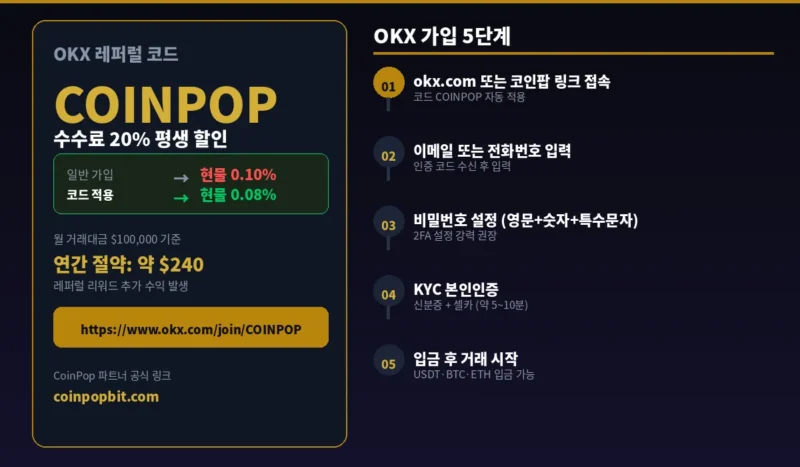
10. How to apply the OKX referral code COINPOP
The OKX partner code provided by CoinPop is as follows:
Referral Code: COINPOP
Using the partner link may open the registration page with the code automatically applied.
If you accessed the OKX registration screen directly, check if a Referral Code or Invitation Code input field is displayed, and enter COINPOP.
Things to check before signing up
It is recommended to check the following before clicking the sign-up button:
- Is the referral code displayed as
COINPOP? - Are the Fee Rebate or discount benefits provided for that account/region displayed on the screen?
- If there are event-based rewards, are there separate conditions and periods?
- Are the products and affiliate benefits available in your current region of residence?
Under the official OKX Affiliate rules, partners can set the structure for invited users per link, and the application of benefits and commissions may vary depending on region, account status, VIP level, and whether special fees are applied.
Therefore, rather than assuming that “the same discount rate is applied for life regardless of country or account,” it is more accurate to use the actual conditions displayed on the registration screen and Fee Rules as the final standard.
11. How much are costs reduced assuming a 20% COINPOP benefit?
Let’s calculate based on the premise that a 20% trading fee discount/rebate benefit is actually displayed and applied on the registration screen.
If you save 20% of the existing fee, the calculation is simple.
Fee after discount = Existing fee × 0.8
For example:
| Example base fee | Assuming 20% savings |
|---|---|
| 0.10% | 0.080% |
| 0.08% | 0.064% |
| 0.05% | 0.040% |
| 0.02% | 0.016% |
Example with $10,000 trading volume
For a trade with a base Taker rate of 0.10%:
- Standard cost: $10
- Assuming 20% savings: $8
- Difference: $2
Example with $100,000 trading volume
- Standard cost: $100
- Assuming 20% savings: $80
- Difference: $20
Example with $1,000,000 cumulative trading volume
- Standard cost: $1,000
- Assuming 20% savings: $800
- Difference: $200
The important thing here is that this does not mean you must actually hold $1,000,000 in your account.
If you repeat short-term trades, your cumulative trading volume for a month can be much larger than your account assets.
Therefore, the higher the trading frequency, the greater the impact of small differences in fee rates.
12. Why you should not simply add referral discounts and VIP discounts
For example:
VIP discount + 20% referral = Simply add the two discounts together
You should not calculate it this way.
OKX’s Affiliate rules include conditions stating that the general Affiliate commission structure may not apply to users with special fee rates, certain high-level VIP users, fee-free trades, or trades using various fee deduction vouchers.
Therefore, for users with high trading volumes, it is most accurate to check the final applied fee rate directly in your account under:
Profile → Fee Rules
or in the fee information on the trading screen.
13. OKX withdrawal fees are not fixed
A common error often seen in existing information articles is:
“OKX BTC withdrawal fee is always 0.0005 BTC”
writing withdrawal fees as a fixed value like this.
We do not recommend writing in this way currently.
According to the official OKX help center, cryptocurrency withdrawal costs can vary depending on network congestion, operational conditions, network type, etc., and the currently applied cost is displayed on the actual withdrawal screen.
For example, for USDT as well:
- ERC20
- TRC20
- Other supported networks
costs can differ depending on the network.
Therefore, when withdrawing, you must check:
- Whether the receiving exchange supports the network
- Whether the address is correct
- What the current withdrawal fee is
- What the minimum withdrawal amount is
Simply choosing the network with the lowest fee can lead to bigger problems if the recipient does not support it.
14. OKX deposit fees
OKX states that it does not charge its own cryptocurrency deposit fees when depositing cryptocurrency into OKX from an external wallet or another exchange.
However, you should not understand this as:
“There is no cost at all to send coins to OKX”
This is because:
- Withdrawal fees
- Network gas fees
may occur at the sending exchange or wallet.
In other words:
OKX not charging a deposit fee and the entire transfer process being free are separate things.
15. How to check OKX fees
The fee rate displayed in your own OKX account takes precedence over any fee table found on the internet.
The official OKX help center also explains that users can check their 30-day trading volume, asset conditions, and current Fee Tier.
The items to check are as follows:
- Current Fee Level
- Spot Maker
- Spot Taker
- Futures Maker
- Futures Taker
- 30-day trading volume
- VIP conditions
- Applicable promotions/referral benefits
Especially since fee policies can change, even if you are reading an article from 2026, you need to get into the habit of checking the account screen one last time before actually placing an order.
16. Market orders are not always bad
You do not have to use limit orders for every trade just because Maker fees are lower.
In a market where prices move rapidly:
- The risk of not being filled
- The opportunity cost of missing the desired price
- Strategy failure caused by constantly modifying limit orders
can be a greater cost than a few dollars in fees.
Therefore:
When Maker is advantageous
- When entry is not urgent
- When trading volume is high and fee sensitivity is high
- When spreads and quotes are stable
- Repetitive short-term trading strategies
When Taker is reasonable
- When you need to reduce risk immediately
- Situations where a stop-loss is needed
- When fast entry is strategically important
- When the cost of waiting for a Maker execution is greater
In other words, the goal is not the lowest fee rate itself, but to optimize total transaction costs and execution quality together.
17. Why you should not choose an exchange based only on fees
While fees are important when choosing an exchange, they are not the only criterion.
In actual trading, you should also look at the following:
- Order book depth
- Trading volume
- Spread
- Order execution speed
- System stability
- Withdrawal stability
- Supported products
- Account security
- Available regions
- Regulatory situation
For example, even if the fee rate is 0.01% cheaper, if the order book is thin and slippage increases, the actual transaction cost may actually increase.
Therefore, to check the overall characteristics, security, trading products, and deposit/withdrawal methods of OKX itself, it is better to refer to a separate comprehensive document rather than repeating everything in this fee document.
OKX Exchange Comprehensive Guide
This page focuses exclusively on fees and costs.
18. OKX Fee FAQ
Q1. What are OKX’s spot fees?
They can vary depending on account level, trading pair, region, and product group. Do not just look at the general rates often cited on the internet; it is most accurate to check your own Maker/Taker rates in Fee Rules after logging in. OKX also distinguishes between the fee structures for general users and VIP users.
Q2. If I use a limit order, am I always a Maker?
No. Even with a limit order, if it is filled immediately with an existing quote, you can become a Taker. To be a Maker, the order must remain in the order book in a way that provides liquidity.
Q3. How do I increase my OKX VIP level?
OKX determines VIP levels using conditions such as trading volume and account assets. Detailed criteria are subject to change, and there were adjustments to VIP conditions in 2026 as well.
Q4. What is the COINPOP referral code?
It is COINPOP.
Partner link:
It is recommended to check the benefits displayed at the time of sign-up for the actual discount or rebate conditions provided to your account.
Q5. Can I enter COINPOP for an OKX account I have already signed up for?
The ability to change affiliate relationships or reactivate accounts for existing users may vary depending on the region and conditions. Since OKX explains that it operates a feature in some regions that allows existing users who have been inactive for a long period to be reconnected via an affiliate link, it is more accurate to check if it is possible for your specific account and region rather than assuming it is “absolutely impossible.”
Q6. Are funding fees also subject to referral fee discounts?
Funding Fees and Trading Fees are separate cost structures. You should not consider general trading fee discounts and funding fees to be the same. Funding fees are determined based on the Funding Rate of each perpetual contract.
Q7. Are OKX funding fees always charged every 8 hours?
No. According to official OKX documentation, there are perpetual futures contracts that use 8-hour, 4-hour, and 2-hour settlement cycles. You must check the actual Funding information for the contract you intend to trade.
Q8. Are withdrawal fees also discounted by referrals?
General trading fees and withdrawal network costs are separate. Withdrawal costs can vary depending on the coin, the network, and network conditions; you should check the current value on the withdrawal screen.
Q9. Do I get an automatic trading fee discount if I hold OKB?
Current official OKX fee reduction guidelines state that OKB cannot be used to offset trading fees, and holding OKB itself does not affect Fee Tier discounts.
Q10. What is the most effective way to reduce fees?
It depends on your trading style, but generally:
- Check your actual Fee Tier
- Reduce unnecessary Taker orders
- Check VIP conditions if your trading volume is high
- Check partner benefits before signing up
- Calculate total costs including the Funding Rate for futures trading
It is reasonable to check in this order.
19. Conclusion – On OKX, you should look at the final applied fee rather than the ‘discount rate’
To properly compare OKX trading costs, you should not just look at a single sentence like:
“The fee is 0.08%.”
or
“You get a 20% discount via referral.”
The actual cost must be viewed by considering:
Base Fee + Maker/Taker + VIP Level + Trading Product + Referral/Promotion + Funding Fee + Withdrawal Fee
all together.
In particular, OKX changed its VIP conditions and some fee policies in 2026. Therefore, the Fee Rules displayed on your OKX account are the final standard, rather than an outdated fee table.
If you are a new user, it is recommended to compare the conditions of a standard sign-up versus a partner sign-up before registering.
OKX Referral Code: COINPOP
You can proceed after checking the actual fee discount or rebate conditions applied on the sign-up page.
Official References
The fee structure and policy explanations in this article were written by cross-referencing official OKX Fee Details, VIP policy change notices, Trading Fee reduction guides, Affiliate Program Rules, Funding Rate policies, and deposit/withdrawal fee guides as of August 2026. Since OKX may change fees and product offering conditions, the account Fee Rules at the time of actual trading take precedence.
Affiliate Disclosure: The OKX links included in this article are affiliate links. If you sign up and trade through these links, CoinPop may receive revenue from OKX. Regardless of the affiliate status, fee policies and risk factors are written based on official materials whenever possible.
Investment Disclosure: This content is for informational purposes only and is not an investment recommendation. Cryptocurrency and derivatives trading involve the risk of principal loss and liquidation, and the availability of services and products may vary by country or region.
Additional referral information for other exchanges or fee comparison materials can be found below.