

Bitget is a trading platform offering spot and futures trading, copy trading, trading bots, and more. Before signing up, first check your eligibility based on your place of residence, actual fees, deposit and withdrawal routes, and security incident history. This global user guide also reviews the company’s follow-up announcements about the September 2026 security incident and the limitations of its protection fund and proof of reserves.
Bitget at a Glance
- According to the official VIP 0 fee schedule viewed on October 24, 2026, standard spot Maker and Taker fees are 0.1% each, while standard futures fees are 0.02% for Maker and 0.06% for Taker. Regional, trading-pair, and product exceptions, as well as the actual rate on your account, take precedence. Official fee schedule
- For eligible users, paying spot fees with BGB may reduce the standard rate from 0.1% to 0.08%, provided the feature is enabled and the user has sufficient BGB. Do not assume this has the same conditions as referral, VIP, or futures benefits. BGB fee payment guide
- Eligibility for registration, derivatives, and stock-related products varies by country of residence. The availability of pages in a particular language does not mean residents of that country are authorized to use the service. Regional access conditions
- Bitget announced that it completed the phased resumption of withdrawals and related services on October 2, following the security incident on September 24, 2026. The current status of individual accounts, assets, and networks must be checked separately. Notice of completed resumption
- The company’s announcement for the 47th PoR, based on a September 29 snapshot, reports a total reserve ratio of 131% across 19 covered assets. This is not a full financial audit or a guarantee against future losses. PoR announcement
- Futures, copy trading, bots, and Earn do not guarantee profits. Understand the costs, potential losses, and counterparty risks before choosing only the features you need.
Updated and reverified: October 24, 2026 (KST). This guide covers the public official materials and information screens reviewed. It is not a firsthand review based on logging in to test account-specific benefits, actual trades, or withdrawals, and it distinguishes the announcement dates and snapshot times of different materials.
Editorial responsibility: CoinPop Editorial Team. You can review our verification and correction standards in Author and editorial responsibility notice (English). Some signup links include affiliate identifiers, and CoinPop may receive compensation when eligible users sign up or trade. We disclose affiliate relationships separately from the evaluation below.
Key reference materials: Fee details · Individual KYC FAQ · PoR lookup · AML and customer verification policy · Terms of Use.
1. Overview, UEX, and Operating Entities
What kind of exchange is Bitget?
Bitget is a global cryptocurrency trading platform launched in 2018.
During its early growth, it made a name for itself as an exchange particularly strong in derivatives and copy trading. It has since expanded into spot and futures trading, trading bots, Earn, Launchpool, Web3, and a range of financial products.
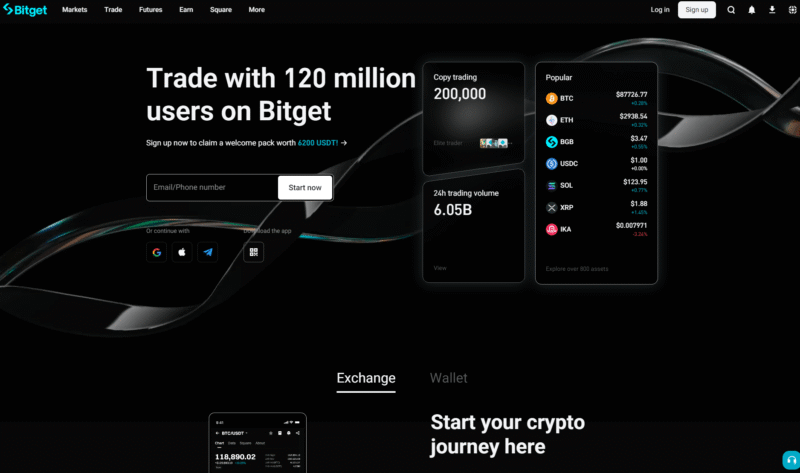
In 2026, Bitget is emphasizing UEX (Universal Exchange).
On conventional cryptocurrency exchanges, the following services are generally separate:
- Cryptocurrency spot trading
- Futures
- On-chain assets
- Web3
- Tokenized assets
- Stock-related products
- Products related to gold, foreign exchange, and commodities
Bitget is moving toward gradually bringing these markets together within a single account and interface.
Bitget’s UEX is a strategy to bring multiple markets and trading methods together on one platform centered on a cryptocurrency exchange. The actual range of products offered and the legal rights attached to them may vary by region and product.
However, not all services are available in every country.
Availability of stocks-related products, derivatives, leverage, Earn, and other services may vary depending on your country of residence and applicable regulations. You should therefore base your judgment on the products actually available in your account.
Features and conditions to check
| Feature | What to check |
|---|---|
| Spot and futures | Fees, order-book depth, and order conditions for each trading pair |
| Copy trading and bots | Profit sharing, copying conditions, and strategy-specific loss risks |
| UTA and margin | Collateral ratio, account mode, and liquidation scope |
| Tokenized assets and Earn | Product rights, redemption, settlement structure, and residency restrictions |
| Reserves and protection fund | Reporting date, covered assets, scope, and incident history |
The current Terms of Use identify BTG Technology Holdings Limited as the platform operator and state that some services may be provided by affiliates. Do not generalize this name as the same contracting entity or licensee for all regions and products. Contracting entity and service scope.
The breadth of products available through UEX is distinct from the actual conditions of access. For a closer look at strategy, liquidity, and the ecosystem, see Bitget in-depth analysis.
2. Regional Access Conditions and the South Korean Case
Eligibility by residence, entity, and product
The Terms of Use reviewed on October 24, 2026 list multiple countries and regions, including the United States, Japan, Russia, France, and Germany, as restricted jurisdictions. This is not an exhaustive list and may change, so check the Prohibited Countries and Eligibility provisions in the terms immediately before signing up. National laws and product-specific conditions also apply. Restricted jurisdictions and eligibility requirements.
Business registration, anti-money laundering registrations or SRO membership, financial promotion approval, and licenses to provide financial products are not the same thing. Treat Bitget’s regulatory and registration roadmap as company-disclosed information, and separately verify the scope for the relevant entity, jurisdiction, and product. Do not determine legal eligibility based solely on whether you can access the site, or bypass restrictions using a VPN or similar means.
South Korean case: account and address verification with Upbit and Bithumb
The official Upbit list viewed on October 24, 2026 shows October 6, 2026 as the list’s effective date and identifies Bitget as a service provider linked for account holder verification. This category allows transfers only to or from an account in your own name; deposits from another person’s account are subject to return. Check the list footnotes for detailed conditions, including those for corporate accounts. Upbit list of supported deposit and withdrawal providers.
Upbit states that for deposits and withdrawals of KRW 1 million or more, account holder verification checks whether the name and date of birth match. Make sure the Korean or English name and registered information match. If verification fails, follow the exchange’s account holder verification procedure. Upbit account holder verification guide.
The Bithumb withdrawal guide for amounts under KRW 1 million, checked on October 24, 2026 (document updated January 30, 2026), includes Bitget in its list of Travel Rule-integrated exchanges. The guide states that prior address registration is not required for this type of transfer, but asset, network, temporary suspension, and additional review requirements must be checked separately. Do not interpret this guidance as meaning the process is identical to Upbit’s or that withdrawals of any amount are unconditionally permitted. Bithumb official withdrawal guide.
Korean example: Checks still required for transfers under KRW 1 million
Being under KRW 1 million does not eliminate checks on account holder identity, source of funds, or suspicious transactions. Check the sending exchange’s latest notices for the KRW conversion basis and verification procedures. Even when transferring assets purchased on a Korean exchange, first compare the sending and receiving providers, your personal information, the network, the full address, and any required tags, then complete a small test transfer.
Korean example: App distribution restrictions and website blocking are different measures
In a report dated January 17, 2026, Electronic Times described a policy restricting new installations and updates of overseas exchange apps that do not meet Korean requirements, effective January 28, and mentioned Bitget. This was a report published before the policy took effect and does not directly verify the current installation or update status of any individual user. Electronic Times report.
On October 13, 2026, Block Media reported that the FIU had earlier asked app marketplaces to restrict apps from unregistered providers and that decisions had been made to block and terminate access to 27 websites belonging to specific providers. This article alone cannot confirm that Bitget was among those 27. App distribution restrictions must be distinguished from blocking access to specific websites, and inclusion on an integrated exchange list does not mean that a provider is registered or licensed in Korea. Block Media report.
3. Registration, KYC, and Account Security
What to Know Before Registering with Bitget
If you plan to register with Bitget, rather than simply downloading the app and signing up, it is best to first check that you have a link where the referral code will be applied correctly.
This is because it may not be possible to apply a referral code retroactively after creating an account without a referral relationship.
2026 Bitget CoinPop Affiliate Registration
Check that the referral code appears on the registration screen.
The affiliate referral code is coinpop.
We recommend checking that the referral code appears correctly on the registration screen before creating your account.
Promotions, trading fee discount rates, new-user rewards, and payment terms may change depending on Bitget’s policies and your region. The actual terms displayed on the screen during registration are final.
KYC Identity Verification
Bitget operates a KYC (Know Your Customer) program.
Bitget’s official regulatory and compliance guidance for 2026 also states that KYC is required for all users.
KYC is not simply a procedure for increasing withdrawal limits.
- Anti-money laundering
- Sanctions screening
- Account ownership verification
- Travel Rule
- Account recovery
- Access to specific financial products
KYC is connected to these account- and transaction-related verification procedures.
Common Reasons for KYC Failure
1. Glare on the ID photo
If glare on the ID obscures your name or number, automatic reading may fail.
It is best to turn off the flash and take the photo in a well-lit environment.
2. Part of the ID is cropped out
Make sure all four corners of the ID are visible in the image.
3. Blurry photo
The photo must be clear enough to read even the small print.
4. Incorrect document type selected
Avoid errors such as selecting Passport and then submitting a different form of ID.
5. Name mismatch
If you transfer assets between exchanges, make sure the legal name and account holder information registered with both exchanges match. See Chapter 2 for detailed procedures by region.
Account Security – Set This Up Before Trading
If you are depositing a substantial amount of funds into Bitget, it is best to complete your security settings before trading.
The priorities are as follows.
1. 2FA
We recommend adding authenticator-based two-factor authentication rather than relying only on SMS verification.
Back up your key and store it securely offline as well.
2. Anti-Phishing Code
This feature lets you check for a string that you set yourself in official Bitget emails.
It helps distinguish fake Bitget emails from official ones.
However, this alone cannot prevent all phishing attempts.
3. Withdrawal Whitelist
You can restrict withdrawals to addresses registered in advance.
This is especially useful for users managing large amounts over an extended period.
4. Do Not Reuse Passwords
Using the same password for your email or another exchange could put multiple accounts at risk if information from one service is compromised.
We recommend using a password exclusively for Bitget.
Steps for Checking Registration and Settings
- Check the terms of service for residency and product eligibility. If you are subject to restrictions, do not register or trade.
- After creating your account, check whether your KYC status is approved. If it is rejected, correct the issue and resubmit it for review.
- Set up security measures such as 2FA, secure backup key storage, and an anti-phishing code. Do not send your password, verification code, or recovery key to anyone.
- A displayed referral code and the actual benefits are separate matters. Check the applicable products, rates, and duration on the registration screen and in your account’s fee rates.
For retroactive application to existing accounts and the risks of self-referral, see the guide to registration terms and checking existing accounts. A discount rate is not guaranteed just because a code is shown on the screen.
4. Fees, Referrals, BGB, and VIP
Bitget Fee Structure
If you plan to trade on an exchange over the long term, the first thing to check before bonuses is fees.
In futures trading in particular, leverage makes the actual trade amount larger than your invested capital, so even a small fee difference can add up to a substantial cost.
Standard Spot Fees
Bitget’s typical spot trading fees for regular users are as follows.
| Category | Standard fee |
|---|---|
| Spot Maker | 0.10% |
| Spot Taker | 0.10% |
Discount programs may be available if you use BGB to pay trading fees, and your actual fees may also vary depending on your VIP level and promotions.
Therefore, the most accurate approach is to check the Fee Rate actually applied to your account.
Standard Futures Fees
Typical standard Bitget futures fees are as follows.
| Category | Standard fee |
|---|---|
| Futures Maker | 0.02% |
| Futures Taker | 0.06% |
A Maker order adds liquidity to the order book, while a Taker order immediately matches an existing order.
Therefore, when possible, using limit orders and Post-Only can help reduce trading costs.
Why Futures Fees Matter More Than You Might Expect
For example, suppose you use 10x leverage with $10,000 in capital to open a position worth $100,000.
Assuming a Taker fee of 0.06%, the cost is as follows.
The following is the fee calculation for entering the position.
$100,000 × 0.06% = $60
The following is the fee calculation for closing the position normally.
$100,000 × 0.06% = $60
The total round-trip trading cost is $120.
Based on $10,000 in principal, a single round-trip trade amounts to approximately 1.2% of your principal.
Of course, actual results vary depending on position size, whether you use limit or market orders, VIP level, discount rates, and other factors.
The important point is this.
Futures trading fees are calculated based on the notional value of the position actually executed, not the margin. If you maintain the same notional value, changing only the leverage setting does not change the fees by that leverage multiple.
Therefore, if you scalp or trade at high frequency, reducing trading costs is just as important as getting the direction of the trade right.
Why You Need to Understand Makers and Takers
Maker
An order that adds new liquidity to the order book.
For example, if BTC is trading at $100,000 and you place a limit buy order at $99,500, the order will generally be added to the order book.
If the order is filled later, it becomes a Maker order.
Taker
An order that immediately takes an order already in the order book.
A market order is a typical example.
In exchange for immediate execution, it generally incurs higher fees than a Maker order.
What is Post-Only?
Post-Only is a feature that restricts limit orders to being placed only as Maker orders.
For example, if you accidentally place a limit buy order above the current price, it may be filled immediately, making it a Taker order.
With Post-Only enabled, an order in this situation is canceled instead of being filled immediately, preventing it from being executed as a Taker order. Check the product screen for order conditions and supported scope.
This feature is very useful for users who trade frequently.
The round-trip cost example above assumes that the notional value of both entry and normal exit is 100,000 USD, and that both trades are Taker trades with a 0.06% fee. This is an illustrative example for linear contracts; the actual settlement asset is the contract's USDT, USDC, or the relevant coin. Total costs also vary with the exit price, execution type, spread, slippage, and funding fees. This should be distinguished from the assumption and settlement process of liquidation. Official liquidation mechanism.
Check BGB payments, VIP status, and referrals separately
As of October 24, 2026, the official spot fee schedule lists Maker and Taker fees of 0.1% for VIP 0 and a rate of 0.08% when paying with BGB. The feature must be enabled, and the applicable account must hold enough BGB; if the balance is insufficient, fees may be charged in the original fee currency without the discount. Do not assume that the spot BGB payment discount automatically applies to futures, or arbitrarily combine it with referral benefits. BGB payment terms.
VIP status is determined by the applicable product's eligibility criteria, such as trading volume, assets, and BGB holdings; rates and thresholds may change. Compare the current official schedule with the actual Fee Rate and transaction history in your logged-in account. For specific calculations, see Fee, BGB, and VIP guide.
If you are considering signing up, review the product, eligibility, period, and rates at Check current signup terms before deciding. This is an affiliate link and does not guarantee compensation or a specific discount rate.
One-time bonuses should be distinguished from recurring costs. Under the same conditions, as the number and size of trades increase, the cumulative fee difference may exceed the bonus, but it is not sensible to increase unnecessary trades or leverage just to save on fees.
5. Deposits and Withdrawals, Networks, and the Travel Rule
Check the sending and receiving requirements first
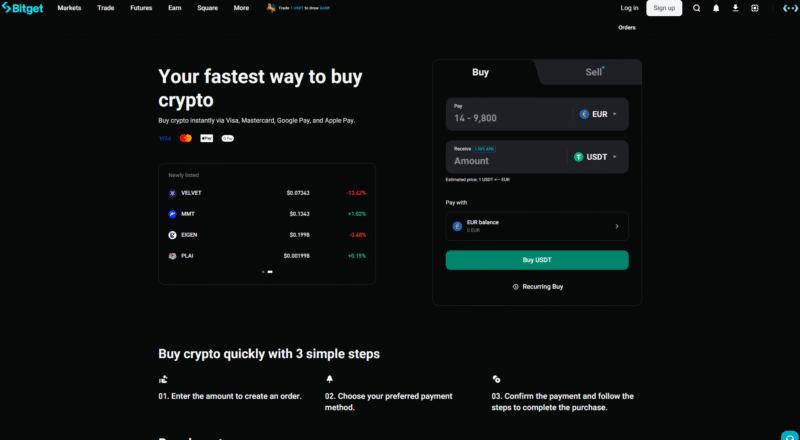
Check not only the asset name, but also the networks supported by the sending and receiving exchanges, deposit and withdrawal status, minimum deposit, withdrawal fee, and any required memo or tag. Fiat deposit methods and third-party payment providers vary by region. The Travel Rule and the thresholds and information requirements for account verification between service providers also vary by country and provider, so also see Chapter 2: Regional usage requirements.
Which coin should you use to transfer funds?
In the past, XRP and TRX were among the most commonly used options.
However, rather than recommending a specific coin unconditionally, it is best to compare the withdrawal fees and supported networks on each exchange at the time of the transfer.
XRP
The advantages of this feature or transfer method are as follows.
- Relatively fast transfers
- Generally low network fees
- Check the quote and supported networks on the sending exchange
Be aware of the following requirements for this transfer method.
If the deposit address requires a Destination Tag, you must enter it as well.
TRX
The advantages of this feature or transfer method are as follows.
- Fast transfers
- Relatively low cost
- Widely supported on global exchanges
USDT
USDT is not an asset that uses only one network.
The following list is for illustrative purposes.
- Ethereum
- Tron
- BNB Smart Chain
- Solana
- Other supported networks
USDT is issued on multiple chains, so you should not determine the transfer route based on the asset name alone.
Therefore, the most important rule is this:
The network selected on the withdrawal exchange must match the deposit network on Bitget.
Do not send funds arbitrarily just because the address formats look similar.
What happens if you select the wrong network?
Blockchain transfers do not have a “cancel” button like credit card payments.
Transfers to an incorrect address or an unsupported network may be difficult or impossible to recover.
Especially for your first deposit, it is safer to send a small test transfer first rather than sending all your funds at once.
Recommended steps
- Copy the address
- Recheck the network
- Check whether a Tag/Memo is required
- Make a small test transfer
- Confirm the deposit on Bitget
- Transfer the remaining amount
Even if it means paying transfer fees one more time, this is much better than sending a large amount to the wrong destination.
Check the entire copied address, not just a few characters at the beginning and end, and consider the possibility of address poisoning or clipboard tampering. Decide whether to send the remaining funds only after confirming that the test deposit is complete and checking the amount actually received. If the funds do not arrive, do not repeat the same transfer; check the TxID, network, address, tag, and required number of confirmations, then use the official support process. Detailed guide to deposits and withdrawals, networks, and the Travel Rule.
6. Futures, Margin, UTA, Orders, and Funding
Basic structure of Bitget futures trading
Futures is one of Bitget's strengths.
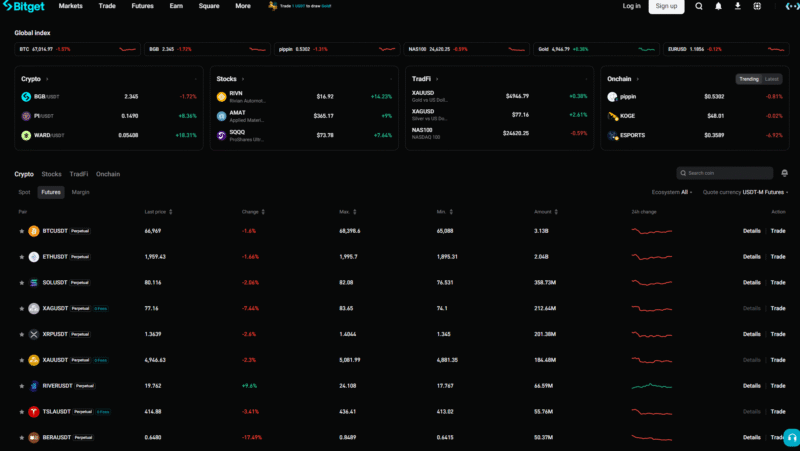
For example, users can trade USDT-margined perpetual futures and build positions to profit from both rising and falling prices.
Long
A Long is a position that aims to profit from a price increase.
Short
A Short is a position that aims to profit from a price decrease.
Leverage can also be used.
However, leverage does not only amplify profits.
It also amplifies losses and liquidation risk.
What leverage really means
Suppose someone with $1,000 takes a $10,000 position using 10x leverage.
If the price moves 1% in their favor, the position will fluctuate by about $100 based on a simple calculation.
That is about 10% of the $1,000 principal.
Conversely, a 1% move in the opposite direction results in a loss of about 10%.
In practice, the following costs and liquidation conditions must also be considered.
- Trading fees
- Funding fees
- Maintenance margin
- Slippage
Fees, funding fees, and slippage affect actual costs, while maintenance margin is not a cost item but a requirement used to determine whether a position can be maintained and when it may be liquidated.
Therefore, do not rely on a simple calculation such as “10x leverage means liquidation occurs if the price moves exactly 10% against you.”
The actual liquidation price varies according to the maintenance margin and the exchange's risk limits, among other factors.
Cross and Isolated
These are concepts you should understand before starting futures trading.
Isolated Margin
The margin allocated to a specific position is managed separately.
For example, even if you hold $10,000, allocating only $500 to a BTC position can isolate that position's risk to a certain extent.
The advantages of this feature or transfer method are as follows.
- Easier to manage the scope of losses
- Can reduce the risk of losses cascading to other assets
- Easier for beginners to understand the risks
Cross Margin
Multiple positions can share the account’s available margin.
The advantages of this feature or transfer method are as follows.
- Capital efficiency
- Greater tolerance for temporary price fluctuations
- Suitable for managing multiple positions and hedging
The limitations of this feature are as follows.
- Losses on one position can affect more of the account’s capital
- It may become harder to assess overall risk in a complex portfolio
Therefore, Cross is not always bad, nor is Isolated always good.
The key is to understand which funds are exposed to liquidation risk.
Bitget UTA (Unified Trading Account)
UTA is Bitget’s account environment that integrates multiple trading and collateral features.
UTA stands for Unified Trading Account. It is a system designed to let users manage multiple products, including spot, margin, and futures, through a more integrated account structure.
Previously, funds were often separated as follows.
Spot account → transfer funds → futures account → transfer funds again
UTA aims to reduce these boundaries and improve capital utilization.
Bitget offers multiple account modes in UTA, and some modes also allow various assets to be used as collateral.
UTA’s biggest advantage – capital efficiency
For example, suppose a user holds the following assets.
- BTC
- ETH
- USDT
- USDC
In a traditional account structure, the required collateral may need to be transferred separately depending on the asset and trading product.
In UTA, supported assets are valued at specified collateral ratios and can be used to manage various positions.
This is quite useful for professional traders.
However, there are also drawbacks.
Efficiently sharing capital also means that risks can become interconnected if it is not managed properly.
Therefore, when using Cross Margin in UTA, you need to monitor not only individual positions but also the Margin Ratio for the entire account.
Order Types
To use futures properly on Bitget, you should understand at least the following order types.
Limit Order
The user sets the price directly.
The advantages of this feature or transfer method are as follows.
- Specify the desired price
- May be filled as a Maker
The limitations of this feature are as follows.
- May not be filled
Market Order
Executes quickly at the best available market price.
The advantages of this feature or transfer method are as follows.
- Prioritizes execution
The limitations of this feature are as follows.
- Taker fees
- Slippage may occur in volatile markets
Trigger Order
Executes an order when a specific price condition is met.
Used for strategies such as breakout trading or stop-loss orders.
Take Profit / Stop Loss
A feature for locking in profits at a target price or limiting losses when the market moves against expectations.
For traders using leverage, it is important to develop the habit of considering TP/SL settings before entering a position.
Hedge Mode
In futures, it is also possible to run Long and Short positions on the same asset at the same time.
For example, suppose you expect BTC to rise over the long term but anticipate a short-term correction.
You could add a Short position of a certain size to reduce some of the price risk without closing the existing Long.
Used appropriately, this can reduce the directional exposure of the overall position.
Hedging also involves the following costs and capital and management burdens.
- Trading fees
- Spread
- Funding fees
- Capital usage
- Position management
Therefore, simply holding Long and Short positions at the same time does not make you safe.
What is a funding fee?
Perpetual futures do not have a conventional expiration date.
To prevent futures prices from diverging too far from spot prices, a mechanism called the Funding Rate is used.
When the funding rate is positive, Long positions generally pay fees to Short positions; when it is negative, the direction may be reversed.
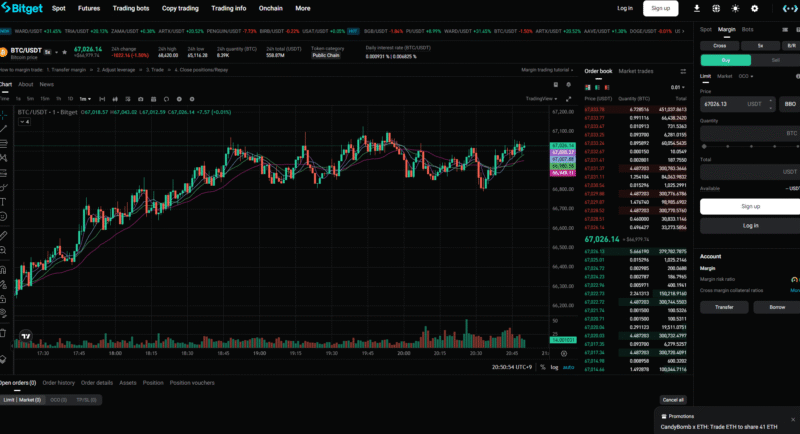
The exact funding intervals and rates may vary by product and market conditions, so check the trading screen.
The displayed liquidation price may be affected by the Mark Price, maintenance margin, risk tiers, account collateral, reserved costs, and other factors; it is not necessarily based on the latest price. Stop-loss orders also do not guarantee execution at the desired price in volatile markets. Refer to the liquidation conditions and the official UTA FAQ.
Post-Only is a feature that ensures an order remains on the order book as a Maker. It may be canceled if it would execute immediately as a Taker; it is not automatically resubmitted at a more favorable price, nor is execution guaranteed. Official order conditions documentation.
7. Security Incidents, Proof of Reserves, and Protection Fund
September 2026 Incident: Distinguishing Announcement Dates and Scope of Confirmation
On September 24, 2026, unauthorized transfers occurred from some Bitget Exchange hot and warm wallets. The initial announcement cited approximately 351.6 million USD, while the company’s follow-up notice on September 30 described an impact of approximately 388 million USD. Estimates and accounting results from different points in time should not be combined as if they were a single, independently verified final loss amount. Initial official notice · Follow-up notice on amount and fund.
| Date and time (UTC) | Confirmed announcement or developments | Limitations of interpretation |
|---|---|---|
| 2026-09-24 | Unauthorized transfers from some hot and warm wallets and a temporary suspension of withdrawals. The company stated that deposits and trading continued and user balances were preserved. | This summarizes the company’s announcement; it is not the result of a direct audit of individual account transactions or balances. |
| 2026-09-26 | After responding to the vulnerability and conducting security checks, the company announced a phased schedule for resuming withdrawals. | A planned resumption should be distinguished from actual availability. |
| 2026-09-28 08:00 | The company stated that the phased resumption of BTC withdrawals had begun. | Resumption was by asset and network, not a simultaneous resumption of all services. |
| 2026-09-29 | The 47th PoR reported an aggregate ratio of 131% across 19 covered assets, based on a 09:00 UTC snapshot. | PoR does not guarantee total liabilities, the company’s financial condition, or protection against future incidents. |
| 2026-09-30 | The company announced the publication of an investigation report and the replenishment of its protection fund to more than 300 million USD. | This was the amount at the time the replenishment was announced; it is not a real-time verified figure for the current wallet balance. |
| 2026-10-02 08:00 | The company announced that the existing phased resumption plan had been completed, including other supported assets, fiat currencies, and C2C. | For today's withdrawal availability by individual account, asset, and network, the withdrawal page and latest announcements take precedence. |
Timeline sources: Company follow-up timeline · Announcement on publication of the investigation report · Announcement of completed resumption.
Details not confirmed regarding the cause, detection time, and attacker
The company's follow-up explanation and Mandiant's initial report describe a breach of third-party security products and equipment and access to the wallet environment, but differ in how they characterize the detection time and detailed intrusion process. This article does not present conflicting minute-level detection times or whether malware was used as a single, definitive technical conclusion. Published initial Mandiant report.
The September 25 reports by The Hacker News and crypto.news conveyed the company's preliminary investigation and suspicions of North Korean links at the time. We do not count two reports citing the same company announcement as two independent instances of technical verification, and this article does not state as confirmed fact that the attacker was officially attributed to a government. The Hacker News · crypto.news.
For details on asset-specific schedules and the background to the correction of the initial amount, see Security incident and withdrawal resumption explained. Official follow-up announcements take precedence after the verification date of that explanation.
PoR: Historical figures and follow-up snapshots
Bitget's 122% figure, published on July 28 as its 44th disclosure, is a historical record. The 47th announcement, checked on October 24, 2026, reported a total reserve ratio of 131% for 19 covered assets, based on a snapshot taken on September 29 at 17:00 UTC+8 (09:00 UTC). We do not describe 131% as the real-time ratio on the date of access or as the result of a financial audit covering all assets and liabilities. Snapshot date and coverage.
Can safety be assessed based on the PoR ratio alone?
No.
PoR is a very useful transparency tool, but it does not explain every risk associated with an exchange.
Basically, PoR shows the relationship between assets verified at a specific point in time and customer balances.
It does not automatically guarantee the following:
- The company's total liabilities
- Future hacks
- Operational risks
- Regulatory risks
- Internal control failures
- Asset liquidity
- The priority of legal claims
The following items and limitations must also be considered.
It is important to distinguish between information that can be verified through PoR and risks that cannot.
Reserve disclosures increase the amount of information that can be verified, but do not by themselves guarantee the conclusion that the exchange is safer than others.
Interpreting “PoR of 100% or more = absolutely safe at the level of a bank” is incorrect.
Merkle Tree verification
Bitget's PoR uses a Merkle Tree-based verification structure.
Users can use the data assigned to them to check whether their assets were included in the reserve snapshot.
For this purpose, Bitget provides MerkleValidator, an open-source verification tool.
The company's claim that it holds assets and a user's verification that their balance is included are separate procedures.
The company's claim that it holds sufficient assets alone does not prove all its liabilities or its solvency.
Separate from the company's claim about its asset holdings, Merkle Tree verification is a procedure that allows users to check whether their balance was included in a specific snapshot.
Protection Fund: distinguishing size, coverage, and replenishment
Early in the incident, the company described its Protection Fund as containing more than 5,500 BTC and 464 million USD. In a follow-up announcement, it said that after covering the incident's impact, it had replenished the fund to more than 300 million USD on September 30. The company's overview page retains figures from different dates, so this article does not identify any one of them as the current balance. The latest addresses, as-of date, and balance should be checked separately using the official fund page and on-chain data. Replenishment announcement.
The Protection Fund is not deposit insurance that compensates for all investment losses. Liquidations of futures positions, market losses, and user security mistakes are not automatically covered; eligibility to claim, incident coverage, and review conditions may apply. PoR, the Protection Fund, and the Futures Insurance Fund serve different purposes.
As a rule, keep only the funds needed on an exchange
Even with PoR and a Protection Fund, centralized exchanges involve counterparty risk.
Therefore, there is no need to keep all cryptocurrency, including assets intended for long-term storage, on an exchange.
A general distinction is as follows:
Funds needed for trading and assets held for the long term serve different purposes.
You may consider keeping primarily the funds needed for trading on an exchange.
Long-term holdings require a separate storage and recovery plan.
A personal wallet may be considered if you have the security management skills and recovery plan to use it.
Of course, personal wallets carry a separate risk: they can be difficult to recover if you lose your Seed Phrase.
Therefore, rather than saying “a personal wallet is always safer than an exchange,” you should also consider your ability to manage security.
8. Copy Trading
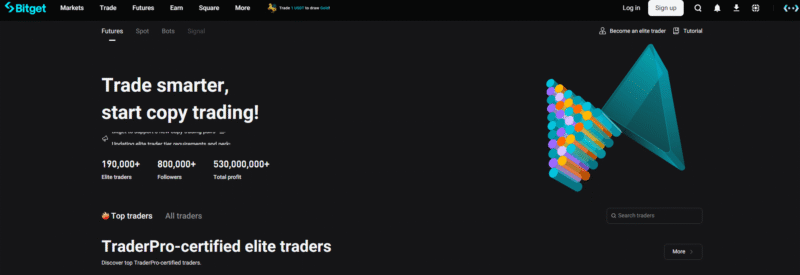
Bitget's flagship feature – Copy Trading
Copy trading is the service most often mentioned when Bitget is compared with other large exchanges.
Copy trading is a system in which trades are automatically replicated in follower accounts according to set conditions when an Elite Trader opens or closes a position.
This is not simply an “automatic profit feature.”
It is closer to entrusting another trader with the allocation of some of your capital and some of your trading decisions.
Therefore, finding a good trader is key.
Why you should not choose an Elite Trader based on ROI alone
For example, suppose there are two traders.
Trader A
- ROI +400%
- Trading period: 20 days
- Maximum drawdown: -65%
- High leverage
- Profits from a few large positions
Trader B
- ROI +80%
- Trading period: 1 year
- Maximum drawdown: -12%
- Stable position sizes
- Long trading record
Based on simple ROI alone, A is clearly superior.
However, that is not necessarily the case when looking at risk-adjusted performance.
Therefore, you should consider at least the following data together:
- ROI
- Total PnL
- Maximum drawdown
- Trading period
- Number of trades
- Average holding time
- Current open positions
- Leverage
- AUM
- Win rate
- Recent performance
- Follower profits
The trap of a high win rate
Which is the better trader: one with a 95% win rate or one with a 60% win rate?
The answer is impossible to know.
Some strategies can repeatedly generate small profits, then lose all accumulated gains in a single loss.
The following is an illustrative example.
9 trades × +1%
Last trade × -20%
This example shows that even with a 90% win rate, the total profit and loss or compounded result can be negative.
Therefore, in copy trading, it is much more important to consider the average profit-to-average loss ratio and maximum drawdown together than the win rate.
Why you should be wary of Martingale traders
Martingale is a method of increasing position size as losses occur.
If the price eventually returns to its original direction, this strategy can produce a high win rate.
The problem arises when the price continues to move in the opposite direction.
Failing to accept small losses can lead to a devastating loss in your account during a single trending market.
When evaluating an Elite Trader, watch for the following patterns.
- An excessively high win rate
- Very small average profits
- Very large maximum losses
- Holding losing positions for a long time
- Continuously increasing positions when losing
- High leverage
- An abnormally high ROI over a short period
Bitget Copy Trading risk management features
One important advantage of copy trading is that followers can directly control risk within a certain range, rather than simply copying trades.
The following are representative examples of settings.
- Copy amount per trade
- Maximum copy amount
- Leverage
- TP/SL
- Slippage limit
- Fund allocation by trader
Available settings and limits vary by copy product and mode, so check the follower settings screen.
Bitget also offers risk controls that prevent an order from being executed if slippage in a copy trade exceeds the configured range.
The key criteria to consider here are:
Apart from choosing a good Elite Trader, the Follower must first set their own risk limits.
Fixed-amount vs. percentage-based copying
Fixed-amount method
Allocate a set amount to each trade.
The following is an example for illustration.
100 USDT per trade.
The advantages of this feature/transfer method are as follows.
- Risk is easy to calculate
- It is easier to limit the impact if an Elite Trader suddenly increases their position size significantly
Percentage-based method
Your order size changes according to the Elite Trader's asset allocation ratio.
The advantages of this feature/transfer method are as follows.
- Can more closely follow the portfolio allocation ratios of the original strategy
The limitations of this feature are as follows.
- If you do not properly understand the Master's risk appetite, your own risk may increase as well
For beginners in copy trading, starting with a small fixed amount and observing actual trading patterns is relatively easy to understand.
Is diversification necessary in copy trading?
You do not need to entrust all your copy-trading funds to a single trader.
The following list is an example for illustration.
- BTC-focused swing trading
- Short-term trend following
- Low-leverage strategy
You can divide your allocation among strategies with different characteristics, such as these.
However, simply increasing the number of traders does not constitute genuine diversification.
Check whether the following characteristics overlap among traders.
- BTC Long
- 20x leverage
- The same trend-following approach
If traders use the same direction, leverage, and strategy, their risks may move together.
What matters is the correlation between strategies.
The biggest misconception about Bitget copy trading
Because it is called copy trading, many people think:
“Just pick someone who's good and put money in.”
That is not how it works in practice.
Copy trading means delegating some of your trading decisions to someone else.
Even if you do not place orders yourself, the risk of loss and responsibility for managing it remain.
Risk management is still your responsibility.
Followers may also be affected by a trader's actions, such as:
- Increasing leverage
- Averaging down
- Not using stop-losses
- Suddenly changing strategies
Followers may be affected as well.
Practical criteria for evaluating a Copy Trader
CoinPop recommends the following order of consideration rather than focusing solely on ROI.
Priority 1 – Maximum Drawdown
Along with the amount of profit, check past periods of losses.
Maximum drawdown shows how much the historical account value fell from its peak to its trough.
Historical maximum drawdown is one criterion for assessing a trader's periods of losses.
Priority 2 – Trading history
A return of +100% over one year may be more meaningful data than +300% over 30 days.
Priority 3 – Open Position
Do not look only at closed trade performance; also check positions that are currently losing.
Priority 4 – Leverage
Check whether a high ROI is simply the result of excessive leverage.
Priority 5 – Consistency of returns
Check whether one big win accounts for most of the total profit.
If you are a beginner starting out with copy trading
For example, if you plan to use 1,000 USDT for copy trading, you do not need to allocate the entire amount from the outset.
If allocating actual funds, consider starting small and observing the following behaviors.
- Actual entry frequency
- Average holding time
- Stop-loss approach
- Whether they average down
- Maximum leverage
- How they respond in volatile markets
It is reasonable to observe and record these actual trading behaviors over a sufficient period.
Actual behavior matters more than backtests.
What to check before profit sharing, copy discrepancies, and stopping
A trader's ROI and a follower's realized P&L may differ because of entry and exit prices, order size, balance and minimum order requirements, slippage, fees, and profit sharing. Check the profit-sharing rate and settlement method, which are applied separately from trading fees, on the relevant trader and product pages. Do not assume that a single rate applies to all spot, futures, bot, and CFD products. Futures profit-sharing guide.
The official web guide for spot copy trading explains that when you stop copying, held assets are sold at market price and profit sharing is settled. The futures guide treats closing positions and stopping copy trading as separate actions, so do not assume that the stop button closes all existing positions at your desired price. Before proceeding, check existing positions, unsettled profit sharing, and funds to be returned in the confirmation window; afterward, check actual remaining positions and order status in the Follower Center. Guide to stopping spot copy trading · Futures follower guide.
9. Trading Bots
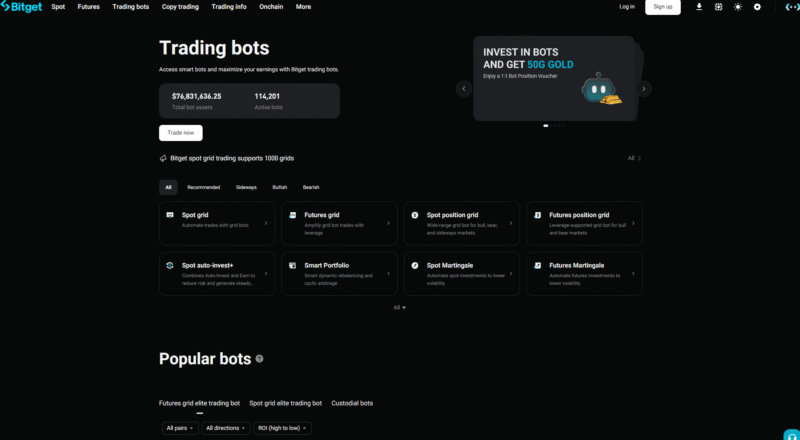
Bitget Trading Bots
You can use automated strategies without placing every order manually.
A representative approach is a Grid strategy.
Grid Trading repeatedly takes advantage of price fluctuations by placing multiple buy and sell orders within a set price range.
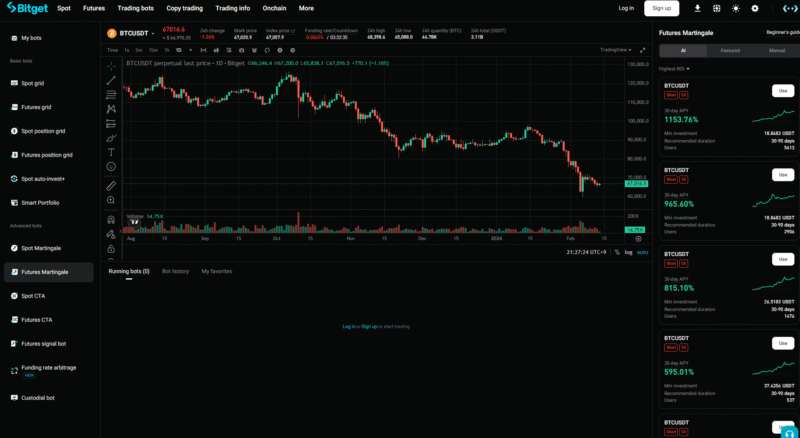
The following is the Grid strategy's assumption that BTC will move within a set price range.
A Grid strategy places buy orders at lower prices and sell orders at higher prices within the configured range.
A Grid bot repeatedly places buy and sell orders based on the configured price range and intervals.
However, Grid is not an automated profit-making system.
When a strong one-way trend emerges, a strategy based on a range-bound market may become unfavorable.
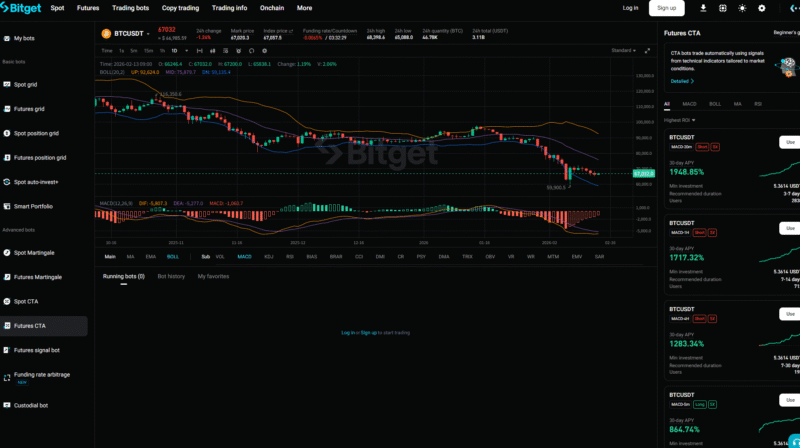
Grid strategies assume a ranging market, Martingale strategies involve adding to positions, and CTA strategies rely on indicator signals, among other differing assumptions. The displayed historical returns and win rates do not predict future results for your current funds. You should also check trading fees, funding fees, unrealized losses, and how positions are handled if a strategy is stopped.
Security When Connecting an API
If you use an API, minimize permissions and consider restricting access to supported IP addresses. Trading permissions alone can still lead to losses from malicious orders, so do not assume it is safe just because withdrawals are disabled. Never send your keys, signing secrets, or recovery keys to anyone else, and revoke unused keys through the official management page.
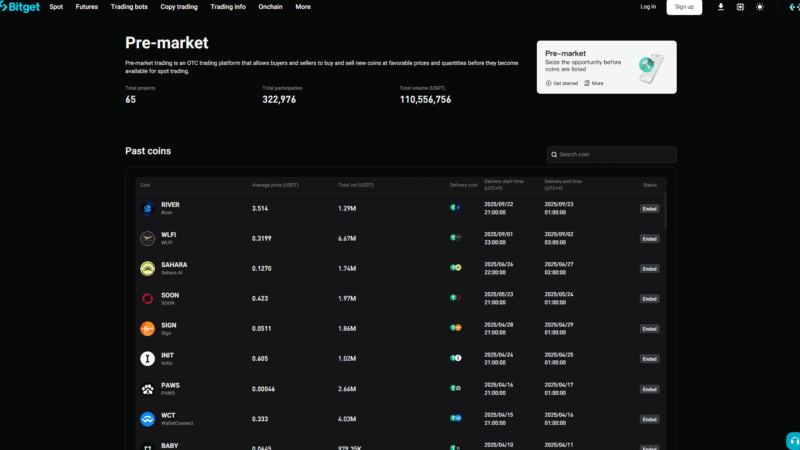
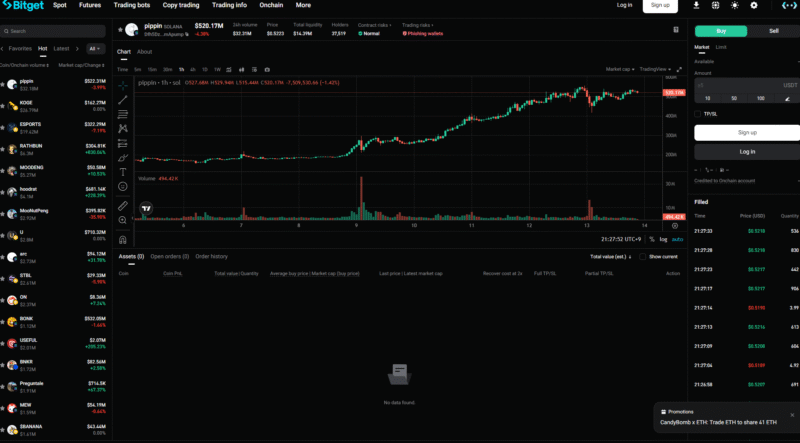
10. Tokenized Stocks, BGB, Earn, and Structured Products
Tokenized Stocks and rToken
In 2026, Bitget is also expanding its range of products related to tokenized U.S. stocks and ETFs.
Some users can trade rTokens linked to U.S. stocks or ETFs using USDT.
The following are examples for illustrative purposes.
- rNVDA
- rAAPL
- rTSLA
- rMSFT
- rSPY
- rQQQ
The list above is illustrative and may vary by product or jurisdiction.
However, an important distinction must be made here.
Tokenized stock products and actual stocks held directly in a U.S. brokerage account may not have the same legal or product structure.
You should also check the following aspects and limitations.
- Legal ownership
- Dividends
- Voting rights
- Custody of underlying assets
- Issuance structure
- Redemption
- Regions where trading is available
Check these product terms in the issuance and trading documents.
Product availability also varies by country of residence.
What Is BGB?
BGB is a platform token in the Bitget ecosystem.
Typical use cases include the following.
- Benefits within the platform ecosystem
- Trading-related benefits
- Various events
- Some services, such as Launchpool
- VIP and user benefits
However, it is difficult to conclude that “holding BGB to save on fees is always worthwhile.”
The price of BGB could fall by more than the amount saved through fee discounts.
Therefore, you should separately consider that BGB is a crypto asset and is subject to price volatility.
Bitget Earn
Bitget also offers Earn products that let you put crypto assets you are not trading to use.
Depending on the time and region, the following types of Earn products may be available.
- Flexible
- Fixed
- On-chain products
- Structured products
Earn includes products with different structures and risks.
The most important thing here is not to look at APY alone.
For example, even if a 50% APY is displayed, check the following conditions first.
- Available for a limited period only
- Low investment cap
- For new users only
- Variable rate
- Structured product
- Underlying asset price risk
The displayed yield may be subject to conditions such as the period, limits, or eligible participants listed above, as well as the risk of changes in principal value.
A high APY does not mean a safe, high-yield deposit.
Structured Products Such as Dual Investment
These products can be easy for beginners to misunderstand because of their high yields.
Dual Investment is not a regular deposit.
The asset received at final settlement may vary depending on the price conditions.
For example, you cannot assume that depositing USDT means you will necessarily receive USDT back.
Therefore, it is best not to participate based solely on a high APY unless you understand the following.
- Target Price
- Settlement Date
- Settlement Asset
- Options structure
- Underlying asset price risk
For tokenized products, check the issuer, custodian, redemption, dividends, trading hours, collateral eligibility, and regional restrictions in the documentation for each product. Bitget's rToken information can help you verify that the product exists and understand the structure as described by the company; it does not guarantee that voting rights or investor protections are the same as those of a conventional securities brokerage account. Official rToken information.
11. Risk Management
Funding Arbitrage—Is It Really Risk-Free?
A typical delta-neutral strategy is as follows.
An illustrative example is buying BTC spot while holding a BTC futures short of the same size.
Assuming a price rise, the profit and loss directions are as follows.
- Spot profit
- Short loss
Assuming a price fall, the profit and loss directions are as follows.
- Spot loss
- Short profit
In theory, this offsets much of the exposure to price direction.
And if the short position is in a market where it receives funding payments, you can seek to earn funding income.
However, this strategy does not provide risk-free returns.
The actual risks include the following.
- Funding rate fluctuations
- Funding rate turning negative
- Changes in the spot-futures basis
- Futures liquidation
- Trading fees
- Slippage
- Exchange risk
- Suspension of deposits and withdrawals
- Price fluctuations in collateral assets
In other words, the accurate description is a delta-neutral strategy that substantially reduces exposure to market direction.
Risk Management—The 1% Rule
In professional trading, position size matters more than leverage.
Assuming account equity of 10,000 USD and a planned risk budget of 1% per trade, the planned amount is as follows. This does not guarantee a cap on actual losses.
Planned risk amount per trade: 100 USD.
The key point is not to “take a position of just $100.”
Calculate the position size in reverse based on the price difference to the stop-loss price.
Position Size Calculation Example
This calculation assumes the following account equity.
Example account equity: 10,000 USD.
The following amount is the planned risk budget.
1% = $100
The distance between the entry price and stop-loss price is assumed to be as follows.
Example stop-loss distance: 2% of the entry price.
If the stop-loss is 2% away from the entry price, the planned position size, excluding costs, is as follows.
$100 ÷ 0.02 = $5,000
This calculation distinguishes between choosing leverage based on intuition and setting a planned loss budget.
Choosing 20x leverage based on instinct alone may fail to account for the stop-loss distance and loss budget.
Rather than setting leverage by feel alone, this calculation considers both the stop-loss distance and planned loss.
Account for Losing Streaks
Every trading strategy inevitably has periods of consecutive losses.
Risking 10% of your account on each trade magnifies the impact of consecutive losses.
Just a few consecutive losses can significantly reduce your account.
By contrast, keeping risk around 1% leaves room to continue executing your strategy even after experiencing consecutive losses.
In trading, what matters is not making one big win, but building a structure that lets you stay in the market.
Trading Journal
If you trade consistently, it is a good idea to record at least the following.
| Item | Details to Record |
|---|---|
| Entry Time | Position Opened |
| Asset | BTC, ETH, etc. |
| Direction | Long / Short |
| Entry Price | Entry |
| Stop Loss | Stop-Loss Price |
| Take Profit | Target Price |
| Position Size | Position Size |
| Leverage | Leverage |
| Reason for Entry | Technical factors/events, etc. |
| Final PnL | Actual Result |
| Fees | Trading Costs |
| Areas for Improvement | Record After Closing the Trade |
Once you have 100–200 records, it becomes easier to identify your actual weaknesses instead of relying on a vague impression.
In the simplified example Position Size = Planned Loss Amount ÷ Stop-Loss Distance as a Percentage of Entry Price, a 1% risk budget on 10,000 USD of equity is 100 USD; with a 2% stop-loss distance, the position size is 5,000 USD. This is a planned figure that excludes fees, funding, slippage, price gaps, and unfilled orders; it is not a guaranteed maximum on actual losses. Include costs in the risk budget and check that liquidation will not occur before the stop-loss.
12. Pros, Cons, Comparisons, and Who It Suits
Comparisons and Limitations by Use Case
| What You Want to Evaluate | Features to Consider on Bitget | Counterpoints and Limitations |
|---|---|---|
| Copy Trading and Automation | Copy settings, records by strategy, bots, and API | Historical returns may differ from actual results for followers |
| Derivatives and Multiple Strategies | Orders, UTA, margin, and subaccounts | Risk may be interconnected through shared collateral and leverage |
| Asset Custody and Counterparty Risk | PoR, fund, and post-incident response records | History of security incidents, limitations of publicly available information, and possible withdrawal restrictions |
| Simple Long-Term Spot Holding | Essential spot trading and deposit/withdrawal features | There is no need to use every complex, high-risk feature |
This table presents CoinPop's qualitative selection criteria; it is not a ranking based on measurements of execution, liquidity, or usability in identical live trading conditions. Bitget's features may be considered an advantage, but we do not assign unsupported star ratings to its regulatory status, security, or UI, or claim that it is better everywhere in the world.
Disadvantages of Bitget
No exchange has only advantages.
1. A Smaller Ecosystem Than Binance
Binance remains a formidable competitor in terms of its overall global ecosystem and brand influence.
2. The Wide Range of Features May Be Complicated for Beginners
Users who only need spot trading do not need to use all of the following features.
- Futures
- Copy Trading
- Earn
- Bots
- UTA
- Web3
- A Variety of Financial Products
This feature-rich environment may be complicated for users who only need spot trading.
3. Copy Trading Can Result in Losses
A good UI does not eliminate investment risk.
4. Services Vary by Country
Some products are not available in the same way in every region.
5. Centralized Exchange Risks
Even with PoR, the counterparty risk inherent in a CEX does not disappear completely.
Bitget vs Binance vs Bybit vs OKX
Here is a brief comparison of the characteristics of each exchange.
| Exchange | Key Strength | Suitable User |
|---|---|---|
| Binance | Scale, liquidity, and ecosystem | Users who want to handle most of their needs on one exchange |
| Bybit | Derivatives and trading UX | Active futures traders |
| Bitget | Copy trading, futures, and UEX | Users looking for copy trading, derivatives, and automation |
| OKX | Trading systems and Web3 | Professional traders and Web3 users |
Rather than choosing an absolute number-one exchange, it is important to choose one that suits your trading style.
The following list is provided as an illustration.
Spot-focused users should compare supported assets, liquidity, and fees.
You can compare actual account and regional conditions across exchanges, including Binance.
Futures users should first check collateral, order and liquidation conditions, and actual costs.
Binance, Bybit, Bitget, and OKX should also be compared using the same trading pairs and product criteria.
Copy trading users should check replication, profit sharing, and termination conditions.
Bitget's copy trading feature is one option to compare, but it does not guarantee returns or superiority.
Web3 users should separately check wallet permissions, recovery, and network risks.
Wallet features from platforms such as OKX should also be compared separately from exchange account features.
If you use multiple products, also check for shared collateral and differences in legal rights.
Bitget’s UEX direction should be assessed based on the products it actually supports and users’ eligibility.
When choosing an exchange, it makes sense to compare these intended uses alongside the conditions that apply in each region.
Who Should Especially Consider Bitget
If you fall into one of the following groups, Bitget is worth including among the options you compare.
Active futures traders
You can use a range of derivatives features and risk management tools.
Copy trading users
This is one of Bitget’s strongest areas of differentiation.
Users who run multiple strategies simultaneously
You can manage funds efficiently using tools such as UTA and Subaccounts.
Trading Bot users
Suitable for users who want to use automated strategies alongside manual trading.
Users who diversify across major global exchanges beyond Binance and Bybit
It can also be an option for users who operate across multiple exchanges rather than concentrating all their trading assets on a single exchange.
Who May Not Need Bitget
If you fall into one of the following groups, you may not need Bitget’s many features.
- Users who hold only Bitcoin spot for the long term
- Users who rarely use overseas exchanges
- Users who are not interested in futures or copy trading
- Users who manage all their assets in personal wallets
You do not need to use every feature just because a service offers many of them.
It is best to assess an exchange’s value based on how efficiently it provides the features you use.
When comparing other exchanges, assess the products, regional availability, and account conditions of Binance, Bybit, and OKX using the same reference date. Do not judge actual execution costs or legal availability based solely on impressions of each brand.
13. FAQ, Checklist, and Conclusion
Checklist for Immediately After Signing Up
If you have created a Bitget account, start by checking the following items.
- Confirm that the referral code was applied
- KYC
- Authenticator 2FA
- Anti-Phishing Code
- Review Withdrawal Whitelist
- Email security
- Test a small deposit
- Test a small withdrawal
- Check your fee tier
- Understand Cross/Isolated before using Futures
- Check leverage
- Learn how to use TP/SL
A few minutes of initial setup can prevent major problems later.
Frequently Asked Questions
Q. Is Bitget a safe exchange?
It is difficult to assess safety using only a binary “safe/unsafe” judgment.
Bitget provides safeguards such as regular PoR, a Merkle Tree verification structure, and a Protection Fund.
Chapter 7 distinguishes the scope and reference date of materials published after the incident from those of the September 29 PoR snapshot.
However, the operational, regulatory, and security risks inherent to centralized exchanges do not disappear completely.
Q. How can I check whether the service is available where I live?
Check the service provider entity, terms, place of residence, and product eligibility together, and refer to the regional conditions in Chapter 2. Do not determine whether use is permitted solely based on the availability of transfer integrations or website access.
Q. What is Bitget’s standard spot trading fee?
The typical standard fee is 0.1% for Maker and 0.1% for Taker.
The actual fee may vary depending on BGB, VIP tier, promotions, and other factors.
Q. What is Bitget’s standard futures trading fee?
The typical standard rates are:
The standard Maker rate for regular futures is 0.02%.
The standard Taker rate for regular futures is 0.06%.
Check the fee tier and promotional terms for your actual account.
Q. What is the CoinPop referral code?
The affiliate referral code shown is coinpop.
It is best to confirm the referral conditions and discount rate on the sign-up page.
Q. Does copy trading guarantee profits?
No.
An Elite Trader’s past returns do not guarantee future returns.
Along with ROI, check maximum Drawdown, leverage, Open Position, operating period, and position size.
Q. Should I use Cross or Isolated for futures?
For beginners, Isolated makes it easier to understand the risk range of an individual position.
However, Cross may be useful in terms of capital efficiency if you are an experienced hedger or run multiple positions simultaneously.
Neither is absolutely superior; they have different risk structures.
Q. Does increasing leverage also increase fees?
The fee rate itself does not increase in proportion to the leverage multiplier.
However, leverage increases the notional value of the actual position, raising fees relative to your invested principal.
Q. Can I separate multiple strategies on Bitget?
You can allocate funds for different purposes using supported account and Subaccount features.
The following list is provided as an example for illustrative purposes.
- Manual Futures
- API Bot
- Long-term Spot
Separating funds and trading records by strategy can help you understand performance and risk.
Q. Can I store coins on Bitget for a long time?
Exchanges are convenient for trading, but centralized exchange risks remain.
Separate long-term holdings from funds used for trading, and consider Self-Custody as appropriate.
However, personal wallets carry a separate risk of mishandling the Seed Phrase, so take your security capabilities into account.
When to Stop as a First-Time User
You can proceed in this order: confirm eligibility → KYC and security → small deposits and withdrawals → understand the spot and order features you need. This sequence does not recommend using futures, copy trading, or bots as mandatory steps. If eligibility is unclear or you do not understand the address, network, costs, or loss structure, stop moving funds and trading, and check the official guidance.
Conditions to Check One Last Time on the Sign-Up Screen
The display of the referral code coinpop and the benefits available for specific products are separate matters. The conditions for rates, duration, and eligibility shown on the sign-up screen and in your account are the final basis for judgment; creating an account alone does not confirm KYC, trading eligibility, or fee benefits.
Conclusion: Assess Features Alongside Incident History
Bitget offers a range of trading features, including copy trading, derivatives, automation, and UTA, but the number of features does not guarantee trustworthiness or profits. The September 2026 security incident is part of its history and demonstrates real operational and counterparty risks. The company’s resumption of withdrawals, replenishment of the fund, and publication of reserves should each be evaluated with their respective announcement dates and limitations in mind.
PoR and the Protection Fund are tools that increase the amount of verifiable information, but they do not guarantee protection against future hacks or losses, or the ability to withdraw. The conclusion of this article is to distinguish funds needed for trading from long-term holdings, verify your region and product eligibility, security management capabilities, and actual costs, and then choose only the features you need.
Disclaimer: CoinPop is an independent cryptocurrency information and market analysis platform. This document is intended for informational purposes and does not recommend buying or selling any particular virtual asset or engaging in leveraged trading. Cryptocurrency and derivatives involve the risk of losing principal and liquidation. Services, fees, promotions, and regulatory conditions may change depending on the country and time.