
Binance: Key Takeaways
Binance is a digital asset platform offering spot and derivatives trading, asset management, and Web3 features. If you are new to the platform, assess it in this order: check availability in your region → sign up and complete KYC → secure your account → test small deposits and withdrawals → check your actual trading costs. A wide range of features or sign-up benefits does not guarantee investment performance or safety.
- According to the official spot fee schedule checked on October 23, 2026, the standard Maker and Taker rates for regular users are 0.1% each, or 0.075% each when the BNB payment discount applies. Because trading pairs, promotions, and account-specific exceptions may affect rates, check both the official fee schedule and your personal rates.
- The calculation example in the USDⓈ-M Futures fee information, checked on October 23, 2026, uses rates of 0.02% for regular-user Maker orders and 0.05% for Taker orders. These are example rates and do not guarantee the actual rates for any contract or account.
- As of October 23, 2026, the official information states that paying fees in BNB on eligible USDⓈ-M Futures trades gives a 10% discount on standard trading fees. Check the required BNB balance and the applicable feature and product conditions; do not confuse this with the spot discount. BNB payment conditions
- Sign-up benefits and rebates are subject to different conditions from the BNB payment discount. Check the current eligibility, rate, and duration of any rebate on the sign-up screen and in your account records, and do not simply add the two percentages and present them as a guaranteed discount rate.
- The availability of services, trading pairs, fiat deposits and withdrawals, and derivatives varies depending on your place of residence, KYC status, and contracting entity. Check the regional availability requirements first, and do not attempt to circumvent restrictions.
- Spot price declines, derivatives liquidations, and exchange or wallet security incidents are distinct risks. SAFU and Proof of Reserves are not deposit insurance that guarantees all losses or a complete financial audit. Official SAFU explanation
Security incidents, regulatory history, and past responses are summarized in Chapter 7: Security and Regulatory History.
Updated and reverified: October 23, 2026 (KST). We distinguished the official rates and product descriptions checked on this date from the announcement dates of past incidents. We did not directly test account-specific sign-up benefits or real-time availability in every region. Conditions that may change should be rechecked on the official site before trading.
This article provides general information and is not personalized investment, legal, or tax advice. Digital assets carry price, depegging, custody, and counterparty risks, while leverage magnifies the risk of losses and liquidation. The sign-up links in this article contain affiliate identifiers, and CoinPop may receive a reward for eligible sign-ups and trading.
1. Binance Overview, Services, and Corporate Structure
Binance is a global digital asset platform founded in 2017, with Changpeng Zhao (CZ) at its center. It grew rapidly after its launch to become one of the major centralized exchanges (CEXs) in terms of spot and derivatives trading volume, user base, and liquidity. Today, Binance has expanded beyond an exchange for buying and selling Bitcoin and altcoins into a comprehensive digital asset ecosystem connecting a range of services, including spot, futures, options, Earn, P2P, institutional trading, API, Binance Wallet, BNB Chain, and Alpha.
Check Actual Liquidity and Total Costs, Not Just Trading Volume
Global Trading Volume and Market Position
One of Binance’s greatest competitive advantages is its high trading volume and liquidity. Market share among global centralized exchanges changes monthly, and trading-volume rankings vary by data provider, trade type, and period, so Binance should not be described as having a fixed number-one position. Exchanges that attract large volumes of trading generally have more buy and sell orders in their order books, making it easier for users to execute orders at prices closer to those they want.
Deep order books are often available for major trading pairs such as BTC and ETH, which can help reduce slippage when executing large trades. However, not all coins have the same level of liquidity. Newly listed altcoins and small-cap tokens with low trading volumes may have wide bid-ask spreads or experience significant slippage on large orders, even if they are listed on Binance.
Therefore, do not assume that every trading pair has sufficient liquidity simply because the exchange has high overall trading volume.
Why Liquidity Matters
In cryptocurrency trading, slippage is just as important as trading fees. For example, if you place a large market order to buy Bitcoin when its current price is 100,000 USDT, the order may be filled across several price levels, as shown below, if there are not enough sell orders available.
- Some at 100,000 USDT
- Some at 100,010 USDT
- Some at 100,050 USDT
As in the example above, an order may be filled at several prices. As a result, the average purchase price will be higher than the price shown on screen. This is called slippage. High liquidity and a deep order book play an important role in reducing this price impact.
Especially as trade size increases, trading costs that account for the actual average execution price and market impact become more important than the nominal trading fee alone.
The Trading Ecosystem and How P2P Differs
A Trading Ecosystem Connecting Spot and Derivatives
Binance’s strengths include not only its trading volume but also the ability to access a variety of products within a single account. Key services include:
- Spot Trading
- Margin Trading
- USDⓈ-M Futures
- COIN-M Futures
- Options
- Convert
- Trading Bots
- Copy Trading
- Simple Earn
- Launchpool
- P2P
- API
- Binance Wallet
- Binance Alpha
- VIP and Institutional Trading Services
This allows users with different needs—from spot investors to leveraged traders, automated trading users, institutional investors, and Web3 users—to choose services within one ecosystem. However, available products may vary depending on the user’s country, KYC information, and regional regulations.
Binance P2P and the Global Payments Network
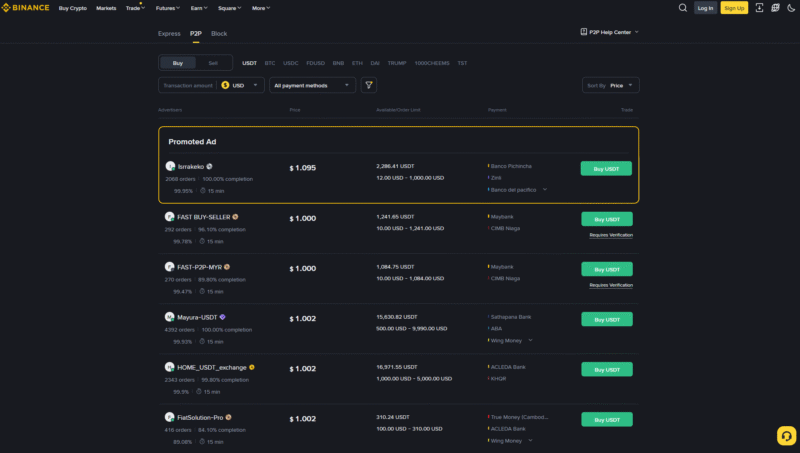
Unlike regular spot trading, which uses the exchange’s order book, Binance P2P is a peer-to-peer market where users buy and sell digital assets directly with one another. Binance P2P supports multiple fiat currencies and payment methods, but the currencies, payment methods, and sellers actually available vary by region and over time. Various payment options, such as bank transfers and online payment services, may be offered depending on the region.
P2P trading uses an escrow arrangement that holds the seller’s digital assets until the transaction is complete, helping reduce risks between buyers and sellers. However, the currencies and payment methods actually available vary by country and region; this does not mean that all users have equal access to Binance’s global P2P features.
Order Processing Infrastructure and Exchange Limitations
Matching Engine and Order Execution Structure
On centralized exchanges such as Binance, a Matching Engine connects buy and sell orders in real time. When a user submits a market or limit order, it is recorded in the Central Limit Order Book and executed according to priorities such as price and time. Binance operates centralized order book and matching engine infrastructure to handle large trading volumes. Processing performance is not published as a single fixed number of orders per second, and actual order execution conditions may vary depending on the trading pair, market conditions, and system status.
High trading volume does not mean the system is immune to outages
Deep order books for major trading pairs and operational infrastructure can support execution conditions, but they do not guarantee service availability. However, no global exchange can completely eliminate the possibility of extreme market volatility, network problems, system maintenance, or external outages. Binance operates infrastructure designed to handle large-scale market trading, but order delays or service outages may occur under extreme market conditions.
Especially when using high leverage in futures trading, you should factor in the possibility of exchange outages when planning position sizes and stop-loss strategies.
Binance’s Core Competitive Strengths
As of 2026, Binance’s competitive position is difficult to explain with a single statement such as “the world’s largest by trading volume.” Its actual strengths come from a combination of the following factors.
- Global-scale trading volume
- High liquidity in major trading pairs
- A range of markets, including spot, futures, and options
- Large-scale matching engine infrastructure
- P2P ecosystem
- API and automated trading environment
- Simple Earn and new token programs
- Binance Wallet and Web3 ecosystem
- BNB Chain
- Binance Alpha
- Institutional and VIP trading infrastructure
- Proof of Reserves
- SAFU User Protection Fund
The fact that these services are connected within a single account and ecosystem is one of Binance’s greatest strengths. However, centralized exchanges carry risks such as operational risks inherent to the exchange, regulatory changes, account freezes, hacking, and counterparty risk. A high market share alone does not mean that all risks have disappeared. The contracting entities and scope of authorization may differ between Binance.com and regional services. For example, current official descriptions distinguish the roles of Nest Exchange Limited, Nest Clearing and Custody Limited, and Nest Trading Limited in ADGM. The regulatory status of one entity should not be interpreted as blanket authorization for all countries and products. Check Terms of Use by Contracting Entity and Region to identify the entity that applies to you.
For a separate comparison of the advantages and limitations, see the Binance review’s analysis of liquidity, security, and usability.
2. Regional Terms of Use and Product Differences
What to check by residence, contracting entity, and product
Before creating an account, check your eligibility to use the service based on your actual residence and identity information. Review the official website’s Terms of Use, regional entity information, product-specific terms, and the list of supported countries on the KYC screen. Availability of spot trading does not mean that futures, Earn, P2P, and stock services are all permitted. Lists and conditions for restricted regions may change according to terms, sanctions, and product policies. Do not assume that a particular country is always permitted or restricted for every product. If you cannot verify the restricted list or your eligibility is unclear, do not sign up, deposit, or trade; confirm with official support first. Do not bypass regional restrictions or KYC by using a VPN, providing a false residence, or using another person’s identity.
Stock Trading and TradFi Perps are different products
The current official Binance Stock Trading description explains access to stocks and ETFs through partner brokers in eligible regions, as well as beneficial ownership of purchased shares. By contrast, TradFi Perps are perpetual derivative contracts that track the prices of stocks, ETFs, and other assets but do not confer ownership of the underlying assets. The two products differ in ownership rights, trading hours, settlement, leverage, funding, and liquidation structure. Check the actual product name and contract terms shown in your account.
Example: South Korea — Check regulatory status and deposit and withdrawal availability separately
South Korea’s Financial Intelligence Unit states that it assesses whether a foreign operator conducts business in Korea by considering factors such as a Korean-language website, marketing targeting Korean users, and support for Korean won payments. An announcement dated October 13, 2026 describes restrictions on new app installations and updates for unregistered operators, as well as measures to block certain websites. This general announcement alone does not establish that Binance.com was included on a specific block list. Official Financial Services Commission and FIU guidance
An Electronic Times report from January 2026 said that Google would implement a policy from January 28 restricting new installations and updates of apps from foreign virtual asset exchanges that did not meet the relevant South Korean requirements, and mentioned Binance as being among those affected. Electronic Times report Subsequently, in a report published on October 13, 2026, Block Media explained that the FIU had previously asked app marketplace operators to restrict new installations and updates of apps from unregistered operators. This follow-up article does not mention Binance directly. Block Media report The app distribution restrictions themselves do not mean that the Binance.com website is blocked in its entirety; whether the website is blocked must be verified through separate measures and the relevant list of targets.
Registered operators in South Korea should be distinguished from Binance.com’s global service. An equity or management relationship with a particular Korean operator does not mean that Binance.com is registered in Korea or that all its services are authorized. South Korean residents should separately check the FIU registration status, the latest list of supported deposit and withdrawal methods for the exchange they use, and account holder verification procedures. Do not determine regulatory eligibility solely from the fact that you can access an app or make a deposit.
For transfers between a South Korean exchange and Binance, check the exchange’s current list of supported operators, account holder verification requirements, and rules for different transfer amounts. Deposits in Korean won and fiat currency deposits to Binance are separate matters; do not rely on past availability and check the actual deposit and withdrawal screens. Even below the Travel Rule threshold, recipient and destination verification or withdrawal restrictions may apply.
3. Sign-up, KYC, and Account Security
Steps from sign-up to first use
- Check the official domain and whether your place of residence is supported, then create an account in your own name. If you use a referral link, verify the code and applicable benefits on the registration screen.
- Set a unique password and 2FA or a supported Passkey, and store your recovery methods securely.
- Complete KYC using your actual residence, name, date of birth, and a supported identity document.
- After checking your verification status and access to the products you plan to use, make a small deposit and withdrawal to verify the address, network, and transaction result.
- Before trading, check your personal fee rate, BNB payment status, and order amount.
Referral registration link: https://accounts.binance.com/register?ref=COINPOP
Check the current terms on the registration screen, and do not proceed if you are not eligible.
KYC Information, Identity Documents, and Address Verification
Binance conducts identity verification (KYC) to comply with anti-money laundering (AML), counter-terrorist financing (CTF), and regulations in each region. New users must currently complete Identity Verification to use Binance’s main products and services normally. Binance also states that new users must complete Verified status to use services, including trading and cryptocurrency deposits.
Information checked during KYC
For personal account verification, you may generally be asked to provide the following information.
- Name
- Date of birth
- Nationality
- Country of residence
- Identity document
- Facial verification (Liveness Check)
- Address information
- Proof of residence, if required
The actual requirements may vary depending on the country and account status.
Basic verification process
A typical personal KYC process is as follows.
- Log in to your Binance account
- Go to the Identification menu
- Select your country of residence
- Select the country that issued your identity document
- Select the type of identity document you will use
- Take a photo of or upload your identity document
- Complete facial verification
- Wait for the review to be completed
Binance lists the available document types separately according to the issuing country and region of residence.
Therefore, rather than relying on recommendations for a particular identity document found online, it is best to choose based on the documents supported on the actual Verification screen.
Address Verification (Proof of Address)
Some users or specific services may require additional proof of residence (Proof of Address). Commonly accepted documents may include the following.
- Bank statement
- Utility bill
- Government-issued document
- Official financial document showing your address
Document types and accepted time periods may vary by country. Binance’s official guidance also explains that the Identity Verification process may require Proof of Identity and, where necessary, Proof of Address.
Verification status, limits, and what to check if verification fails
Verified and withdrawal limits
However, rather than stating a single fixed withdrawal limit, Binance currently directs each user to check the limit that currently applies to them on the Identification page.
The following factors affect the actual limit:
- Verification level
- User type
- Region
- Account risk management
- VIP level
- Product
The actual limit available to you may vary depending on the factors above.
The most accurate way to check is to log in and view your current limit directly on the Identification or Withdrawal page.
Common reasons KYC fails
Common reasons identity verification fails include:
1. The ID photo is blurry
Verification may fail if the photo is shaky or low-resolution and the name and document number cannot be recognized properly.
2. Strong glare
Light reflecting off the hologram or coating on the ID may obscure some information.
3. Expired ID
Expired IDs cannot be used for verification. Binance also requires a valid official photo ID.
4. Account information does not match the ID
If details such as your name, date of birth, or nationality differ from those on your ID, additional review or correction may be required.
5. Facial verification failure
The Liveness Check may not be completed properly due to factors such as poor lighting, objects covering your face, or camera quality.
Can KYC information be changed later?
Binance provides a feature for updating information for users who have already completed verification, subject to certain conditions. Reasons for needing an update may include:
- Expired ID
- Name change
- Change of ID number
- Change of nationality
If any of the above applies, you can make changes or go through reverification in the Verification Center. Therefore, entering KYC information incorrectly does not necessarily mean you must create a new account. Select an ID type based on the documents accepted for your place of residence and on your account screen. No particular document can be guaranteed to be the fastest or to have the highest approval rate for all users. Official personal account KYC process
Passkeys, 2FA, anti-phishing, and withdrawal address management
Using Passkeys
Binance supports Passkeys. They can strengthen login authentication by linking it to your smartphone's biometric authentication, screen lock, or a security key. Compared with using SMS verification alone, they can help improve protection against SIM swap and phishing attacks.
Hardware security keys
For even stronger security, you can use a FIDO-based USB/NFC security key. Because authentication is difficult without the physical key, it can significantly reduce the risk of account takeover. However, having only one security key can be inconvenient if it is lost, so you should also prepare a recovery method.
Anti-Phishing Code
On Binance, users can set their own Anti-Phishing Code. After setup, the code you chose appears in official emails and supported messages sent by Binance, providing an additional way to identify phishing attempts. However, rather than assuming a message is fraudulent just because the code is missing, it is safer to verify it through Binance's official Verify and Support channels.
Withdrawal address whitelist
Adding frequently used personal wallet or exchange addresses to your whitelist can also improve security. It can serve as an additional line of defense, making it harder to withdraw funds immediately to an unauthorized external wallet even if your account is compromised.
The most important security principles
- Do not reuse your exchange password on other sites
- Enable 2FA on your email account as well
- Do not use SMS as your only authentication method
- Use a Passkey or a separate authentication method
- Set up an Anti-Phishing Code
- Use a withdrawal address whitelist
- Never expose your API Secret
- Do not log in through phishing links
- Bookmark and use the official app and official domain
The security of a crypto account cannot be achieved with a single feature. The most effective approach is to enable several independent security measures at the same time. You can find more information about address registration and verification procedures, and points to keep in mind, in the Binance withdrawal address whitelist guide.
Mobile screens and security alerts
Lite and Pro environments
The interface available to users may vary by version and region, but Binance has offered a simplified screen for beginners and a professional screen with more trading features. A simple interface is convenient if you do not need complex charts or futures features. The Pro environment, on the other hand, is suitable for active trading.
Price alerts
You can set price conditions for coins you are interested in and receive an alert when they reach a specific price. This is useful for monitoring important price levels without keeping the chart open.
Security alerts
More important than price alerts are security alerts related to logins and withdrawals. If you see activity that you did not perform, check the following security alerts.
- Login
- API creation
- Withdrawal
- Security setting changes
If an alert is triggered, check your account status immediately.
Common mistakes on mobile
Because smartphone screens are small, it is easy to enter the wrong network, address, or amount. Before making a withdrawal, be sure to check the following:
- Coin
- Network
- Address
- Memo or Tag
- Withdrawal amount
It is a good idea to double-check the items above before a transaction.
4. Fees, Rebates, BNB Payments, and VIP
Spot trading fees and BNB payment terms
Binance standard spot trading fees
For typical spot trades, Binance Regular Users may be charged a standard fee of around 0.1% for both Maker and Taker orders.
For example, if you execute a trade worth 10,000 USDT at a 0.1% fee rate, the simple calculation gives a fee of 10 USDT per trade. However, actual fees may vary depending on the following factors:
- VIP level
- Recent trading volume
- BNB holdings
- Trading pair
- Promotions
- Region
- Fee policies for specific products
- Whether fees are paid in BNB
Therefore, rather than relying on a single fee figure that has remained fixed for a long time, the most accurate approach is to check Binance's current Fee Schedule.
What if you pay trading fees in BNB?
Binance offers a feature that lets you pay spot trading fees using BNB.
For standard spot trading, enabling BNB fee payments currently provides a 25% discount.
For example, if the standard fee rate is 0.1% and the 25% BNB discount applies, a simple calculation gives a rate of 0.075%. However, BNB discount policies and rates may change, so it is best to check your account’s fee settings and Binance’s official Fee page.
Maker and Taker Fees
To understand fees accurately, you also need to know the difference between Maker and Taker.
A Maker adds a new order to the order book, thereby providing liquidity.
For example, if you place a limit buy order below the current BTC price and it is filled later, it may be processed as a Maker trade.
A Taker executes an order that is already on the order book immediately.
Market orders and limit orders that are filled immediately are typical examples. If you trade in large volumes or make frequent short-term trades, the difference between Maker and Taker fees can affect your overall returns. The standard spot rates for regular users and calculations, checked on October 23, 2026, are as follows. For promotions, trading-pair exceptions, and account-specific rates, refer first to the official fee schedule. Check your order history to see which asset was actually deducted for fees.
| Assumption | Calculation | Cost |
|---|---|---|
| Spot trade value of 1,000 USDT, fee rate of 0.1% | 1,000 × 0.001 | Equivalent to 1 USDT |
| Same amount, 0.075% rate with BNB payment enabled | 1,000 × 0.00075 | BNB equivalent to 0.75 USDT |
| USDⓈ-M notional value of 10,000 USDT, example Taker rate of 0.05% | 10,000 × 0.0005 | 5 USDT one way |
| 10% discount for eligible BNB payments in the same futures example | 5 × (1 − 0.10) | BNB equivalent to 4.5 USDT |
The table above is a hypothetical calculation by CoinPop and does not guarantee the actual amount deducted from your balance or the BNB conversion price. Futures fees are applied to the notional value of executed trades, not the margin used, and may be incurred on each entry and closing/exit fill. Funding, borrowing interest, spread, slippage, and withdrawal costs are separate. Futures calculation and BNB conditions
Do not simply add signup rebates and BNB discounts together
Referral Codes and Fee Benefits
If a referral link or Referral ID is applied when signing up, referral program benefits may be linked to your account. However, referral benefits are not always the same.
- Referral program
- Time of signup
- Spot or futures product
- Region
- Promotion
- Referral partner settings
The actual discount or rebate conditions may vary according to the factors above. Referral discounts and reward terms can vary by signup date, product, region, and program, so check the benefits actually shown on the signup page.
How to Apply the COINPOP Referral Code
If you are planning to sign up, you can apply the referral information using the link below.
Referral ID: COINPOP
After opening the signup page, check that the Referral ID is correctly entered as COINPOP. It is best to use the terms shown on the signup page at the time of registration as the final reference for the exact referral discount or reward rate.
Can You Add a Referral Code After Signing Up?
Referral relationships are generally set up during the creation of a new account, so adding or changing a preferred Referral ID freely after completing signup may be restricted. Whether a Referral ID can be added or changed after signup may depend on your account status and Binance policies, so check whether it has been applied during the new-account signup process.
If you want to use referral benefits, the most important thing is to confirm that the Referral ID has been applied correctly before completing account creation.
How to Reduce Actual Trading Fees
To reduce trading costs on Binance, it is more effective to manage several factors together rather than relying on just one method. Common measures include:
- Check whether BNB fee payments are enabled
- Use Maker orders
- Check your VIP level
- Check whether referral benefits have been applied
- Check for trading pairs with preferential fees
- Reduce unnecessary high-frequency trading
In particular, if you trade very frequently, you should calculate actual trading costs, including slippage, rather than looking only at the nominal fee rate.
A past COINPOP registration page dated August 16, 2026, showed a trading rebate of up to 20%, but this is not a guaranteed rate that applies to all users who sign up today. Check the registration page and your personal fee and rebate history for the current eligibility, rate, and duration. Referrer commissions and signup benefits are separate; do not add rebates and BNB discounts as 20%+25%=45%. For an explanation of how they differ, see Binance Cashback and Rebates Explained.
VIP, OTC, and Order Execution Services
What Is OTC Trading?
OTC (Over-The-Counter) trading involves using a separate liquidity structure to trade large amounts of assets, rather than executing orders directly on a standard exchange order book. It is intended to reduce market impact and slippage that can occur when a large order is executed at market price across multiple price levels.
Binance Execution Services
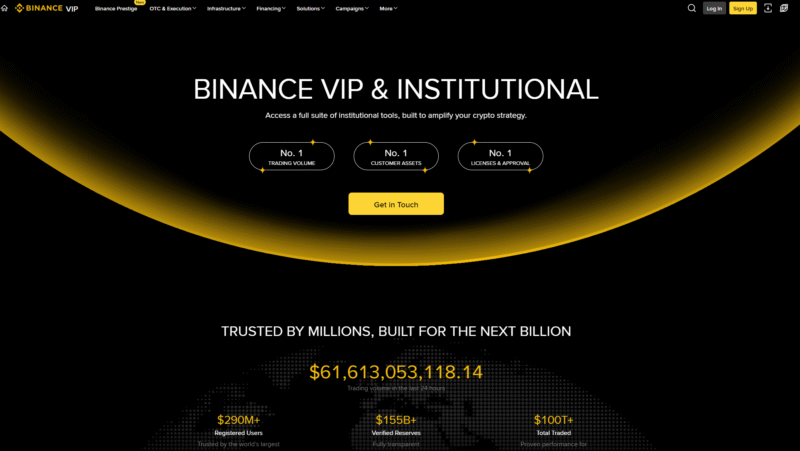
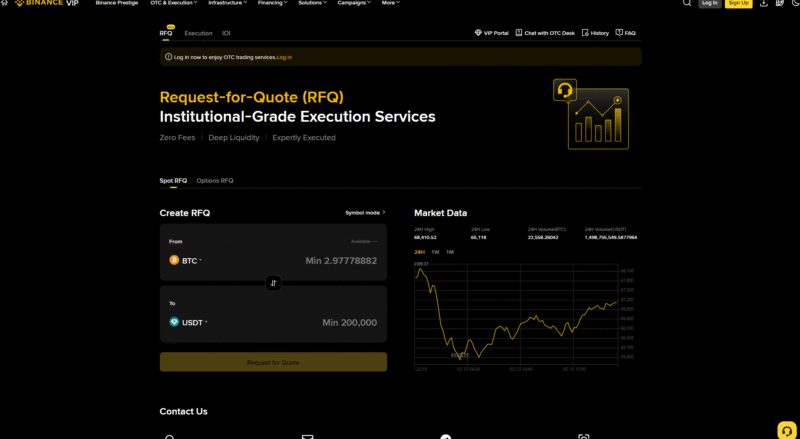
In addition to standard OTC trading, Binance offers features for handling large orders, such as RFQ (Request for Quote), Spot Block Trading, and Execution Algorithm. In particular, institutions and high-net-worth investors can manage execution quality by splitting orders or comparing quotes from multiple liquidity providers, rather than placing a market order all at once.
Minimum trade sizes and terms of use may change by service, so check the current terms on the Binance VIP & Institutional page before using a service.
VIP Levels
Binance has several VIP tiers, and eligibility may be determined by the applicable program, including trading volume, asset holdings, and BNB holdings. Higher VIP levels may offer benefits such as:
- Preferential trading fees
- Higher API limits
- Higher withdrawal limits
- Institutional trading features
- Priority customer support
- Large-order solutions
- Preferential terms for certain financial products
It is important to note that VIP fees and requirements are not fixed. Rather than memorizing Maker and Taker fees for a particular VIP level as figures that remain unchanged over time, check the actual Binance Fee Schedule.
Total Cost of Convert Quotes and Order Book Trading
The Biggest Advantage of Convert
It is very easy to use. Enter an amount, and Binance provides an estimated exchange price; once you approve it, the trade is executed. It is especially convenient for beginners who do not understand order books and limit orders.
If the Trading Fee Is Shown as Zero, Is It Always Cheaper Than Spot?
Not necessarily.
Binance Convert does not show a separate standard Spot trading fee, but the quote itself may differ from the market’s best bid and ask.
Therefore, when comparing trading costs, do not look only at “0% fees”; compare the actual amount you will receive.
Small Trades
Convert is convenient for exchanging small asset balances or leftover funds for another coin. It can also be useful when trading directly on the Spot Market is inconvenient due to minimum order amounts or trading-pair limitations.
Large Trades
If the trade size is large, it is a good idea to compare Convert’s quote directly with the estimated execution price in the Spot order book. Depending on the circumstances, Convert’s quote may be more favorable, or splitting and executing the order yourself may be advantageous.
Ultimately, what matters is not the stated fee, but the quantity of assets you receive in the end.
5. Deposits, Withdrawals, Networks, and the Travel Rule
Cryptocurrency transfers must meet the supported asset, network, and verification requirements of both the sending and receiving platforms. Fiat deposit methods vary by country, currency, and contracting entity; do not assume that bank transfer, card, or P2P examples from another country also apply to your account.
The Travel Rule and Recipient Information
The Travel Rule is an anti-money laundering requirement to collect and transmit sender and recipient information when transferring virtual assets. FATF standards are applied through legislation and oversight in each country, so thresholds, required information, and verification methods vary by country. Do not assume that all countries have the same threshold or interpret below-threshold transactions as having no verification requirements at all. Check FATF guidance on virtual assets and service providers and regional terms of use.
Networks, Memo/Tag, and Small Test Transfers
Are XRP and TRX the best coins for transfers?
XRP and TRX have often been used for transfers to overseas exchanges because they offer fast transfer speeds and, in some cases, relatively low network fees. However, it is not appropriate to conclude that “XRP and TRX are the standard, while BTC and ETH are inefficient.” The following factors affect the actual transfer cost:
- Coin price
- Network congestion
- Exchange withdrawal fee
- Minimum withdrawal amount
- Supported network
- Market fluctuations in the coin
Actual transfer costs and support availability depend on the factors above. Also, if you buy XRP or TRX to make a transfer and the price moves, you could incur a price fluctuation loss greater than the network fee.
Therefore, immediately before making the transfer, it is best to compare the sending exchange’s withdrawal fee and the networks supported for Binance deposits before choosing.
Why the XRP Destination Tag Matters
When depositing XRP to a centralized exchange, you may generally be provided with a Destination Tag as well as an XRP address.
An exchange may use one address system for multiple users and use Tags or similar identifiers to determine which account a deposit belongs to. Therefore, if a Destination Tag is shown on the Binance XRP deposit screen, you must enter both the address and Tag correctly.
What happens if you omit a Memo or Tag?
If you send an asset that requires a Memo/Tag without one, the blockchain transfer itself may succeed, but the funds may not be credited to your Binance account automatically.
Binance provides Wrong or Missing Tag/Memo Recovery and Self-Service Recovery procedures for such situations.
However, not all deposits sent incorrectly can be recovered.
- Supported asset
- Network
- Deposit address
- Transfer status
- Whether the exchange can recover it
Recovery outcomes may vary depending on the asset, network, and whether it is supported. Recovery may also incur fees or take a long time to process.
The most important thing is matching the network
When transferring virtual assets, matching only the coin name is not enough. For example, the same USDT may be issued and transferred on multiple networks, including:
- Ethereum
- BNB Smart Chain
- Tron
- Arbitrum
- Other supported networks
As in the examples above, the same asset may exist on multiple networks. The network selected on the sending exchange must be compatible with the network selected on the Binance deposit screen. Transfers over unsupported networks may not be credited automatically, and recovering the assets may be very difficult.
Make a small test transfer if it is your first time sending to an address
If you are transferring a large amount of assets for the first time, it is safer to make a small test transfer first, taking the minimum withdrawal amount and fees into account, rather than sending the entire amount at once. After confirming that the test deposit has been credited successfully, transfer the remaining amount. This can greatly reduce the risk of errors with the address, network, or Memo.
What to Check If a Deposit Is Not Credited
If a deposit is not credited
First, check the TXID status in a blockchain explorer. The items to check are:
- Whether the transfer succeeded
- Network
- Recipient address
- Confirmations
- Memo or Tag
- Binance’s minimum deposit requirements
If the transfer is complete on the blockchain but has not been credited to your account, it may be an exchange deposit processing issue, so it is best to contact support with the TXID ready.
What if you sent it over the wrong network?
Do not assume that recovery is guaranteed. Even if networks use the same address system, the exchange must support recovery for that asset and network. Recovery availability and costs may vary depending on the circumstances. Before sending, check the asset, network, address, Memo/Tag, minimum deposit amount, withdrawal fee, and support status, and keep the TXID and confirmation of successful credit. For detailed steps, see the Binance deposit and withdrawal guide.
6. Spot, Futures, Margin, Liquidation, and Orders
Differences Between Spot, Futures, and Contract Units
Spot Trading
Spot trading is the most basic way to trade: you buy and hold cryptocurrency directly. For example, if you buy Bitcoin in the BTC/USDT market, the actual BTC balance is reflected in your account. Even if the price of Bitcoin subsequently falls, a typical spot purchase does not result in forced liquidation like a futures position.
However, if the price falls significantly, the market value of your holdings may decrease. The absence of liquidation risk does not mean there is no risk of loss.
Binance Spot offers a variety of trading pairs, including pairs that use USDT, USDC, FDUSD, BTC, and BNB as quote assets. The trading pairs actually supported may change due to listings, delistings, and regional policies.
Futures Trading
Unlike directly holding the underlying cryptocurrency, futures trading involves trading derivative positions that track price movements.
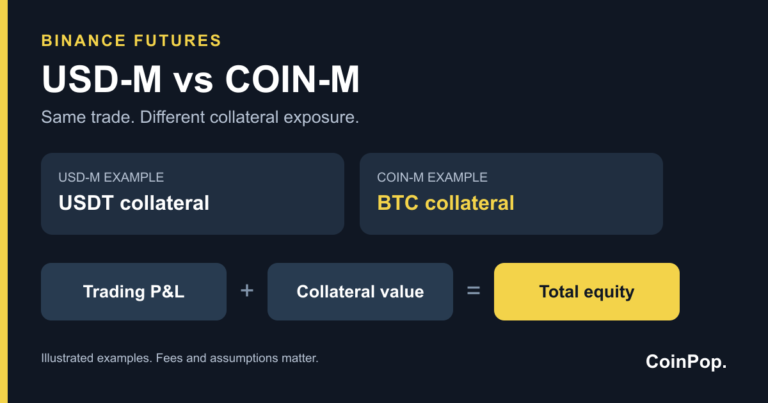
Binance’s main futures products can be broadly divided into USDⓈ-M Futures and COIN-M Futures.
USDⓈ-M Futures
USDⓈ-M is a futures product that uses stablecoins such as USDT and USDC as margin and settlement units. Since profits and losses are easy to calculate in units close to the dollar value, it is widely used for typical futures trading. For example, with BTCUSDT perpetual futures, you invest based on the price of BTC, but actual profits and losses are calculated in USDT.
COIN-M Futures
COIN-M uses cryptocurrencies such as BTC or ETH themselves as margin and settlement assets. It can be used by people who hold Bitcoin long-term and want to manage positions in BTC terms. However, you should understand that if the underlying asset’s price falls, not only can the position incur losses, but the dollar value of the cryptocurrency used as margin may also decrease.
Long and Short
In the futures market, you can take positions based not only on price increases but also on price decreases.
Long is a position that bets on prices rising, while Short is a position that bets on prices falling.
For example, if BTC rises from 100,000 USDT to 110,000 USDT, a Long position may profit while a Short position may incur a loss. Conversely, if it falls to 90,000 USDT, a Short position would be advantageous.
| Category | Regular spot purchase | Futures contract | Margin Borrowing |
|---|---|---|---|
| Trade Structure | Buy and Hold Crypto Assets | Position on Contract Price Movements | Borrow Assets to Trade Spot and Other Markets |
| Key Additional Risks | Price Declines, Custody, and Exchange Risks | Margin, Leverage, Liquidation, and Perpetual Funding | Collateral, Borrowing Interest, Repayment, and Liquidation |
| Costs to Check | Trading Fees, Spread, and Withdrawals | Trading Fees Based on Notional Value and Applicable Funding | Trading Fees and Borrowing Interest |
| Caution | The absence of liquidation in ordinary spot trading does not mean there is no risk of loss | Stop-loss orders do not guarantee execution during periods of rapid volatility | Check supported assets, interest rates, and collateral terms for each product |
Leverage, Cross and Isolated, Liquidation, and ADL
Isolated Margin
Isolated manages the margin allocated to a specific position separately. Even if that position incurs a substantial loss, its impact on other funds can be relatively limited. This is an easy-to-understand structure for users new to futures trading who want to clearly manage risk for each position.
Cross Margin
With Cross, available margin can support the risk of multiple positions together. This may help keep the liquidation price farther away, but, conversely, a single large loss can affect the shared margin pool in that futures account. Therefore, it is not accurate to simply say that Cross is safer than Isolated.
Leverage and Actual Risk
Choosing 10x leverage does not necessarily mean that your entire account becomes 10 times riskier. The key factor is the actual position size. A trade using only 100 USDT as margin and one using 8,000 USDT as margin carry completely different levels of risk, even at the same leverage, if total assets are 10,000 USDT.
Liquidation Price
If losses on a leveraged position cause it to fall below the maintenance margin requirement, the liquidation process may begin. Therefore, forced liquidation should not be used as a stop-loss method. In general, risk management is better served by setting your own stop-loss strategy well ahead of the liquidation price.
Insurance Fund and ADL
Binance Futures has an Insurance Fund to cover losses that may arise during the liquidation process. In extreme market conditions, if the fund cannot cover the losses, ADL (Auto-Deleveraging) may act as the final risk-management mechanism. Therefore, even a profitable position is not completely safe in every situation.
Funding Fees
Perpetual futures have no expiration date. Instead, a Funding Rate is used to adjust the price difference between spot and futures. Depending on market conditions, funding fees may be paid by longs to shorts or vice versa. If you hold a position for a long time, you should calculate not only directional gains but also cumulative funding costs. Cross refers to the shared margin pool for the relevant product and account mode; it does not mean that all separate wallets and spot assets are always automatically collateralized. Liquidation is affected by factors such as mark price, maintenance margin, position size, and fees, so it should not be calculated solely using a fixed percentage price drop. Distinguish between a stop-loss price, which is a planned exit condition, and a liquidation price, which is a forced risk-management threshold.
OCO, OTO, OTOCO, and Post Only
OCO (One Cancels the Other) Orders
OCO lets you place two orders at the same time; when one is executed, the other is automatically canceled. A common use is to manage take-profit and stop-loss orders simultaneously for a coin you hold. For example, if you hold BTC, you can place a take-profit order above the current price and a stop-loss condition below it. When either one is executed first, the other order is automatically canceled.
This allows you to manage two scenarios at once without continually checking the chart.
OTO and OTOCO
Binance also supports conditional orders that extend OCO functionality. OTO (One-Triggers-the-Other) activates a second order after the first order is fully filled. OTOCO activates an OCO order combining take-profit and stop-loss conditions after the first order is fully filled. For example, you can place a limit order to buy BTC at a specific price and set it up to automatically create take-profit and stop-loss conditions as soon as the purchase is complete.
What Is Post Only?
Post Only is an order condition that prevents an order from being filled immediately as a taker. An order that would immediately match the opposing quote may be rejected or canceled; placement or execution is not guaranteed. Even a limit order can become a taker order if its price overlaps with the current opposing quote and it is filled immediately. When Post Only is enabled, orders that would execute immediately are handled so they do not fill as taker orders on the order book.
This makes it useful for high-frequency traders who prioritize maker fills and users who carefully manage trading costs.
Spot OTO and OTOCO activate subsequent orders only after the initial trigger order has been fully filled. Do not assume that follow-up take-profit or stop-loss orders are already active while the initial order is only partially filled. With Stop-Limit, a limit order is submitted after the trigger, so it may not be filled during rapid movements or price gaps. Check the supported order types, quantity limits, and actual order status for each product. Official Binance Spot Order Specification
Charts, Market and Limit Orders, and Order Execution in Slices
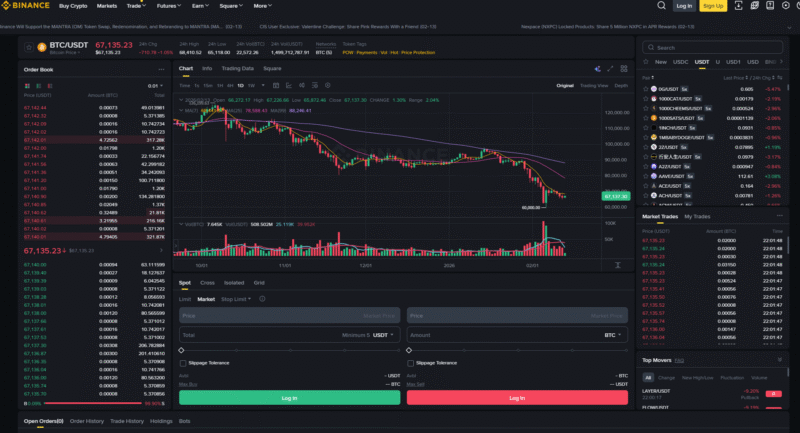
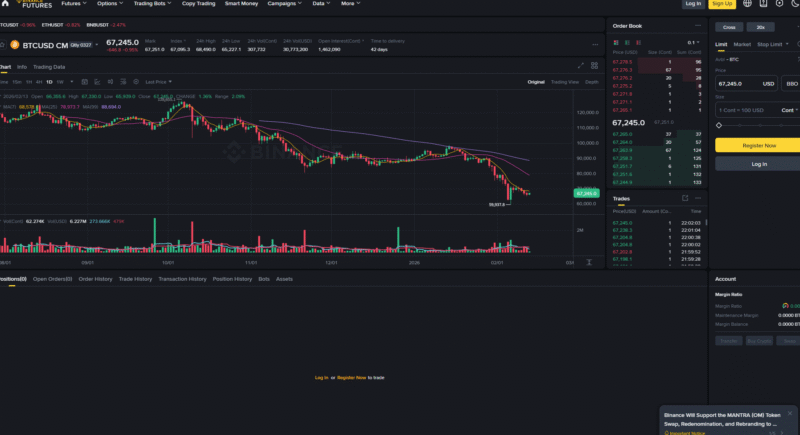
Volume
Checking trading volume alongside price movements can help you assess the level of market participation. Even if the price breaks to a new high, if trading volume is extremely low, you should separately evaluate the reliability of the breakout.
VWAP
VWAP (Volume Weighted Average Price) is an average price weighted by trading volume. Institutions and short-term traders may use it as a reference indicator for assessing the market's average execution level.
Why Look at Multiple Time Frames Together
An uptrend on a 5-minute chart may be only a small rebound within a larger downtrend on the daily chart. Therefore, check multiple time frames together as follows.
- Long-term chart → Overall trend
- Intermediate chart → Structure
- Short-term chart → Entry
You can check multiple time frames together, as shown in the example.
Limit and Market Orders
If fast execution is most important, a market order may be preferable, but it can incur slippage and taker fees. If you want to control the price, a limit order may be preferable, but it may not be filled. Therefore, neither order type is always better.
Execute Large Orders in Slices
Executing a large market order all at once in an illiquid market can significantly worsen the average execution price. In such cases, you can consider limit orders, TWAP, and other execution strategies.
As trade size increases, not only directional forecasts but also Execution Quality itself affects returns.
7. Security Incidents, Regulatory History, SAFU, and Proof of Reserves
Key Security and Regulatory Events and Confirmed Responses
| Date | Confirmed Facts | Limitations of Interpretation |
|---|---|---|
| May 2019 | An official security notice announced that approximately 7,000 BTC had been withdrawn in a single transaction and that SAFU would cover the incident. Official notice at the time | Past responses do not promise compensation for all future incidents or investment losses. |
| November 2023 | The U.S. Department of Justice announced a guilty plea by the Binance entity and a settlement exceeding $4 billion, as well as CZ's personal guilty plea related to anti-money laundering and resignation as CEO. U.S. Department of Justice announcement | The corporate settlement and the individual's criminal case must be distinguished. |
| October 2025 | CZ's pardon is listed in the U.S. Department of Justice's pardon list. Official pardon list | An individual's pardon does not mean that all corporate settlement obligations or regional restrictions are removed. |
| October 2025 | Binance announced a compensation plan for futures, margin, and loan users affected by the depeg of USDE, BNSOL, and WBETH collateral during specific time periods, along with improvements to risk management. Official eligibility, period, and calculation details | This does not mean that every investor who suffered losses due to a market crash is eligible for compensation. |
SAFU’s Role, Scope, and Governance Structure
SAFU (Secure Asset Fund for Users), the User Protection Fund
Binance operates SAFU (Secure Asset Fund for Users), the User Protection Fund, a dedicated emergency fund for user protection.
SAFU was established in July 2018. Initially, it grew by allocating a portion of trading fees to the fund.
Binance’s official materials in 2026 describe SAFU’s asset maintenance target as approximately $1 billion and publish related wallet addresses. Binance Academy also reports a valuation of approximately $1 billion as of February 2026, but the maintenance target should be distinguished from the valuation at a particular point in time.
What Does SAFU Protect?
SAFU is an emergency fund established to protect users in exceptional circumstances, such as serious security incidents. It does not automatically reimburse users in full for all losses incurred on Binance. Whether SAFU applies and the scope of any compensation may depend on the cause of the incident, Binance’s assessment, and relevant policies.
- A user withdraws directly to an incorrect address
- Theft of a private key or account takeover
- Investment losses
- Forced liquidation of futures positions
- Loss of assets due to phishing
Losses such as those listed above cannot be assumed to automatically qualify for SAFU compensation.
SAFU can therefore be viewed as an additional user protection measure, but it should not be regarded as equivalent to a deposit protection scheme or insurance that covers all losses.
SAFU’s Structure in 2026
In its official explanations about SAFU in 2026, Binance states that part of the fund is used as a capital reserve to meet regulatory obligations in the Abu Dhabi Global Market (ADGM), and that SAFU is managed through Nest Clearing and Custody Limited, a regulated custodian and clearing institution. The related assets can also be verified on-chain through SAFU’s publicly disclosed wallet addresses.
This enhances transparency compared with showing only the internal ledger of a centralized exchange. However, SAFU and an exchange’s Proof of Reserves are different concepts.
SAFU is a user protection fund for emergency situations.
Proof of Reserves (PoR) is a transparency system designed to verify whether an exchange holds reserve assets corresponding to the crypto assets deposited by users.
It is useful to understand both systems together. SAFU’s asset composition, size, and management terms may change. Do not interpret past dollar valuations as current balances or guaranteed compensation limits; check the official SAFU information and publicly disclosed wallets.
PoR, Merkle Trees, Reserve Ratios, and the Difference Between Verification and Audits
What Is Proof of Reserves (PoR)?
Binance publishes information through its Proof of Reserves system so users can verify user assets against the reserve assets held by the exchange. Using cryptographic verification techniques such as Merkle Trees, users can check whether their account balances are included in the reserve verification data.
What Is a Merkle Tree?
A Merkle Tree is a structure that organizes large amounts of data into a hierarchy of hash values, enabling efficient verification of the integrity of the entire dataset. It can be used to verify whether a particular user’s balance is included in the full dataset without publicly disclosing all exchange users’ balance information.
Reserve Ratio of 100% or More
For a particular asset, the Reserve Ratio may be shown as over 100% if the exchange holds more reserve assets than the net customer balances. For example, if customers have a net total of 100 BTC deposited, the concept is to verify whether the exchange holds at least 100 BTC in corresponding reserve assets.
However, PoR should not be understood as “proof that an exchange can never go bankrupt.”
Limitations of PoR
Proof of Reserves is a useful tool for enhancing exchange transparency, but it is not the same as an audit that fully demonstrates an exchange’s overall financial health. Users should distinguish among the following:
- Reserve assets
- Customer liabilities
- The company’s own debt
- Operating expenses
- Legal risks
- Counterparty risks
PoR is therefore an important security and transparency indicator, but it does not eliminate all risks associated with centralized exchanges.
On-Chain Addresses and Reserve Verification
Binance provides reserve data for supported assets on its Proof of Reserves page, where users can check whether their account data is included. Supported assets and verification methods may change or expand over time, so it is best to check the current PoR page. For information on how to verify reserve assets and individual balances, see Binance’s official Proof of Reserves. Proof of reserves at a particular point in time is not equivalent to a comprehensive audit of all liabilities, legal rights, liquidity, and solvency.
Custody Infrastructure and Personal Account Security
Hot Wallets and Cold Storage
Centralized exchanges generally operate separate hot wallets for quickly processing user deposits and withdrawals and cold storage for long-term custody.
Hot wallets are connected to online systems, allowing deposits and withdrawals to be processed quickly, but are relatively more exposed to external attacks.
Cold storage aims to reduce exposure to external attacks by keeping private keys in a way that is isolated from online environments.
Binance does not publish a single fixed figure for the allocation ratio between its cold and hot wallet assets or for its internal custody structure.
Multi-Signature and Security Infrastructure
In large-scale crypto asset management, it is common to use multiple approval mechanisms so that all assets cannot be moved based solely on one private key or one administrator’s decision. The information that can be verified through Binance’s published PoR, wallet addresses, and account security features should be distinguished from internal security infrastructure that has not been disclosed.
Exchange Security and Personal Security Are Separate
Even if an exchange is secure, users can lose assets if their accounts are taken over through phishing. Therefore, do not check PoR alone; also enable the following security features on your personal account:
- Passkey
- Authenticator
- Anti-Phishing Code
- Withdrawal Address Whitelist
- Email 2FA
It is important to enable these security features together. Binance offers a withdrawal address whitelist feature, which, when enabled, restricts withdrawals to registered addresses only. For details on waiting periods for new addresses, address book settings, and distinguishing between withdrawal errors, see Binance’s guide to setting up a withdrawal address whitelist.
8. Earn, Launchpool, Megadrop, and Dual Investment
Simple Earn: Flexible and Locked Products and Redemption Risks
Binance Simple Earn
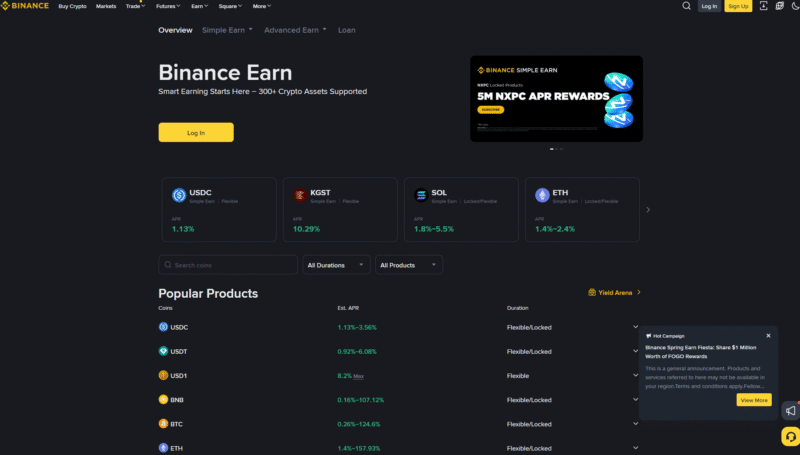
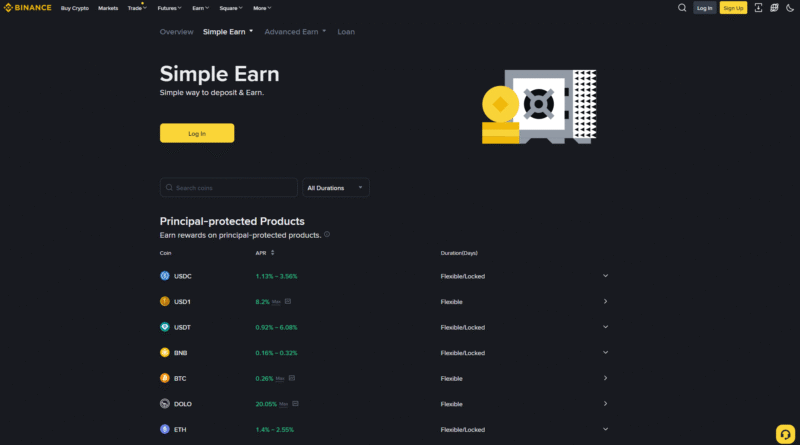
Simple Earn is a major Earn service that allows users to earn rewards on the cryptocurrencies they hold. It is broadly divided into Flexible Products and Locked Products.
Flexible Products
Flexible products allow assets to be redeemed relatively freely. They can be used for idle funds or cryptocurrencies that you do not plan to sell for an extended period. The APR shown for a product should not be assumed to be equivalent to a fixed deposit interest rate; it may change depending on market conditions, promotions, and product terms. Some products may also have a Tiered APR or Bonus APR structure, in which the additional APR applies only up to a certain amount.
Therefore, check whether the highest APR shown on the screen applies equally to your entire balance.
Locked Products
Locked products require assets to be deposited for a set period. They may offer a higher APR than Flexible products, but early redemption may adjust rewards or take a certain amount of time to process. Terms such as the product duration, APR, and early redemption conditions may change frequently, so check the actual terms when subscribing.
Is Simple Earn a Guaranteed-Return Product?
Simple Earn APRs and rewards may vary depending on market conditions and product terms, and are not guaranteed as fixed interest. Simple Earn APRs may fluctuate depending on the product, and even if you receive rewards, a decline in the price of the underlying cryptocurrency may reduce your total assets in fiat currency terms. For example, even if the number of coins you hold increases by 5% over a year, a 40% drop in the market price of those coins could result in a substantial loss in fiat currency terms.
Therefore, it is more accurate to understand Earn as a way to earn additional rewards on assets you hold, not as a product that eliminates price risk.
APR, APY, and Asset Price Fluctuations
The Difference Between APR and APY
APR (Annual Percentage Rate) generally refers to an annualized return that excludes the effect of compounding. APY (Annual Percentage Yield) is an annualized return that includes the effect of compounding. Rather than focusing only on the high figures shown in advertisements, check the conditions that apply to the rates below.
- Bonus APR that applies only up to a specified amount
- For new users only
- Limited-time promotion
- Limited to certain regions
The displayed rates may come with conditions such as those above, so distinguish them from the rates that actually apply to your total investment.
Why You Shouldn't Choose Based on a High APR Alone
The greatest risk with crypto Earn products is the price of the underlying asset, not the interest rate itself. For example, even if you earn a 10% annual reward, the total value of your assets will decline significantly if the coin's price falls by 50%. Therefore, Earn is not a product that eliminates the price risk of your investment assets. The current official Simple Earn information explains variable rewards and the possibility of redemption limits or delays for different products, and also discloses the risk of losing principal in extreme situations. The ability to redeem, a guarantee of value in fiat currency, and deposit protection are not the same thing.
How to Participate in Launchpool and Launchpad
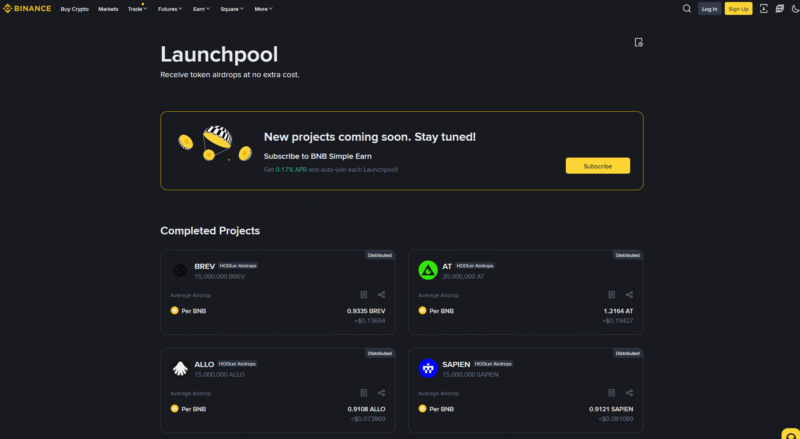
Binance Launchpool
Launchpool is a service that lets you allocate certain assets to designated pools and receive tokens from new projects as rewards. The assets available, duration, reward amount, eligibility, and other details may vary by project. BNB or certain stablecoins may be used, for example, but the same assets are not always required.
The Biggest Advantage of Launchpool
It offers an opportunity to receive additional tokens from new projects while putting assets you already hold to use. However, it would be inaccurate to conclude that you can "earn new coins without risking your principal." The price of assets committed to Launchpool may fall, and the price of new tokens may also drop significantly after listing. Therefore, when evaluating Launchpool risks, consider the following factors together.
- Price fluctuations in deposited assets
- Price of new tokens
- Estimated APR
- Reduced rewards as the number of participants increases
- Event period
Consider the above risk factors together.
The Difference Between Launchpad and Launchpool
Binance's new token distribution services have evolved over time.
The traditional Launchpad is known as a platform for participating in token sales for new projects, and in the past it used methods such as snapshots of BNB holdings and subscriptions.
By contrast, Launchpool generally involves allocating certain assets to a pool and receiving new token rewards over a set period.
The important point is not to assume that Launchpad's past operating methods will be applied unchanged to every future project. Binance is also expanding new token distribution and discovery systems such as Alpha and Megadrop, so check the terms in the current announcement when participating in a new project. Prices of tokens from new projects, including Launchpad projects, may fluctuate significantly after listing, and past cases of price increases do not guarantee future performance.
Megadrop and Web3 Quest
How Megadrop Works
Participation requirements vary by project. Common ways to participate include:
- BNB Locked Products
- Web3 Quest
- Specified on-chain activities
An event may combine these participation elements to calculate a score, which may then determine token rewards.
Is Holding More BNB Always an Advantage?
The amount of BNB held may be an important factor, but the formulas and caps can vary by event. Some projects also assign a separate weighting to Web3 Quest, so you should not assume the results are determined solely by the amount of BNB held.
Web3 Quest
Web3 Quest involves performing designated activities on a particular project or network.
- Using a specific DApp
- Token swap
- On-chain interactions with a project
Eligibility may depend on the items above and on the conditions of each event. Check the official page for each event for the exact requirements.
Megadrop Participation Risks
Receiving tokens for free or as rewards does not mean the entire process is risk-free. BNB itself is subject to price fluctuations, and completing Web3 Quest may also involve smart contract risks. In addition, new tokens may be highly volatile after listing. Therefore, buying an excessive amount of BNB solely for token rewards may entail separate investment risks.
Dual Investment Settlement and Opportunity Costs
Dual Investment
Dual Investment is a structured product with a structure different from ordinary deposits or simple staking.
Users select a specific Target Price and Settlement Date, and the asset they ultimately receive back may vary depending on future price conditions. Common strategies include Buy Low and Sell High.
Sell High
Investors who are willing to sell their cryptocurrency at a specific target price can use this strategy. If the specified conditions are met on the Settlement Date, settlement may be made in a different asset according to the target conditions.
Buy Low
This strategy can be used when you want to buy a particular cryptocurrency at a target price lower than the current price. The asset received at final settlement varies depending on the price conditions.
Key Risks of Dual Investment
Do not subscribe based solely on a high APR. Dual Investment is not an ordinary principal-protected deposit, and settlement follows the specified conditions even if the market price moves far from the direction you expected. Accordingly, before considering the APR, check the following settlement terms.
- Which asset am I putting in?
- What is the Target Price?
- When is the Settlement Date?
- Under what conditions, and in which asset, will I receive the settlement?
Before using Dual Investment, make sure you fully understand the settlement asset, price, timing, and conditions. Dual Investment is a much more complex product than Simple Earn for beginners who do not fully understand how it works.
9. Trading Bots, Copy Trading, and API
Differences Between Grid, Price Range, and Rebalancing
Spot Grid
A grid bot places multiple buy and sell orders within a set price range and repeatedly trades as the price rises and falls. For example, if you expect Bitcoin to move between 90,000 and 110,000 USDT, you can divide that range into multiple grid levels and configure the bot to buy at lower levels and sell at higher ones. If the price moves sideways for an extended period, there may be an opportunity to accumulate small gains through multiple trades, but the strategy's efficiency can drop sharply if the price moves well outside the set range.
Difference Between Arithmetic and Geometric
Arithmetic and Geometric are common methods for setting grid intervals.
The Arithmetic method divides the grids using the same price difference between each one.
For example, prices are divided into fixed increments, such as 90,000 → 92,000 → 94,000 → 96,000 USDT.
The Geometric method divides the grids using the same ratio between each one.
If the price range is broad or the asset itself is likely to move significantly, a percentage-based approach may be easier to manage. Neither method is always superior; results vary depending on the volatility of the traded asset and the range settings.
Futures Grid Features
Unlike spot grids, futures grids can use leverage and long and short positions. They may offer high capital efficiency when prices move repeatedly within a specific range, but there is also a risk of liquidation if the market moves strongly in the wrong direction. In particular, setting up a narrow-range grid with high leverage can cause losses to grow rapidly even with small price changes. Futures grids therefore require a much higher level of risk management than spot grids.
Rebalancing Bot
A rebalancing bot is a strategy for maintaining target allocations across multiple assets. For example, suppose you set the allocation to 50% BTC and 50% ETH. If the price of BTC rises significantly and the portfolio allocation shifts to 60% BTC and 40% ETH, the rebalancing process reduces some of the BTC and increases the ETH allocation to bring the portfolio back toward its target ratio. This can have the effect of reducing holdings in assets that have risen and increasing holdings in assets that have risen less.
However, in a strong one-way trend, performance may be lower than simply holding the assets.
Distinguish Spot DCA from recurring Auto-Invest purchases
DCA generally means investing a fixed amount at regular intervals. However, Binance Spot DCA bots are products that automate additional buys or sells and closing positions by letting users set price deviation, base order size, additional order size and multiplier, maximum number of additional orders, and take-profit conditions. They should not be described as having the same functionality as Auto-Invest, which uses fixed amounts at set time intervals. See the official Spot DCA and Auto-Invest comparison to understand the differences. Additional orders can increase the capital committed during a loss-making period and do not guarantee profits or an improved average entry price.
Risk limits to set before running automated trading
Bots are not systems that eliminate losses. In fact, automating a flawed strategy can result in losses occurring more quickly and repeatedly than when trading manually. Therefore, be sure to review the following:
- Total funds available to invest
- Maximum amount to commit to the strategy
- Price range
- Number of grids
- Leverage
- Stop-loss level
- Maximum acceptable loss
- Actual return, including fees
The key to automated trading is not achieving high returns, but designing conditions that allow your account to survive even in an unfavorable market.
Copy Trading: Execution Differences, Drawdowns, and Profit Sharing
How Copy Trading Works
There are two main roles in copy trading.
A Lead Trader is a trader who manages their own portfolio.
A Copy Trader is a user who selects a specific Lead Trader, allocates funds, and copies their strategy.
When a Lead Trader places a trade, orders are also reflected in the followers' accounts, according to the configured copy mode and investment limits.
Copying a trader does not mean you will earn exactly the same returns
Actual returns may differ. The main reasons include:
- Order execution timing
- Market liquidity
- Slippage
- Available funds
- Minimum order size
- Copy settings
- Trading fees
- Differences in entry timing between the Lead Trader and followers
Therefore, you should not expect to reproduce the Lead Trader's historical returns exactly.
Key Metrics for Evaluating Lead Traders
The most common mistake is choosing a Lead Trader based only on their ROI ranking. You should review the following metrics together.
ROI
The return relative to the funds invested. A higher figure may look better, but it may also result from using high leverage or taking extreme risks.
Maximum Drawdown (MDD)
The largest loss from a peak during the trading period. Even with a high ROI, an excessively high MDD may indicate a strategy that actual investors would find difficult to tolerate.
Trading history
A long-term track record spanning multiple market conditions is more useful for analysis than an account that has recorded high returns for just a few weeks.
Trading frequency
If there are too few trades, it is difficult to evaluate a strategy statistically. Conversely, ultra-high-frequency strategies can be heavily affected by trading costs and slippage.
Position concentration
You should also check whether most funds are concentrated in one or two coins or diversified across multiple positions.
Profit Sharing
In copy trading, Lead Traders may receive a portion of their followers' profits as Profit Share. The important point is that there is no single fixed rate that applies across all Binance copy trading. Terms may vary depending on factors such as spot or futures trading, the Lead Trader program, and portfolio type, so check the Profit Sharing terms shown on the actual screen before starting to copy.
The Biggest Pitfall of Copy Trading
Traders who have recently recorded large gains through aggressive positions may appear near the top of the return rankings. However, investing based only on a high ROI over a short period carries risks such as:
- Excessive leverage
- Averaging down
- A strategy without stop-losses
- Concentration in a specific altcoin
- A short trading history
- Abnormally high volatility
Therefore, rather than focusing on a high ROI, it is important to consider both low drawdowns and a sufficiently long trading history.
Is Copy Trading Safer for Beginners?
Not necessarily. Copy trading is convenient in that you do not have to place orders yourself, but it does not transfer the investment risk to someone else. If a Lead Trader makes a poor decision, followers can incur losses in the same direction. Therefore, when using copy trading, it is sensible to allocate only a portion of your total investment and diversify across multiple strategies.
API Permissions, Key Storage, and Testing Environments
API Key and Secret Key
When you create an API, an API Key and Secret Key are generally issued. The Secret Key in particular should be handled with the same care as a password. If exposed, it could put your account at serious risk.
Enable Only the Permissions You Need
A program that only needs to check prices and balances may not need trading permissions. For security, grant an API only the minimum permissions required by the program. In particular, it is best not to enable withdrawal permissions unless there is a specific reason to do so.
IP Whitelist
If the automated trading server has a fixed IP address, it is best to restrict API access to that IP only. This is an important security measure that makes it difficult to access the API from unregistered IP addresses even if the API Key is leaked.
Do Not Hardcode the API Secret in Your Code
It is extremely risky to write the Secret Key directly into Python source code and then upload it to a public repository such as GitHub. It is better to use environment variables or a separate secrets management system.
Testnet and Demo Trading
Before using real funds, you can test your order logic in the Spot Testnet or Futures Demo Trading environment. Automated trading programs can generate repeated orders from even a small coding error, so thorough testing is needed before connecting to a live account.
The Essentials of API Automated Trading
A good automated trading system is not one that promises high returns.
- API outages
- Network outages
- Rejected orders
- Partial fills
- Duplicate orders
- Server reboots
- Rate Limit
- Abnormal Price
An automated trading system must be able to handle exceptional situations such as those described above.
API Expiration, Access Restrictions, and Connection Errors
IP Access Restriction
If you run automated trading on a server with a fixed IP address, restricting the API Key to approved IP addresses can be a powerful security measure. This is because it can prevent the key from being used from unapproved IP addresses, even if the API Key is exposed externally. However, in situations where the IP address changes regularly, such as on mobile networks or with dynamic IPs, you should configure this setting to suit your operating environment.
Must an API Key be reapproved every 90 days?
It would be inaccurate to say that all API Keys must be reapproved every 90 days without exception. API Key validity, permission restrictions, and security policies may vary depending on factors such as how the key was created and the account conditions. Regularly check the status and permissions of each API Key in API Management.
If an API connection error occurs
If an API error occurs in an automated trading program, it is a good idea to check the following items first.
- Whether the API Key and Secret are correct
- Whether API permissions are enabled
- Whether the IP Restriction matches the current server IP
- Whether Spot or Futures permissions are required
- Whether the server time differs significantly from Binance server time
- Whether the API Rate Limit has been exceeded
- Whether the trading pair is currently available for trading
API errors can occur not only because a Key is incorrect, but also because of issues with permissions, IP addresses, server time, minimum order quantities, and other factors.
10. Binance Wallet, Alpha, and the BNB Ecosystem
Exchange Wallets, Web3 Wallets, and MPC
The Difference Between Binance Wallet and an Exchange Wallet
Assets held in a Binance exchange account are managed through a centralized exchange account system. By contrast, Binance Wallet uses an on-chain address to interact directly with the blockchain. Therefore, trading within an exchange and trading with a Web3 Wallet are structurally different.
Keyless Wallet and MPC
One of the key features of Binance Wallet's current architecture is its Keyless Wallet, which uses MPC (Multi-Party Computation). Instead of managing all permissions with a single Seed Phrase, as a conventional wallet does, it can use a structure that divides cryptographic keys into multiple Key Shares. Therefore, it is inaccurate to say, “Creating a Binance Wallet always gives you a 12- or 24-word Seed Phrase.”
Binance Wallet Extension may also offer the ability to import wallets based on an existing Seed Phrase or Private Key, so Keyless Wallet and external wallet import features should be understood separately.
Always Back Up Your Wallet
Not having a Seed Phrase does not mean you do not need a backup. Keyless Wallet also has a backup structure required for recovery, so be sure to complete the recovery procedure outlined in the app. If you lose your device or have trouble accessing your account, you may be unable to access your assets without a recovery method.
Swap, Bridge, DApp Approvals, and Wallet Selection
DEX and Swap
Binance Wallet lets you swap tokens using on-chain liquidity. During this process, check the following:
- Network
- Token Contract Address
- Estimated amount to receive
- Price Impact
- Gas Fee
- Slippage
- Token approval permissions
It is especially important to check the Contract Address, as fake tokens with the same name and ticker may exist.
Bridge
A Bridge is a feature for moving assets between different blockchains. It is used to transfer assets between chains, such as moving assets from Ethereum to BNB Chain or another network. However, bridges can introduce additional smart contract and third-party protocol risks, making them structurally more complex than simple transfers within an exchange.
DApp Approval Risks
One of the main things to watch out for when using a Web3 wallet is Token Approval. If you grant a malicious smart contract unlimited permission to use your tokens, the assets in your wallet may later be stolen.
- Do not connect to unknown DApps
- Do not grant Unlimited Approval indiscriminately
- Regularly revoke outdated permissions
- Review the request before signing
It is advisable to follow the security principles above when connecting to DApps and signing.
Which Is Better: an Exchange Wallet or a Web3 Wallet?
They serve different purposes. If you want to trade Spot and Futures, an exchange account is convenient. A Web3 Wallet, on the other hand, is an option when you need to engage in on-chain activities such as:
- DeFi
- On-chain trading
- Alpha
- Airdrops
- Web3 projects
- DEX
- On-chain derivatives
Binance Wallet is more useful when you want to use on-chain services.
Alpha and Alpha Points: Requirements and Risks
The Essentials of Binance Alpha
A token's appearance on Alpha does not mean that its listing on Binance Spot is guaranteed. This distinction is important.
Alpha is one way to explore new projects, but the formula Binance Alpha selection = guaranteed future Binance Spot listing does not hold.
Alpha 2.0
Alpha 2.0 is designed to integrate Alpha features more closely with the Binance exchange environment. This allows users to access certain on-chain tokens in a more streamlined way than through a typical external DEX. Supported assets, trading methods, networks, and features may change over time.
What Are Alpha Points?
Alpha Points are a points system that evaluates user activity within the Binance Alpha and Wallet ecosystem. Users who meet certain conditions may use them to participate in token events, airdrops, and other activities. However, the points calculation method is not fixed. Binance has changed rules related to factors such as balances, Alpha trading volume, and specific event conditions, so you should not base your activity solely on past points formulas.
What to Check When Using Alpha Points
- Current points
- Points validity period
- Points required to participate in an event
- Whether points are deducted
- How trading volume is counted
- Eligible tokens
- Wallet or Exchange usage requirements
Conditions may vary from event to event.
Risks of Alpha Trading
Alpha tokens may be much more volatile than mainstream crypto assets. For early-stage tokens in particular, check the following:
- Low circulating supply
- Low liquidity
- High FDV
- Large-scale Unlocks
- Holdings of insiders and early investors
- Sharp price fluctuations
Be sure to check the project's conditions and risk factors. Being a new project does not guarantee long-term value.
How to Use Alpha Most Effectively
It is more reasonable to view Alpha as one of the tools for discovering early-stage on-chain projects than as “a place to guess which coin Binance will list next.”
When evaluating a project, check the following factors in addition to whether it is included in Alpha.
- Tokenomics
- Market capitalization
- FDV
- Circulating supply
- Unlock schedule
- Trading volume
- On-chain users
- Project revenue model
It is a good idea to consider the above factors together. In 2026, the functionality of Web3 Wallets is expanding, including the addition of on-chain Perpetual Futures to the Binance Wallet app. This means Binance Wallet is expanding beyond a simple token storage wallet to also serve as a trading interface.
BNB utilities, Auto-Burn, and BEP-95
Key uses of BNB
BNB is commonly used for the following purposes.
- Discounts on Binance trading fees
- Gas fees on BNB Chain
- Simple Earn and certain products
- Token launch programs such as Launchpool
- Web3 services
- DeFi
- On-chain payments
- Participation in certain events and promotions
However, BNB requirements and benefits for each service may change over time.
BNB Auto-Burn
In the past, BNB burns were often described as being linked to Binance's trading volume or revenue. Currently, the amount burned is determined quarterly through the BNB Auto-Burn mechanism. It is a structure that gradually reduces the supply based on a published formula using factors such as the price of BNB and block production data from BNB Chain. This should be understood separately from a simple quarterly distribution of revenue by the centralized exchange Binance.
BEP-95 and real-time burns
BNB Chain also operates a mechanism based on BEP-95 that continuously burns a portion of the gas fees generated on the network. BNB has two supply-reduction mechanisms:
- Quarterly Auto-Burn
- Real-Time Burn based on network use
Do burns necessarily mean the price will rise?
A reduction in supply can increase scarcity, all else being equal. However, token prices are not determined by supply alone.
- Overall market liquidity
- BNB Chain usage
- Growth of the Binance ecosystem
- Regulation
- Investor sentiment
- Growth of competing chains
A range of factors such as those above affect token prices simultaneously. Therefore, BNB burns should not be interpreted as guaranteeing a long-term price increase.
11. Taxation and transaction recordkeeping
Taxation and recordkeeping principles by place of residence
Taxable transactions, profit and loss calculations, cost-basis methods, filing deadlines, and foreign account reporting requirements vary depending on your tax residence. The profit and loss shown on an exchange or in a Binance Tax report does not establish the amounts to report in every country. Keep records of trades, exchanges, fees, funding, borrowing interest, Earn rewards, deposits and withdrawals, and transfers between wallets, including the original asset denominations and timestamps, and check for omissions and duplicates.
Exporting transaction history and checking for omissions
After logging in to the official website, look for the Export or Export Transaction Records feature in Transaction History under Wallet or Assets. Select a period, account, and asset to generate the file, then download and save it after receiving the completion notification. You may need to export long periods in multiple batches, and the interface, generation limits, and download retention period may change. Official guide to generating transaction history
Do not assume that spot, futures, funding, Earn, Convert, and external wallet records will all be included in the same file. Compare the first and last dates, asset balances, and total fees in reports for each account, and check that transfers between your own accounts have not been counted twice as trades. Do not make files public or include API keys or identity documents in tax calculation documents.
South Korea example: current tax guidance and foreign financial account reporting
According to the National Tax Service's current guidance, checked on October 23, 2026, income from the transfer or lending of virtual assets on or after January 1, 2027 is subject to separate taxation as other income, with an annual basic deduction of KRW 2.5 million and a national tax rate of 20%. Note that the total rate is 22% when the 2% personal local income tax is included, distinct from the 20% national tax rate. Laws may be amended before they take effect, so check the latest legislation when filing. National Tax Service tax overview · Government explanation of the tax rate including local tax
Foreign financial account reporting is separate from the taxation of the income described above. Residents and corporations subject to reporting obligations in Korea must check whether they are required to report in June of the following year if the combined balance of reportable foreign financial accounts exceeded KRW 500 million on any one day at the end of a month during the relevant year. Accounts with overseas virtual asset service providers may also be included; the calculation does not add each account's highest balance from different dates. For details on residency status, exemptions, and other requirements, consult the National Tax Service guide to foreign financial account reporting. This article does not determine your individual tax obligations.
12. FAQs and common mistakes
Withdrawal restrictions after 2FA recovery or security measures
When Google Authenticator or 2FA is unavailable
If you lose or replace your phone and can no longer access your existing Authenticator, you must use Binance's account recovery and security verification reset process. Depending on the situation, additional identity verification may be required, such as:
- Another authentication method
- Identity verification
- Facial verification
- Account information verification
Submit identity verification materials only as specified through the official support interface.
Does a reset always result in a 48-hour withdrawal ban?
Binance may restrict withdrawals for a certain period or require additional verification when security settings are changed or account risk is detected, but the restriction period and conditions may vary depending on the circumstances and security measures.
Checking the withdrawal availability time shown on your actual screen is the most accurate approach. Binance may also temporarily suspend withdrawals depending on the account or security situation and require identity verification to reactivate them.
When withdrawals are suddenly restricted
Binance may apply temporary withdrawal restrictions or a cool-down in some situations where it detects an account security risk or determines that user protection is necessary. It also provides additional warnings and protective measures during withdrawal processes when potential fraud is detected. If withdrawals are restricted after a login or security setting change that you did not make, first check whether your account has been compromised rather than simply trying to remove the restriction.
Contacting official customer support
Using the official Support Center
Binance's Help Center provides support for issues such as the following:
- 2FA reset
- Password changes
- KYC issues
- Name and date of birth corrections
- Changing country of residence information
- Deposit and withdrawal issues
- Account restrictions
- Security issues
Using the official app or the Support menu on Binance.com is the safest option.
Scams impersonating support agents
It is not normal support procedure for a legitimate customer service representative to contact you first by private message and ask for your Seed Phrase, Private Key, or password. You should never share this information under any circumstances.
Reviewing the risk-reward ratio, position size, and drawdown
A high win rate alone does not make a good strategy
For example, even if you make a profit on 9 out of 10 trades, your account can end up in the red if you repeatedly make small profits and then suffer a very large loss on the final trade. Therefore, consider average profits, average losses, maximum losses, and expected value alongside the win rate.
Risk-Reward Ratio
If you risk losing 1 on a trade while targeting a profit of 2, the risk-reward ratio is 1:2. A higher risk-reward ratio does not necessarily mean higher profits, but it can be used together with your win rate to assess a strategy's expected value. You also do not need to mechanically use a 1:2 ratio for every trade. The optimal risk-reward ratio may vary depending on the strategy.
Position size matters more than leverage
You should not judge risk based solely on the leverage number. Even if you choose 100x leverage, using a very small position can limit the actual risk to your overall account. Conversely, even 3x leverage can expose you to significant risk if you commit most of your assets to a single position.
Therefore, the key is not how much you lose at liquidation, but what percentage of your total assets you lose when you stop out.
Drawdown management
Drawdown refers to how much an account has fallen from its previous peak.
- 10% loss → approximately 11.1% gain needed to recover the principal
- 20% loss → 25% gain needed
- 50% loss → 100% gain needed
- 80% loss → 400% gain needed
As losses grow, the return needed to recover increases exponentially.
Therefore, traders who survive over the long term prioritize controlling maximum losses over achieving the highest returns.
10 Common Mistakes
- Avoid sending a large amount without checking the address, network, and Memo/Tag.
- Do not assume that because a small transfer succeeded, other assets or networks are automatically supported as well.
- Do not share your password, recovery phrase, private key, or 2FA code with anyone claiming to be customer support.
- Do not understand leverage only as a multiplier on returns or use the liquidation price as your stop-loss price.
- Do not trade without checking which collateral applies to Cross and Isolated, as well as the actual order and position sizes.
- Do not overlook funding, borrowing interest, spread, slippage, or round-trip execution costs.
- Do not look only at a copy trader's ROI or a bot's past returns and ignore maximum drawdown and current risk.
- Do not interpret APR, Launchpool, Alpha, or token burns as guaranteed returns or as guarantees of listing or price increases.
- Do not grant unnecessary withdrawal permissions to an API or store keys in public code or messaging apps.
- Do not continue using the service without checking transaction records, reporting obligations, regional restrictions, and updated terms.
13. Final Checklist and Conclusion
For First-Time Users and Users Expanding Their Use of Features
Recommended Steps for Beginners
If you are new to Binance, the following order is easy to understand.
- Create an account
- KYC
- Set up a Passkey or 2FA
- Set up an Anti-Phishing Code
- Make a small deposit
- Trade using Convert or Spot
- Test a withdrawal
You do not need to use everything from Futures to Web3 services right from the start.
Intermediate Users
Once you understand how Spot trading works, you can expand to the following features.
- Limit orders
- OCO
- OTOCO
- Simple Earn
- DCA
- Grid Bot
- Binance Wallet
- Alpha
It is best to try each feature with a small amount before increasing the scale.
Advanced Users
Users with sufficient trading experience who understand the system can consider the following features as needed.
- Futures
- API
- Automated trading
- TWAP
- Copy Trading
- OTC & Execution
- On-chain DeFi
- Alpha and new projects
You can use advanced trading features as needed. However, the more advanced the feature, the greater the system risks and potential losses, along with the opportunities for profit.
Final Checklist Before Signing Up or Trading
What to Check Before Signing Up for a New Binance Account
If you plan to create a new account, it is best to check the referral terms before completing registration. Check whether the COINPOP code has been applied and what benefits are currently available on the registration screen.
After opening the link, check that the Referral ID has been applied correctly on the registration screen before proceeding. Fee discounts and promotional benefits may vary depending on the timing, product, and account eligibility, so it is best to treat the actual terms shown on the registration screen as final.
Final Checklist
Before actually using Binance, it is a good idea to check the following items one last time.
- Confirm that it is the official website
- Complete KYC
- Enable a Passkey or 2FA
- Set up an Anti-Phishing Code
- Strengthen the security of your email account
- Double-check the withdrawal address and network
- Check whether a Memo/Tag is required
- Test with a small amount on your first transfer
- Separate Spot and Futures funds
- Understand the difference between Cross and Isolated
- Set a stop-loss level before using leverage
- Check the Funding Rate
- Use an IP Whitelist when using an API
- Back up your Web3 Wallet
- Check DApp approval records
- Check the circulating supply and unlock schedule of Alpha tokens
- Download your transaction history regularly
- Check whether you need to report overseas financial accounts
- Check referral terms before completing registration
- Do not invest more than you can afford
Binance is a cryptocurrency platform with an extensive range of features and liquidity, but the mere availability of many features does not guarantee investment performance. Understanding trading costs, security, risk management, and asset custody, and selectively using only the features you need, is the most practical way to use Binance over the long term. For straightforward investing, Spot and security settings alone may be sufficient.
Long-term investors can add Simple Earn or DCA, while active traders can use Futures and advanced orders. Web3 investors can use Binance Wallet and Alpha, while institutions and high-net-worth investors can consider VIP and OTC & Execution Services.
What matters is not the number of features, but using only the features you understand.
Leverage, automated trading, copy trading, and Alpha are all convenient tools, but none eliminates investment losses. For anyone new to Binance, the safest approach is to first learn account security and deposit and withdrawal procedures thoroughly, then gradually explore the trading features one at a time.
The button above leads to an existing affiliate link. Check the current terms, eligibility, and risks on the registration screen, and do not deposit funds or use leverage solely to obtain benefits. CoinPop is responsible for writing and editing; if you suspect an error, you can request a correction by providing the source and relevant terms.