

Binance USDⓈ-M and COIN-M futures can produce the same gross trading profit in dollar terms while leaving you with different total asset values. The difference is not just the currency used to display P&L: BTC collateral also rises or falls in value. This guide separates the contract result, collateral movement and trading fees under matched, hypothetical starting conditions.
The examples compare a USDT-settled BTCUSDT position with a BTC-settled BTCUSD inverse position. They do not cover every Binance margin mode, recommend a product, or establish that futures are available in your jurisdiction.
Same starting value, different final equity
Start with $2,000 of collateral and a $10,000 long position at a hypothetical BTC price of $100,000. If BTC falls 10%, the modeled USDⓈ-M account ends at $1,000 before costs, while the COIN-M account ends at $800. The extra $200 reduction comes from the BTC collateral—not an additional $200 contract loss.
| BTC exit price | Gross contract P&L, USD equivalent | USDⓈ-M final equity | COIN-M final equity, USD equivalent |
|---|---|---|---|
| $90,000 (−10%) | −$1,000 in either model | $1,000 | $800 |
| $100,000 (0%) | $0 | $2,000 | $2,000 |
| $110,000 (+10%) | +$1,000 in either model | $3,000 | $3,200 |
These are hypothetical endpoint calculations, not observed trades, live prices, an exchange account balance forecast or a liquidation simulation. Formulas are based on Binance’s P&L explanation; inputs and results are CoinPop’s own calculation. Sources checked November 5, 2026.
Conditions behind the comparison
- USDⓈ-M model: 2,000 USDT collateral and a 0.1 BTC long position in BTCUSDT.
- COIN-M model: 0.02 BTC collateral and 100 BTCUSD contracts at $100 per contract, giving $10,000 of entry notional.
- Common valuation: BTC starts at $100,000. At each modeled endpoint, the contract price and the USD price used to value BTC are assumed equal. USDT is assumed to remain worth $1. These are calculation assumptions, not market observations.
- Account scope: one isolated position, no other balances or positions, and no deposits, withdrawals or collateral changes. The $10,000/$2,000 ratio is 5:1 at entry; it is not a recommendation or a statement of the exchange’s required margin.
- Exclusions: the first table excludes commissions, funding, slippage, spreads, collateral-acquisition or conversion costs, taxes and any liquidation charges. It assumes the position reaches the endpoint without earlier liquidation or forced reduction.
The two accounts have the same starting dollar value, but not identical total BTC exposure: the COIN-M account also owns BTC collateral. That difference is the point of the comparison. A price path that triggers liquidation would make these endpoint values inapplicable.
What changes between USDⓈ-M and COIN-M?
Check the exact symbol and settlement asset before comparing a displayed profit. In the examples here, BTCUSDT is linear and its P&L is in USDT; BTCUSD is inverse and its P&L is in BTC. A number in BTC cannot be compared directly with a number in USDT.
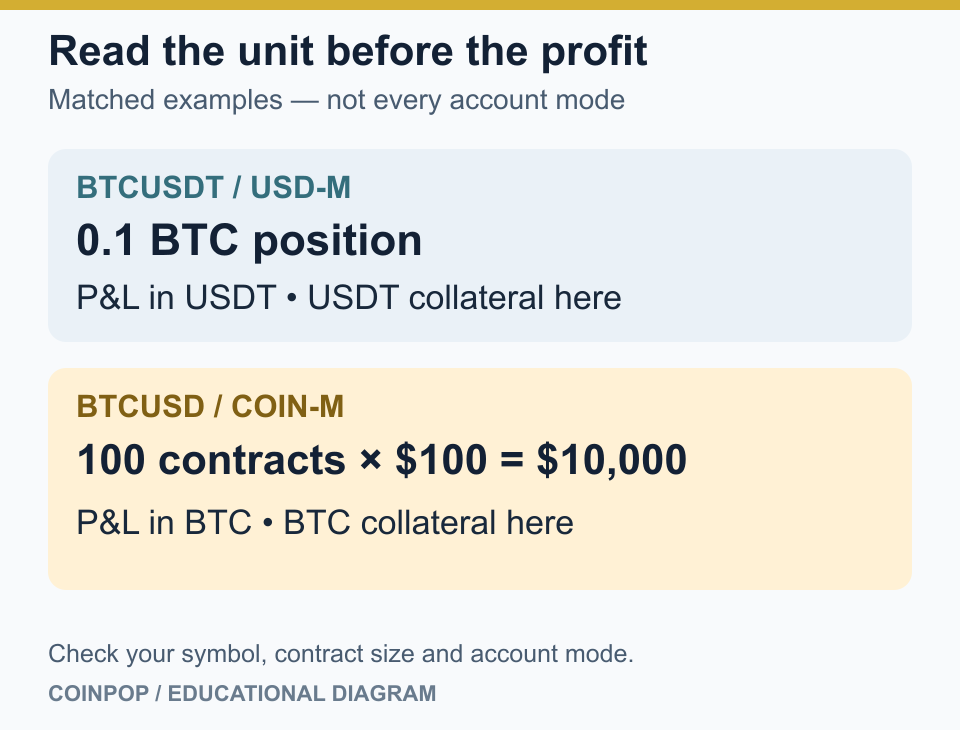
| Item | BTCUSDT USDⓈ-M example | BTCUSD COIN-M example |
|---|---|---|
| P&L unit | USDT | BTC |
| Position input | BTC quantity | Number of fixed-USD-value contracts |
| Collateral in this model | USDT | BTC |
| Main extra valuation question | What is USDT worth in the reporting currency? | What are the BTC collateral and BTC P&L worth at the valuation time? |
Binance’s product comparison explains the settlement distinction. Its public COIN-M contract metadata, checked November 5, 2026, identified BTCUSD_PERP with BTC as the margin asset and a $100 contract size. Confirm the specification for your actual symbol rather than applying that multiplier to every coin.
Also distinguish settlement from eligible collateral. Binance’s Multi-Assets Mode documentation allows eligible assets to support USDⓈ-M positions. This guide deliberately does not model collateral ratios, auto-exchange or portfolio offsets in that mode. “USDⓈ-M always means cash-only collateral” would therefore be too broad.
How to reproduce the long-position calculation
Use the full precision of the inputs while calculating, then round the displayed result. Here, P₀ is the entry price, P₁ is the exit price, Q is the BTC quantity, and N is the COIN-M position’s fixed USD contract value.
Linear gross P&L in USDT = Q × (P₁ − P₀).
At a $110,000 exit: 0.1 × (110,000 − 100,000) = +1,000 USDT.
Inverse gross P&L in BTC = N × (1/P₀ − 1/P₁).
At the same exit: 10,000 × (1/100,000 − 1/110,000) = approximately +0.00909091 BTC. At $110,000 per BTC, the unrounded amount is worth $1,000.
For the falling-price case, 10,000 × (1/100,000 − 1/90,000) is approximately −0.01111111 BTC. Valued at $90,000, that is a $1,000 contract loss. The larger loss measured in BTC units is not proof of a larger dollar contract loss in this matched example.
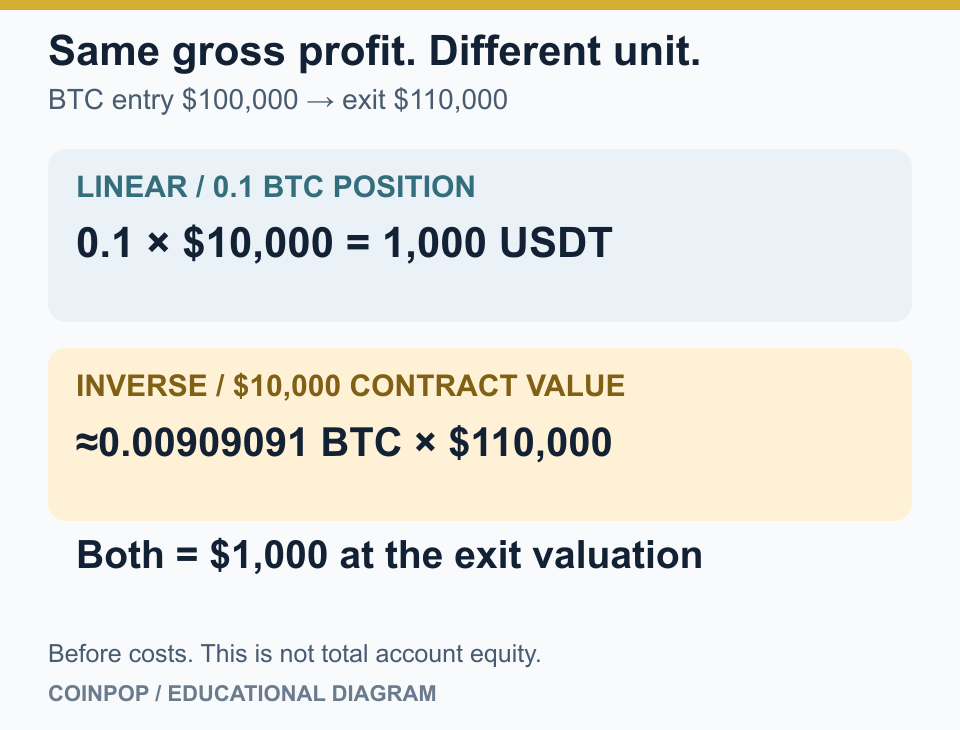
There is an independent algebra check. If N = Q × P₀, then:
Inverse P&L in BTC × P₁ = N × (P₁/P₀ − 1) = Q × (P₁ − P₀).
The matched endpoint dollar profits are equal before costs under these assumptions. This identity does not make the contracts interchangeable, remove basis or funding differences, or prove that their margin risk is identical. Prices must be positive; the inverse formula is undefined at zero.
Why the final asset value is still different
The COIN-M account starts with 0.02 BTC, not $2,000 of stablecoin collateral. That original BTC alone is worth $1,800 after a 10% decline and $2,200 after a 10% rise.
At the lower endpoint, add the −$1,000 contract P&L to the $1,800 remaining collateral value: final equity is $800. At the higher endpoint, add +$1,000 to $2,200: final equity is $3,200. The USDⓈ-M model keeps its collateral at an assumed $2,000 before adding contract P&L.
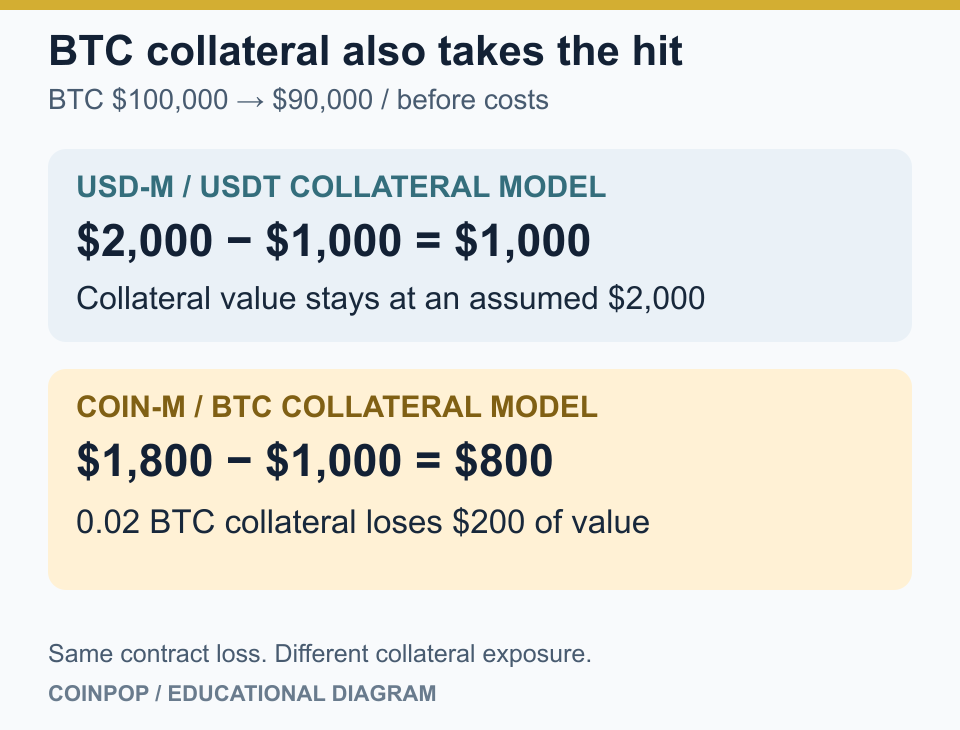
Writing the same calculation in units makes the distinction explicit:
- USDⓈ-M modeled equity: 2,000 USDT + linear P&L.
- COIN-M modeled equity in BTC: 0.02 BTC + inverse P&L in BTC.
- COIN-M modeled equity in USD: the resulting BTC balance × P₁.
Let r = P₁/P₀ − 1. In this long example, USDⓈ-M equity is 2,000 + 10,000r, while COIN-M equity is 2,000 + 12,000r. Their difference is 2,000r: exactly the gain or loss on the original BTC collateral.
This is a valuation decomposition, not the platform’s available-to-withdraw figure. Margin requirements, open orders and other account settings can affect what you can use or withdraw. For a wider reconciliation of trading results and balance changes, see CoinPop’s futures P&L reconciliation guide.
Add trading fees without mixing units or valuation times
A fair cost comparison needs each executed leg, its actual maker/taker rate and the asset used to pay the fee. Do not assume that a limit order necessarily earns a maker rate, or that the same rate applies to two products or accounts.
For an isolated arithmetic example, assume 0.05% on entry and 0.05% on exit for both models, with no discounts. This is a hypothetical input, not a quote for your account. Binance’s fee calculation guide provides the position-value formulas and directs users to the applicable fee schedule.
- USDⓈ-M fee per leg: Q × execution price × fee rate, in USDT.
- COIN-M fee per leg: N ÷ execution price × fee rate, in BTC.
For the $90,000 exit, USDⓈ-M fees are 5 + 4.50 = 9.50 USDT. COIN-M fees are 0.00005 BTC at entry plus approximately 0.00005556 BTC at exit. The full unrounded BTC fee amount is worth $9.50 at the exit price.
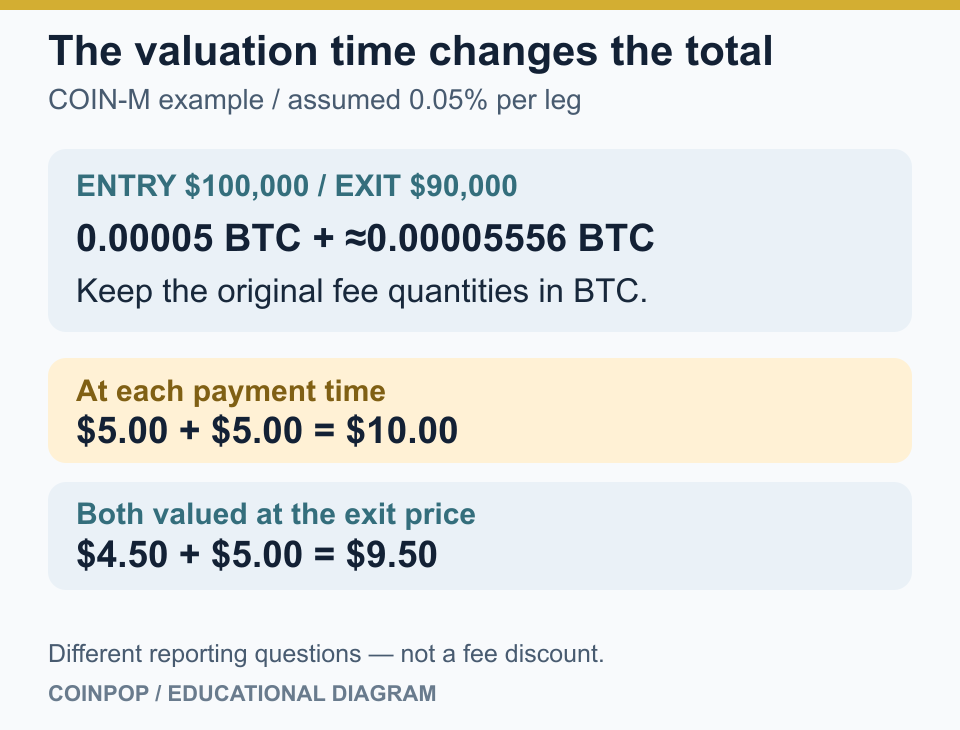
| BTC exit price | Total commission, exit-time USD equivalent | USDⓈ-M equity after commissions | COIN-M equity after commissions, USD equivalent |
|---|---|---|---|
| $90,000 | $9.50 in either model | $990.50 | $790.50 |
| $100,000 | $10.00 in either model | $1,990.00 | $1,990.00 |
| $110,000 | $10.50 in either model | $2,989.50 | $3,189.50 |
“After commissions” is not net return after every cost. Funding, slippage, collateral acquisition/conversion, taxes and liquidation costs remain excluded. Both starting collateral budgets are measured before the modeled entry fee.
The equal commission equivalents are a result of the matched quantities, identical assumed rates and exit-time valuation—not a general claim that COIN-M and USDⓈ-M cost the same. In the declining-price case, the two COIN-M commissions are each worth $5 at their own payment times, but their combined BTC amount is worth $9.50 at exit. A ledger that converts fees when charged will answer a different question.
Perpetual funding needs a separate record of the actual rate, position value and settlement event. Do not deduct a full funding payment merely because a position was open for part of an interval, or assume a positive rate means you received money. See the funding-fee calculation guide for the separate payment mechanism.
Five checks before using the comparison for an account
- Confirm product access and identity. Check the relevant Binance entity, regional eligibility, exact symbol, perpetual or delivery type, settlement asset and current contract specification. An accessible educational page is not proof that the product is available to you. Do not bypass restrictions.
- Read quantity in its proper unit. A BTC amount and a count of inverse contracts are not interchangeable. Multiply contract count by the documented contract size before comparing entry notional.
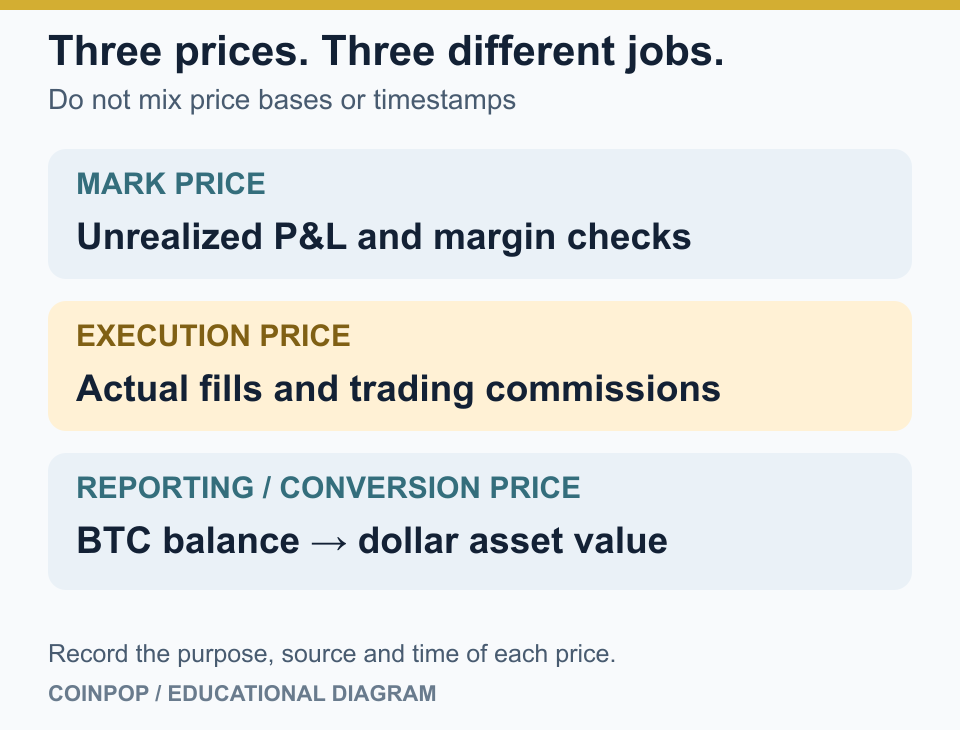
- Separate price bases. Mark Price, execution price and the BTC/USD reporting price may differ. Do not combine an unrealized Mark Price P&L with a different conversion time without noting the difference.
- Check account mode and margin requirements. Isolated, cross, Multi-Assets and Portfolio Margin are not one calculation. The tables above do not estimate liquidation prices or prove that an account could hold the position throughout the price path.
- Reconcile fees and transfers. Use actual execution records, commission assets, funding entries and deposits/withdrawals. Compare total asset value separately from the trading P&L line.
For broader account setup and eligibility context, use the Binance comprehensive guide. This article does not repeat its registration instructions or promise referral benefits.
Frequently asked questions
Is COIN-M automatically more profitable when Bitcoin rises?
No. In the modeled long comparison, its larger final dollar value includes appreciation of BTC collateral. That is additional BTC exposure, not free profit from a superior contract. The same collateral movement worsens the result when BTC falls.
Does USDⓈ-M always use only USDT as collateral?
No. The calculation uses a USDT-collateralized, single-asset example. Other settlement assets and eligible collateral arrangements exist, and Multi-Assets or Portfolio Margin requires its own rules and valuation inputs.
Does the 5:1 starting ratio tell me the liquidation price?
No. Liquidation depends on the product’s maintenance-margin rules, account mode, Mark Price, fees and other balances or positions. Neither a 20% loss threshold nor a guaranteed maximum loss follows from this simplified ratio.
Can I compare a profit in BTC directly with a profit in USDT?
Only after choosing a common reporting currency and valuation time. Keep the original asset quantities alongside the converted values so you can see whether a change came from the contract, the collateral or the conversion price.
Sources and calculation scope
Official sources were checked on November 5, 2026. The formulas and product definitions come from Binance; the matched scenarios, decomposition and arithmetic checks are CoinPop’s analysis. No live order, deposit or withdrawal was placed for this article.
- How to Calculate Profit and Loss for Futures Contracts — linear and inverse P&L formulas.
- USDⓈ-Margined and COIN-Margined Futures — settlement and contract units.
- Futures Fee Structure and Calculations — fee assets, execution value and account-rate caveats.
- Multi-Assets Mode — why collateral rules cannot be generalized from the single-asset model.
- Public COIN-M exchange information — BTCUSD_PERP contract metadata at the check time. Current metadata may change.
Binance’s educational FAQs state that applicable legal terms, exchange/clearing rules and contract specifications take precedence. Recheck the specification and your account’s current fee rate before relying on an example. This is educational scenario analysis, not investment advice or a recommendation to open a futures position; leveraged trading can cause substantial losses.