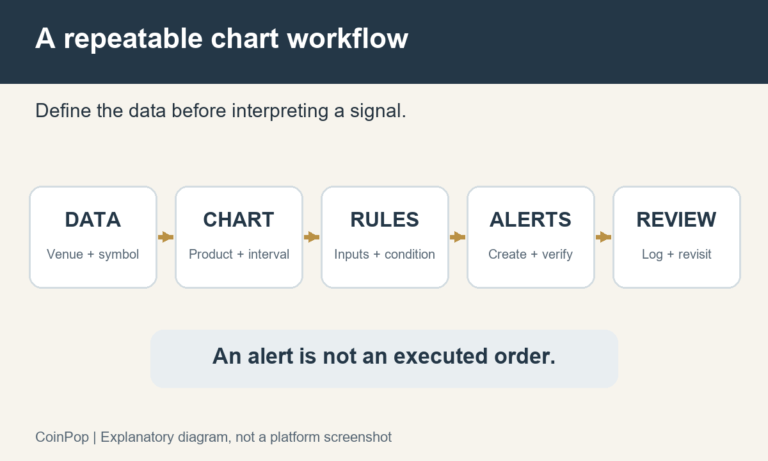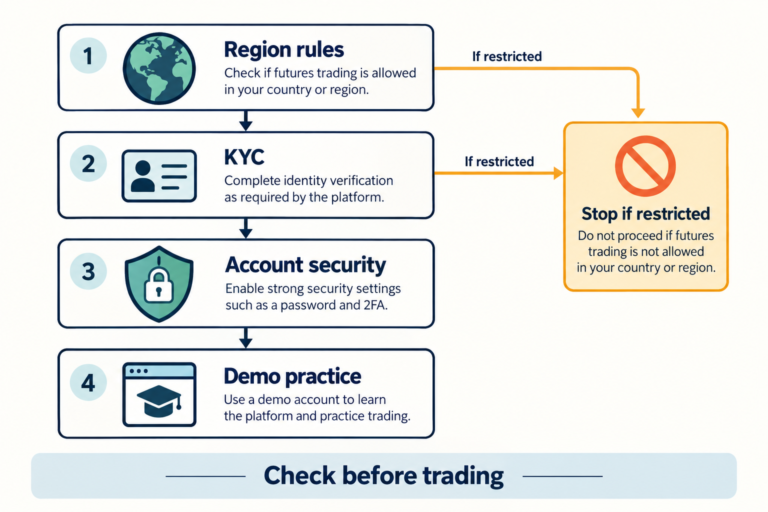

When comparing Bybit and Bitget for copy trading, look at the selected product, profit-sharing terms, order-copying method, and stop conditions before focusing on the exchange names. Bybit Classic and Pro have different operating structures, and Bitget Spot and Futures also differ in costs and risks. Compare them under the same conditions, then check eligibility to sign up and use each product separately.
This article contains affiliate signup links for CoinPop. If you sign up through a link, CoinPop may receive compensation from the exchange, but this does not guarantee the user’s trading performance or profits. The benefits and fees displayed on the signup page and in your account take precedence.
Check the account requirements on the official sign-up page. Completing registration and being eligible to use copy trading are separate matters.
Check the current terms on the linked sign-up page. Discounts and bonuses should be distinguished from profit-sharing costs.
Key takeaway: Neither Bybit nor Bitget is unconditionally better for every user. After rechecking the official standard fee documents on October 24, 2026, the basic spot fees for standard-tier users are 0.1% for both Maker and Taker on both exchanges. The basic futures Taker fee is slightly lower on Bybit at 0.055%, compared with 0.06% on Bitget; Maker fees are 0.02% on both. Bitget, however, notes that paying spot fees in BGB may qualify for a 0.08% rate, and it offers a broader range of copy trading products.
The basic futures Taker rate and paying spot fees in BGB are factors to consider, but they are not enough on their own to determine where to sign up. First check the exchanges’ incident histories, custody structures, and withdrawal handling, as well as your eligibility to use them and their products in your region. Then compare the order and copy trading features you actually need, along with total trading costs. Actual fees and product availability can vary by country, KYC status, VIP tier, account type, and campaign, so use the signup page and your account’s fee page as the final reference.
Bybit vs. Bitget at a glance
| Comparison item | Bybit | Bitget |
|---|---|---|
| Basic spot fees | Basic Maker 0.1% / Taker 0.1% | Basic Maker 0.1% / Taker 0.1% |
| Basic futures fees | Basic Maker 0.02% / Taker 0.055% | Basic Maker 0.02% / Taker 0.06% |
| Spot fee discounts | Varies by VIP tier, trading volume, assets, and applicable programs | 0.08% may apply when paying in BGB, according to official guidance; rates vary by VIP tier |
| Copy trading | Copy Trading Classic and Pro; check supported assets and product terms | Offers a comparatively wide range of copy trading options, including spot, futures, bots, and CFDs |
| Options | Options trading fees are listed separately in the official fee schedule | Check product availability and regional requirements separately in your account |
| KYC | Standard, Advanced, and Pro tiers; additional requirements may apply by region | Identity verification is required to use core services |
| Proof of reserves | Publishes Merkle Tree-based verification materials and audit scope | Publishes monthly reserve materials and Merkle Tree verification features |
| Recommended for | Users who prioritize placing futures and options orders directly and managing derivatives in detail | Users who prioritize BGB discounts and a broad range of copy trading options |
1. How much difference do the actual fees make?
Assuming a trading amount of 10,000 USDT and that all orders are filled, a simple calculation based on basic fees alone gives the following results. This example excludes slippage, funding fees, withdrawal fees, VIP discounts, and referral benefits.
- Spot Taker: Bybit 10 USDT, Bitget 10 USDT
- If paying Bitget spot fees in BGB at 0.08%: 8 USDT
- Futures Taker: Bybit 5.5 USDT, Bitget 6 USDT
- Futures Maker: Bybit 2 USDT, Bitget 2 USDT
The difference in futures Taker costs is 0.5 USDT per 10,000 USDT. It may seem small for a single trade, but it adds up if you repeatedly enter and exit positions. However, a limit order is not always filled as a Maker order, and slippage on market orders may exceed the fee difference. Rather than choosing an exchange based on a single fee rate, consider execution quality, order features, funding fees, and the actual discount rate on your account.
For detailed calculations, see the Bybit fee guide and the Bitget fee guide.
2. If you mainly trade futures and derivatives
Both exchanges offer perpetual futures and leveraged trading, but your choice should depend on your actual order habits rather than “maximum leverage.” If you place a high proportion of market orders, Bybit’s slightly lower basic Taker fee may offer a cost advantage. If you are also considering options trading, the fact that Bybit’s official fee documents list a separate options fee structure is another factor to compare.
By contrast, if you mainly place Maker limit orders, the difference in basic fees for standard-tier users is small between the two exchanges. In that case, it is more important to check supported markets, the order interface, conditional orders, API stability, funding fees, and liquidity for the trading pairs you actually use. Leverage amplifies losses and liquidation risk as well as gains, so a high leverage limit should not be considered an advantage in itself.
If you have confirmed your eligibility and want to know what to check on the actual order screen, refer to Bybit futures order, stop-loss, and closing procedures. This comparison article covers criteria for choosing an exchange, while that guide covers placing orders and checking position status.
3. If you mainly use copy trading
Compare copy trading only after checking the supported products and what is available for your account. Bitget Support distinguishes between spot, futures, bot, and CFD copy trading, as well as features related to gold and indices. Bybit also offers Copy Trading Classic and Pro, but Classic has product-specific conditions, such as USDT support, according to its official FAQ. Check what is supported before getting started.
Copy trading does not guarantee your principal or profits, even if you choose an experienced trader. Do not look only at past ROI, win rate, or number of followers; also check maximum drawdown, position holding periods, leverage, profit sharing, slippage, and liquidation history. Bitget’s official guide also notes that orders may not be copied if the follower account has insufficient balance or slippage limits prevent execution.
3-1. Classic, Pro, Spot, and Futures are not the same product
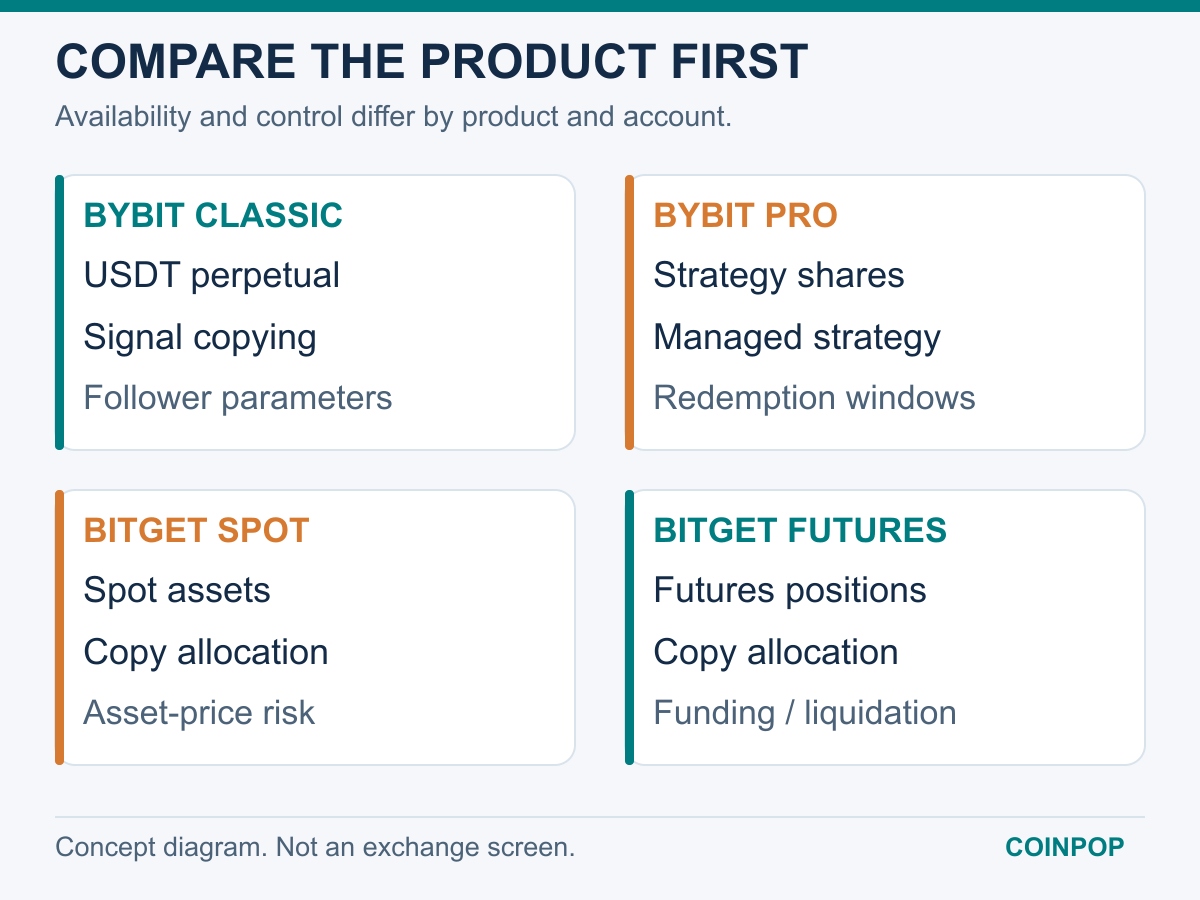
To compare the two exchanges fairly, first compare Spot with Spot and Futures with Futures. If you think of Bybit Pro as an advanced settings screen for Classic, you may misunderstand fund controls and redemption terms. The table below outlines structural differences verified in official help materials; it does not combine bots, CFDs, and TradFi products into a single table.
| Comparison item | Copying and operating structure | Differences to check before choosing |
|---|---|---|
| Bybit Classic | According to official guidance, USDT perpetual order signals are copied to the follower's account. | Copy mode, balance, and contract terms affect execution results. Check the profile and the settings you can actually edit. |
| Bybit Pro | A separate operating structure that uses strategy shares and NAV. | Do not treat it as a product where you directly adjust individual positions as in Classic. Check when investment and redemption are possible and the scope of fund control. |
| Bitget Spot Copy Trading | Distinguish supported spot trading from allocation accounts for each trader. | Consider price declines, locked-up funds, and profit-sharing terms for spot trading. Do not apply Futures funding and liquidation explanations as-is. |
| Bitget Futures Copy Trading | Futures orders are copied, with settings for fixed ratio and fixed margin distinguished. | Check leverage, funding, liquidation, position handling when stopping, and the separate account balance. |
Sources: Bybit Classic FAQ, Bybit Pro FAQ, Bitget Spot Copy Trading Guide, Bitget Futures Copy Trading Guide.
3-2. What is the difference between ratio copying and fixed amount or margin?
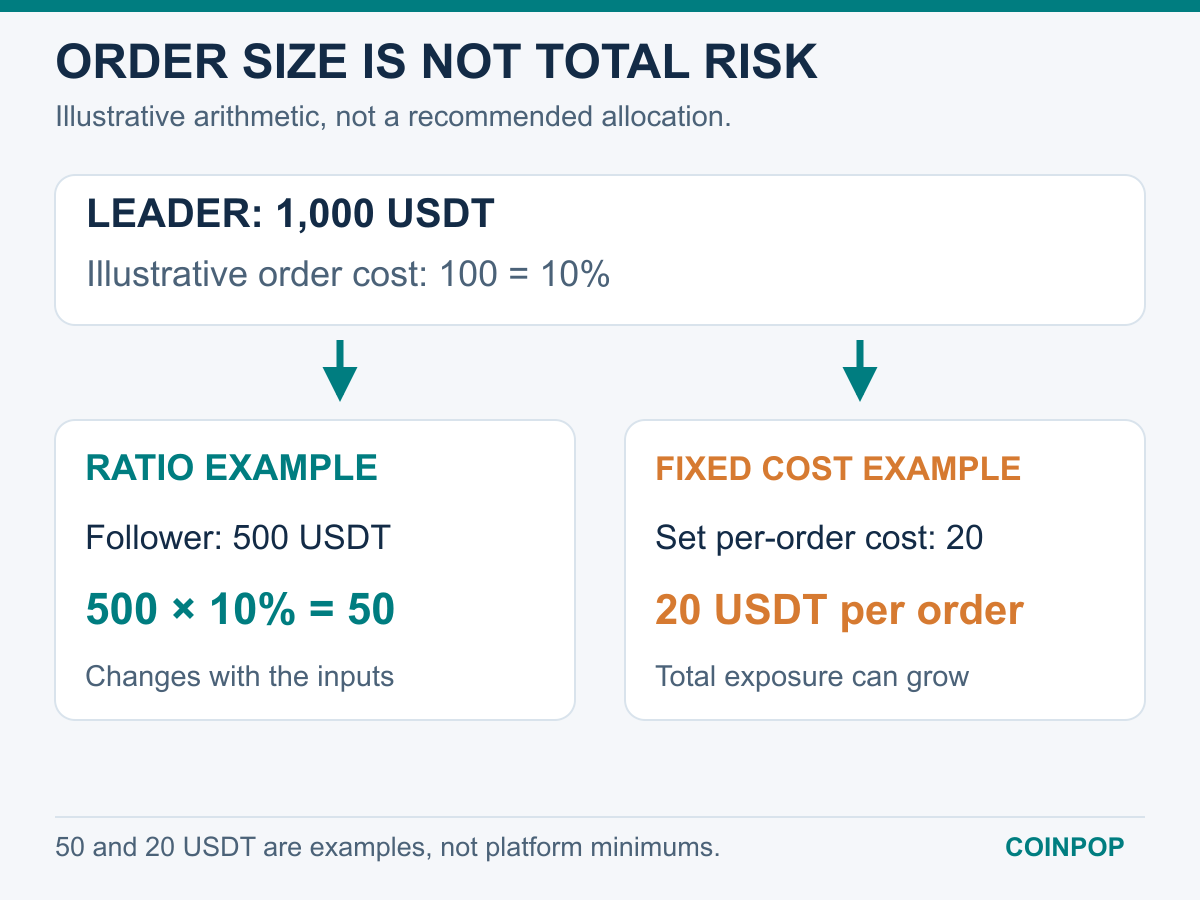
The ratio method calculates order size based on the relative funds of the trader and follower, while the fixed method sets an amount or margin for each copied order. Even when the names are the same, the balance and order costs used in the calculation, as well as the settings that can be edited, differ by product. Do not interpret a spot purchase amount and futures margin as the same thing.
Illustrative assumptions: If the trader's calculation base is 1,000 USDT and the order cost is 100 USDT, the ratio is 10%. Applying the same simple ratio to a follower's 500 USDT gives 50 USDT, while an example with the cost fixed at 20 USDT per order is 20 USDT. Neither 50 nor 20 is a platform minimum or recommended investment amount. Actual orders vary with available balance changes, minimum order requirements, fees, and leverage terms.
The fixed method does not fix total losses either. As orders accumulate, used margin and exposure may increase, and the ratio method cannot reproduce the same entry price, exit price, or return. Even when funds are split among several traders, risk may overlap if they use strategies involving the same coin and direction.
3-3. Profit sharing and total costs: Do not look only at differences in base fees
The difference in standard Futures taker rates was compared in Chapter 1, but the final cost of copy trading is broader. Check entry and exit fees in actual executions, funding paid or received, trader profit sharing, and settlement adjustments separately. Do not apply standard account fee comparisons directly to other products such as Pro.
| Item to check | What to look at on Bybit | What to look at on Bitget |
|---|---|---|
| Trading and funding costs | Compare the derivatives rate information in the Classic FAQ with your account's actual trading and funding history. | Separate Spot and Futures, and check the actual trading rates and Futures funding history. |
| Profit-sharing rate | For Classic, check the trader's tier and profile terms. Do not confuse them with Pro's operating and allocation terms. | Distinguish Spot and Futures, public and private portfolios, and the current allocation terms in the profile. |
| Estimated deductions and final settlement | Distinguish advance deductions, final settlement, and refunds in the official guidance. An estimated deduction does not necessarily equal the final cost. | The Spot and Futures guides explain High Water Mark settlement. Also check settlement terms for cases where positions or held assets remain. |
| Return comparison | Instead of the trader's screen ROI, review deposits and withdrawals, realized/unrealized P&L, and costs in your own account over the same period. | Check which costs are already included in the net profit shown on screen, then compare without deducting them twice. |
Bybit's profit-sharing explanation distinguishes advance deductions from final offsetting and refunds. Bitget provides separate settlement terms for Spot and Futures. Check which P&L is subject to profit sharing, unsettled amounts, and open positions; do not assume that the full amount can be transferred immediately just because a profit has been made.
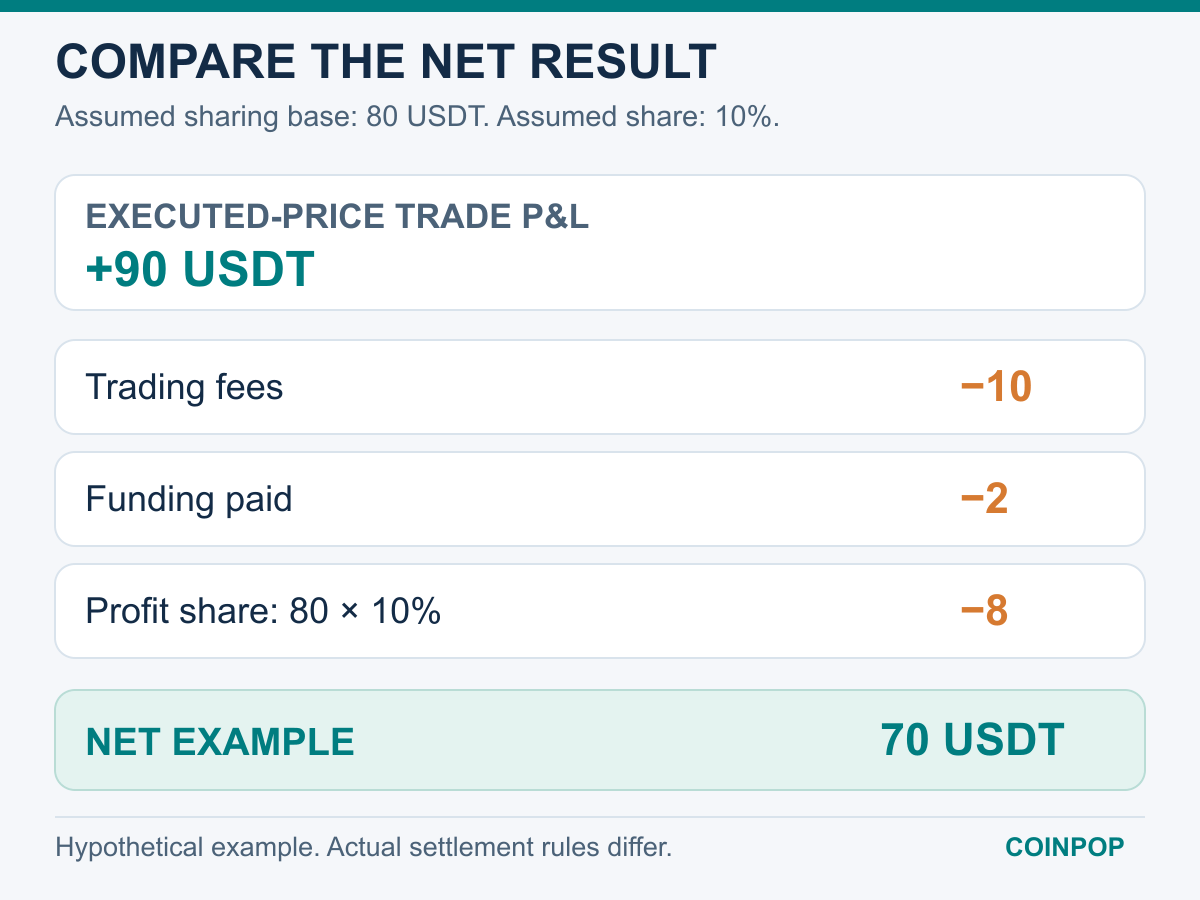
Total cost calculation example: Assume trading P&L calculated using actual execution prices is +90 USDT, entry and exit fees are 10 USDT, and net funding paid is 2 USDT. In this example only, the amount subject to profit sharing is 90−10=80 USDT; assuming a 10% profit-sharing rate, the share is 8 USDT, and final net P&L is 90−10−2−8=70 USDT. This is an arithmetic example for separating cost items, not actual operating performance or a settlement formula common to both exchanges.
If net funding was received, count it as income. If trading and funding costs are already included in the exchange's Closed P&L or net profit, do not deduct them again. Because slippage is reflected in P&L based on execution prices, do not deduct it again as a separate estimate. Reconcile deposits, withdrawals, and conversion costs separately based on amounts actually incurred, after comparing trading performance.
3-4. Criteria for choosing a trader to check before ROI
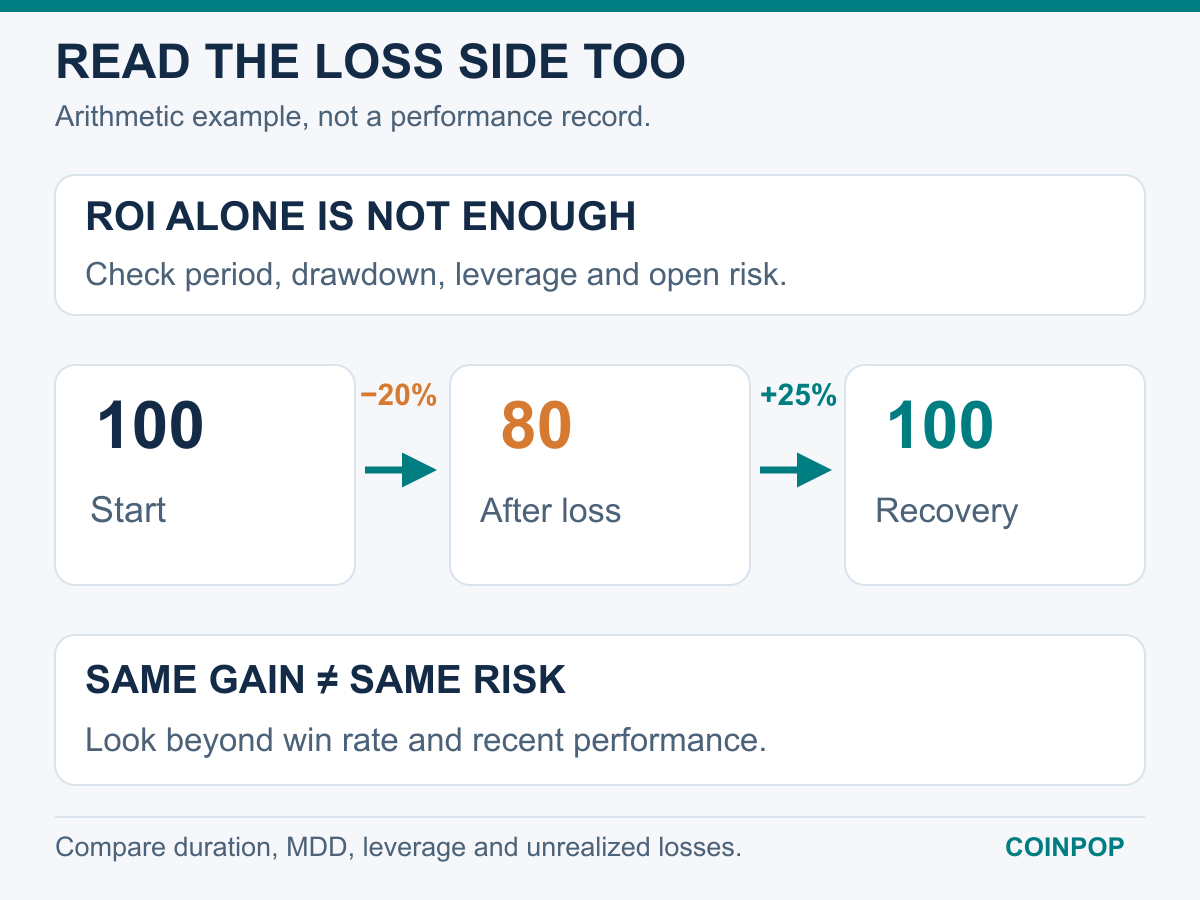
When comparing the top recent-return accounts on the two exchanges, align the observation period and product. Do not rank high returns over a short period alongside performance over a longer period. If the public track record is short or unrealized losses and trading records are difficult to verify, it is better to defer judgment. A high win rate can also mask risk in strategies that hold losing positions for a long time.
- Observation period and drawdown: Check whether the periods match and what period and asset basis the maximum drawdown (MDD) uses.
- Current open risk: Check unrealized losses, position holding period, average and maximum leverage, and concentration in a single asset.
- Follower results: Check the difference between trader ROI and followers' actual P&L, as well as failed copies and trading frequency.
- Ability to stop: First review the positions that would remain if you stopped now, along with settlement and redemption restrictions.
Drawdown asymmetry matters too. If value falls from 100 to 80, the loss is 20%, but it must increase by 25% to recover from 80 to 100. This is the arithmetic required to recover the principal, not a price forecast. A displayed low MDD does not guarantee a limit on future losses.
3-5. When Bybit or Bitget copy trading does not work
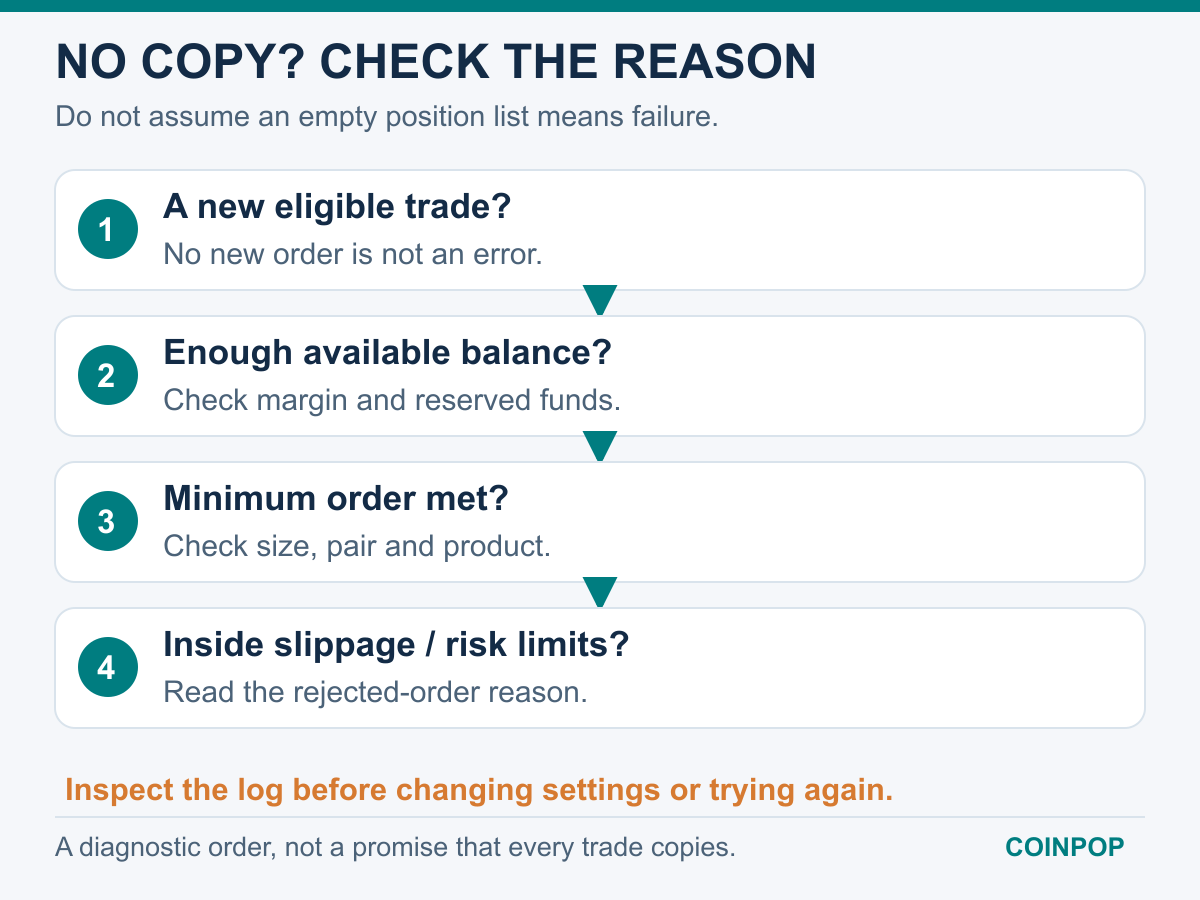
First, distinguish the follow relationship, the trader’s new orders, and actual fills in your account. Bybit Classic FAQ explains that it copies orders placed after you start, so the mere fact that existing positions do not appear immediately does not mean there is an error. If an actual copy was rejected, check the order history for causes such as insufficient funds, minimum order requirements, slippage, or setting limits.
| Troubleshooting order | Records to check | Responses to avoid |
|---|---|---|
| Whether there are new orders | Check whether there were new orders to copy after you joined or followed the trader. | Do not restart repeatedly just because no positions are showing. |
| Balance and order requirements | Check your available balance, margin in use, minimum order requirements, and eligible trading pairs. | Do not add funds beyond what you can afford to lose just to match a number. |
| Slippage and risk settings | Review the rejection reason, currently applied limits, and the scope of synchronization and editing. | Do not indiscriminately disable price protection or loss limits just to get a fill. |
| Product and usage restrictions | Check the exact product name and your account and residency eligibility. | Do not apply settings from another product or circumvent restrictions. |
3-6. Stopping copying, closing positions, and withdrawing funds are separate steps
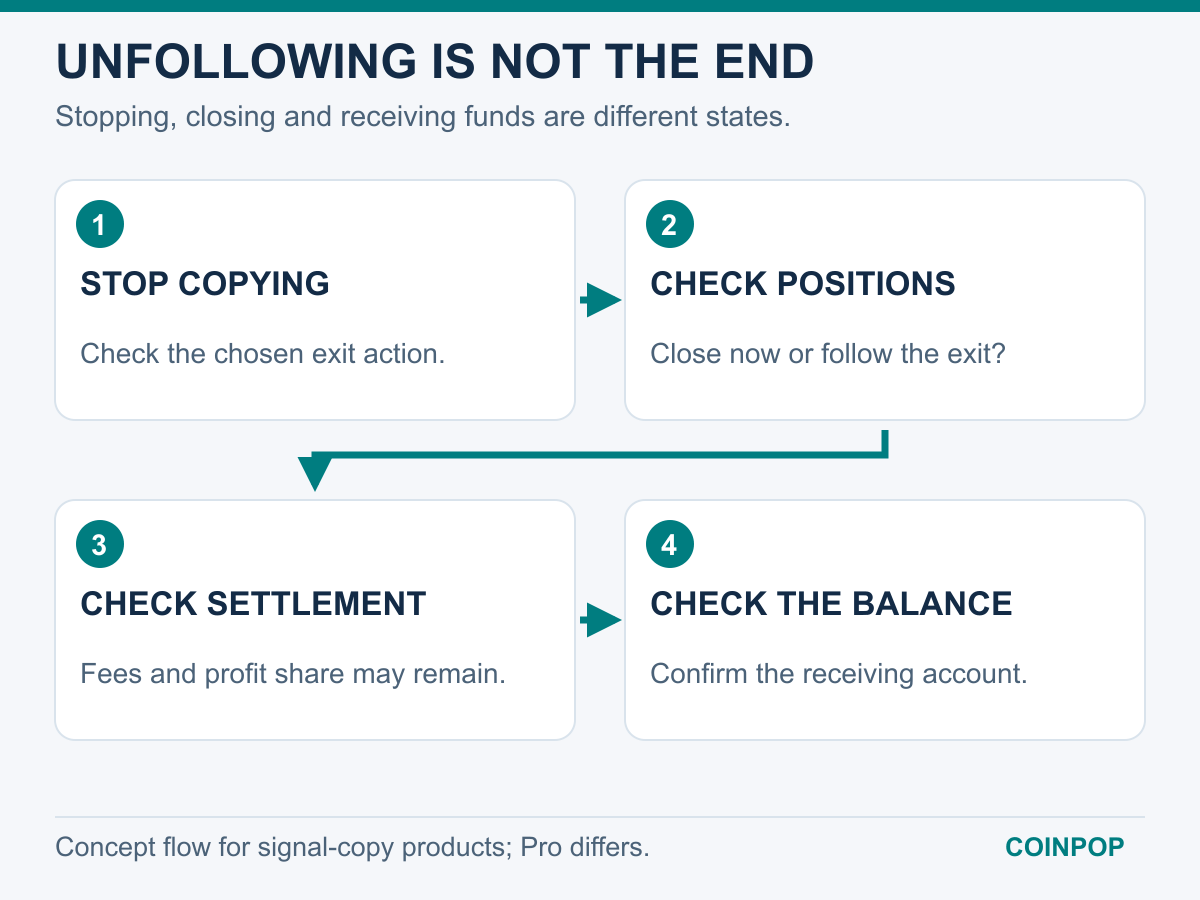
In signal-copying products, selecting Stop copying or unfollowing does not mean that all positions will immediately close at the same price. On the stopping screen, check whether positions will be closed immediately at market or whether the trader’s closures will be followed, and identify any remaining orders or positions. In volatile markets, the stop-loss or closing price may differ from the actual fill price.
The Bitget Futures guide describes the options to close positions immediately at market when stopping or to follow the trader’s closing strategy. For Spot, separately check assets that have not yet been sold and the settlement terms. Bybit Classic also requires you to confirm that open positions and the copy relationship have been cleared, then verify the actual balance in the receiving account. Pro has separate redemption and management-period rules, so do not apply this closing flow to it as-is.
Finally, check the copy status, open positions and unfilled orders, profit-sharing and fee settlement, and the balance in the receiving account, such as Funding or Spot, separately. If the actual amount differs from the estimated return shown on screen, compare the trade and settlement records. No guarantee is made that the full amount will be returned at a specific time.
This article compares the selection criteria for the two exchanges. If you need instructions for Bybit Classic’s initial setup, confirming that it works properly, and stopping, continue to How to copy trade on Bybit: Initial setup, loss limits, and stopping. Refer to it when checking the expected results at each setup stage.
4. KYC and account requirements
Bybit divides individual KYC into Standard, Advanced, and Pro tiers. Depending on your account and region, additional proof of address or enhanced due diligence may be required. Its official FAQ states that one person cannot complete KYC simultaneously on multiple accounts.
Bitget states that identity verification has been required since January 1, 2024, to use core services such as cryptocurrency deposits and trading. On both exchanges, the services actually available to you may depend on your country of residence, submitted documents, account status, and local regulations. Avoid using another person’s identity, a false address, or a VPN to circumvent restrictions, as this could result in account restrictions and withdrawal problems.
5. How should you assess proof of reserves?
Both Bybit and Bitget operate Merkle Tree-based proof-of-reserves pages and provide a process for users to check whether their assets are included in the audit data. Bitget says it publishes monthly data on platform and user assets, while Bybit also provides information on regular reserve audits and public code for verification.
However, a displayed reserve ratio of 100% or higher does not fully guarantee all of an exchange’s liabilities, operational risks, hacking risks, or solvency. Proof of reserves is important transparency information, but it is not the same as deposit insurance. It is advisable to keep only the amount needed for trading on the exchange and consider separate custody arrangements, including a personal wallet, for long-term holdings.
Security incident histories should also be reviewed separately from reserves. Bybit’s official incident timeline describes the ETH cold wallet incident on February 21, 2025. Bitget’s official follow-up announcement reported unauthorized transfers from some hot and warm wallets and suspended withdrawals on September 24, 2026, and announced the completion of a phased resumption on October 2. This summarizes each company’s announcements separately and does not guarantee withdrawals for all accounts, assets, or networks, or future security.
You cannot rank one exchange as safer than another based solely on the type of wallet involved in an incident. Check the time of the announcement and actual service status, the scope of the investigation, the handling of customer balances, and remedial measures together. Proof of reserves and protection funds do not mean deposit insurance or automatic compensation for all losses. For details on the Bitget incident and the limits of what can be verified, see Bitget security incident and withdrawal resumption guide.
6. Which users might each exchange suit better?
When Bybit may be a better fit
- You place a high proportion of market orders for futures and want to reduce basic Taker costs, even slightly
- You want to compare derivatives fee structures, including options
- You trade primarily by placing orders directly and managing positions in detail
- You are already familiar with Bybit’s interface and API environment
When Bitget may be a better fit
- You want to use a discount structure that lets you pay spot fees in BGB
- You want to compare a range of copy trading options in addition to spot and futures
- You plan to manage a separate copy trading account and set risk limits
- You already use BGB and features in the Bitget ecosystem
You do not have to choose only one exchange. However, managing multiple accounts at the same time makes KYC, security settings, deposit and withdrawal networks, and fund management more complicated. First check regional and account eligibility and custody risks, then decide which features you will use. Testing the network with a small transfer does not eliminate losses caused by using the wrong network, address, or tag.
7. Checklist to review before signing up
- Check whether you can sign up and use the relevant products in your country of residence.
- Take a screenshot of the referral code and benefits displayed on the signup page.
- After completing KYC, check the actual fee page in your account.
- Remember that fees differ across spot, futures, and copy trading.
- Set up 2FA, an anti-phishing code, a withdrawal address book, and passkeys.
- Start by testing the network with a small deposit and withdrawal.
- Do not mistake bonuses, trading fee discounts, and post-trade rebates for the same benefit.
For issues with referral codes and existing accounts, see the Bybit Referral and Account Security Guide and the Bitget Referral Code Guide.
To check contact verification, KYC, and security for a new Bybit account, see the Bybit PC and Mobile Signup Process. If you already have an account, account recovery and checking its current linked status should take priority over signing up again.
Frequently Asked Questions
Which has lower fees, Bybit or Bitget?
For standard-tier users, spot Maker and Taker fees are around 0.1% on both exchanges. Based on the official base fee schedules, futures Taker fees are 0.055% on Bybit and 0.06% on Bitget, making Bybit slightly lower; Maker fees are 0.02% on both. Bitget lists a spot fee of 0.08% when paying fees with BGB. Actual account fees vary by region and tier.
Which is better for copy trading?
In terms of product range, Bitget offers a variety of options, including spot, futures, bots, and CFDs. Bybit also offers Classic and Pro, so it may suit users who trade directly as well. Neither platform guarantees profits, and you should check a trader’s maximum drawdown and leverage first. For criteria that also include Binance and OKX, see the Copy Trading Comparison Guide for Four Exchanges.
Can I use both exchanges at the same time?
You can, provided you meet each exchange’s terms and the requirements for your region, but managing security and funds becomes more complicated. Avoid duplicate accounts and accounts in another person’s name, and complete KYC and 2FA separately on each exchange.
Will my copy-trading returns be the same as the trader’s?
There is no guarantee they will be the same. The start time, fill price, order size, leverage, failed copies, and trading and profit-sharing costs may differ. Compare the actual activity in your account over the same period, rather than the trader’s ROI.
Can I withdraw my money immediately after stopping copy trading?
Stopping copying, closing open positions, product-specific settlement, and returning the balance are separate statuses. Check for any remaining positions, assets, or unsettled profit sharing. For products with separate redemption terms, such as Pro, read the applicable rules.
Official Reference Materials
- Bybit Trading Fee Structure
- Bitget Fee Breakdown
- Bybit Individual KYC FAQ
- Bitget Individual Verification FAQ
- Bybit Copy Trading FAQ
- Bitget Spot Copy Trading Guide
- Bybit Proof of Reserves
- Bitget Proof of Reserves
Update and verification scope: On October 28, 2026 (Korea time), the product distinctions, copying methods, profit sharing, failures, and termination guidance for copy trading were cross-checked against official help pages and updated. The general-tier base fees, regional restrictions, and security incident timeline remain based on information checked on October 24, 2026. Signup benefits and conditions that vary by login account, as well as actual fund management and fills on physical devices using the app, were not verified. The explanatory images are original CoinPop diagrams, not official exchange screens or proof of returns. Author: Hyun Lee. Policies and terms may change, so the current official screens and account information take precedence.