
After buying cryptocurrency on an exchange, one of the most important questions is simple.
“Is it safe to leave this coin on the exchange?”
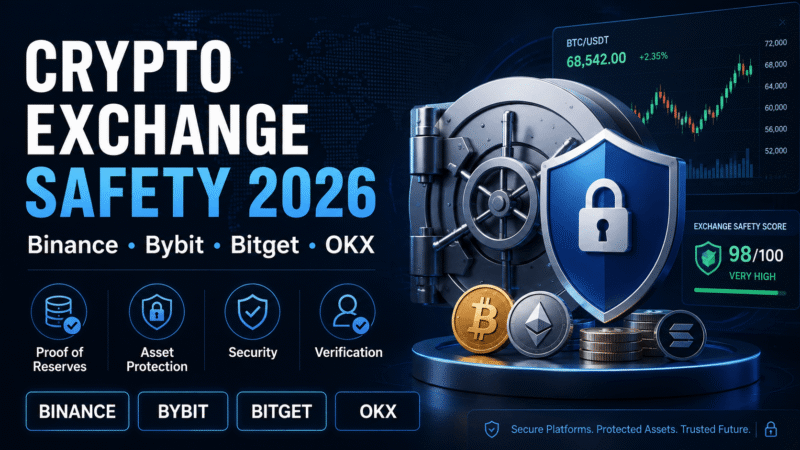
Major cryptocurrency exchanges such as Binance, Bybit, Bitget, and OKX are centralized exchanges (CEXs) that hold customer assets and process trades and withdrawals.
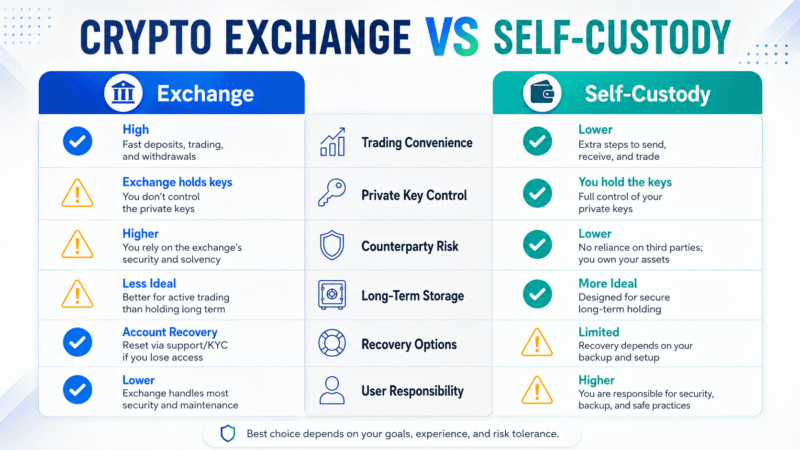
This is convenient for users. They do not need to manage the seed phrase for a personal wallet, can quickly switch between spot and futures trading, and can sell immediately when needed.
However, storing coins on an exchange also means entrusting the exchange with direct control over your assets.
Therefore, when assessing an exchange’s safety, simply checking whether it has ever been hacked is not enough.
In 2026, you should consider at least the following factors together.
- Does it actually hold at least 1:1 in customer assets?
- Does it publish Proof of Reserves?
- Can users independently verify whether their assets are included?
- Are there external audits or cryptographic verification methods?
- Does it have a separate protection fund in addition to customer assets?
- Can it respond effectively to a major hack or a withdrawal crisis?
- What is the exchange’s own credit risk when assets are held there for an extended period?
Based on official materials reviewed on 2026-10-26, this article compares the asset custody structures of Binance, Bybit, Bitget, and OKX. Because the reserve data does not reflect simultaneous due diligence conducted on the same date, it distinguishes the assets covered, snapshot dates, and verification methods in each report, and does not convert the ratios into a single safety ranking.
Updated · Official sources checked: 2026-10-26 KST · CoinPop Editorial Team
Proof of Reserves and protection fund amounts change over time. The figures in this article are based on the relevant date or the latest materials published by each exchange. Before storing significant assets, it is advisable to check the exchange’s live Proof of Reserves page again.
1. The Bottom Line: Is It Safe to Store Coins on an Exchange?
The most accurate answer is “The transparency and safeguards of major exchanges have improved significantly compared with the past, but storing assets on an exchange is not the same as keeping them in a personal wallet.”
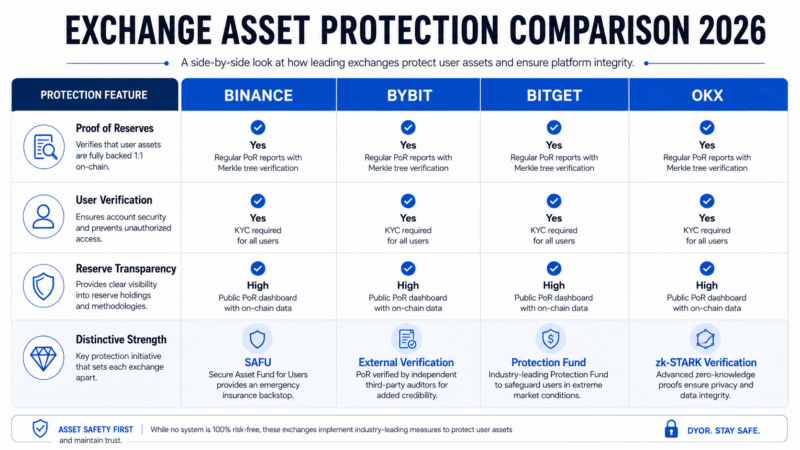
Binance states that it holds customer assets on a 1:1 basis and operates a reserve verification system using Merkle Trees and zk-SNARKs. Binance also operates a separate emergency fund, SAFU, and states that as of February 2026, its SAFU wallet held 15,000 BTC.
In its 40th official PoR announcement, Bybit reported 50 covered assets in the 2026-09-23 snapshot and independent verification by Hacken. The key ratios reported by the company are USDT 110%, USDC 223%, BTC 104%, and ETH 103%. These are published figures for that date and scope; they do not guarantee the company’s current total liabilities or immediate withdrawals.
Bitget’s 47th official PoR reports 19 covered assets in the 2026-09-29 snapshot and a total reserve ratio of 131%. The 122% figure from July is historical. Differences between ratios from different dates and scopes should not be interpreted as differences in safety scores.
OKX’s official PoR page shows its 48th report for October 2026 and approximately $29.4 billion in major assets. The key ratios reviewed are BTC 110%, ETH 100%, USDT 105%, and USDC 101%; assets outside the report’s coverage and snapshot scope, as well as subsequent transactions, are not included.
In other words, all four exchanges currently operate Proof of Reserves systems for customer assets.
However, an important distinction must be made here.
Proof of Reserves verifies that “the exchange holds the relevant assets”; it is not a guarantee that the exchange will never go bankrupt in the future.
2. What Is Proof of Reserves?
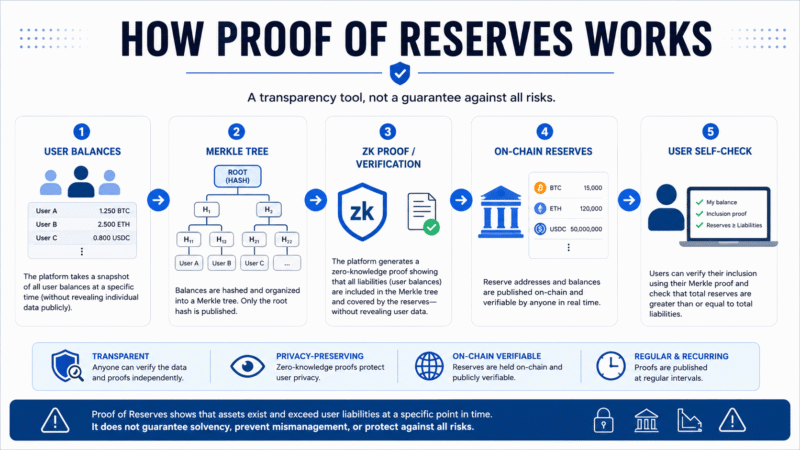
Proof of Reserves, or PoR (Proof of Reserves), is a verification method that shows whether a cryptocurrency exchange actually holds the cryptocurrency it owes to its customers.
For example, if the exchange’s records show that all its customers hold 100,000 BTC, the wallets actually controlled by the exchange should contain at least the corresponding amount of BTC.
The basic reserve ratio can be understood as follows.
Reserve ratio = Assets held by the exchange ÷ Assets owed to customers × 100
A ratio of 100% means the exchange holds reserves equal in value to customer assets.
A ratio of 105% means there are approximately 105 units of assets for every 100 units of assets held by customers.
Conversely, a ratio below 100% may signal that the exchange does not have sufficient reserves to return all customer assets simultaneously, measured in the same asset.
OKX also explains in its latest PoR materials that a reserve ratio below 100% may be considered a warning sign.
3. But Wouldn’t It Be Meaningless If an Exchange Just Made Up the Numbers?
That is why cryptographic technologies such as Merkle Trees and zero-knowledge proofs are used.
For example, simply claiming to hold a certain amount of assets is not enough to verify reserves.
“We hold 100,000 BTC.”
A simple claim about holdings must be distinguished from actual verification that account balances are included.
It is an entirely different matter to provide a system that lets users verify whether their account balances were actually included in the calculation of total customer liabilities.
A key technology is the Merkle Tree.
It puts information from numerous customer accounts into a single cryptographic data structure, allowing each customer to verify whether their account is included in the overall data.
Alongside Merkle Trees, Binance uses zk-SNARKs. According to Binance, the zk-SNARK system is used to verify whether each user’s balance is included in the calculation of total customer assets and whether total customer liabilities have been artificially reduced by using negative net balances.
For a similar purpose, OKX uses a zk-STARK-based verification method, and users can also retrieve their Proof of Reserves report and verify it themselves using an open-source Validator.
Bitget also provides a Merkle Tree-based structure and the open-source MerkleValidator.
Bybit also provides a verification feature that lets users check for themselves whether their account assets are included in the PoR.
4. Does Proof of Reserves Mean an Exchange Can Never Go Bankrupt?
No.
This is the most important point in this article.
Proof of Reserves and full solvency are not the same thing.
PoR is very useful for checking how much cryptocurrency an exchange holds against the customer assets covered in its disclosures at a particular point in time.
However, it does not reveal all of an exchange’s risks.
For example, the following issues must be considered separately.
- The exchange company’s own liabilities
- Obligations to external creditors
- Litigation and regulatory risks
- Transactions between affiliated companies
- Working capital issues
- Losses resulting from hacks
- Withdrawal system failures
- Third-party custodian risks
- Assets not included in the disclosed coverage
- Asset movements after the Proof of Reserves snapshot
Therefore, you should not interpret a PoR of 120% as meaning that an exchange is automatically 15% safer than one with a PoR of 105%.
This is because a single reserve ratio cannot assess the overall financial health of an exchange.
5. Binance Reserves and SAFU Structure
Binance’s Proof of Reserves page states that customer account balances are backed 1:1, with additional reserves also held. Binance also says that its own capital structure carries no debt, but this should be recognized as the company’s own statement.
A distinctive feature of Binance PoR is its Merkle Tree + zk-SNARK combination.
Users can check their Merkle Leaf and Record ID on Binance to verify whether their account was actually included in a particular PoR snapshot.
Another Binance safeguard: SAFU
Binance has SAFU (Secure Asset Fund for Users).
SAFU is an emergency user protection fund established in 2018.
According to Binance’s official website, as of February 2026, the SAFU wallet holds 15,000 BTC.
It is important to distinguish between SAFU and PoR.
Proof of Reserves
→ Verifies whether the exchange holds the assets entrusted to it by customers
SAFU
→ Protective assets set aside separately to respond to extreme emergencies such as hacks
Structurally, these are two different safeguards.
Binance Assessment
| Item | Assessment |
|---|---|
| Disclosure of 1:1 reserves | Publicly available features and conditions need to be verified |
| Cryptographic verification | Publicly available features and conditions need to be verified |
| Direct user verification | Publicly available features and conditions need to be verified |
| Separate protection fund | Publicly available features and conditions need to be verified |
| Information disclosure structure | Publicly available features and conditions need to be verified |
| Comprehensive protection structure | Publicly available features and conditions need to be verified |
※ The table summarizes the existence of publicly available features and the conditions to verify; it is not a quantified safety rating or credit assessment.
6. What is the status of Bybit’s reserves?
The latest comparison data for Bybit is its 40th official announcement, reflecting a snapshot dated 2026-09-23. The original figures from the 38th announcement in July are not presented as current.
The 40th report covers 50 tokens based on major managed assets. Check the official report for your account again to confirm the assets covered and whether they are included.
As of the 2026-09-23 03:00 UTC snapshot, the main reserve ratios announced by the company are as follows.
| Asset | Reserve ratio on September 23 |
|---|---|
| USDT | 110% |
| USDC | 223% |
| BTC | 104% |
| ETH | 103% |
The major assets in the 40th official announcement were valued at approximately $19.6 billion. Changes in valuation are not treated as simple increases in deposits or safety, since cryptocurrency prices and reporting scope vary.
7. Bybit’s 2025 hack is an incident that must be considered
When assessing Bybit’s security, the large-scale 2025 hack cannot be overlooked.
The FBI’s official announcement dated 2025-02-26 stated that approximately $1.5 billion in virtual assets was stolen from Bybit around February 21 and attributed responsibility to North Korea. This government attribution for the incident should not automatically be applied to incidents at other exchanges. Reserves and continued operations afterward must also be assessed separately from the fact that the incident occurred.
Two aspects must be considered simultaneously when assessing this incident.
Negative aspect
It demonstrated that even a large centralized exchange can suffer actual large-scale asset losses from an attack involving its wallets or signing infrastructure.
Positive aspect
Despite the massive loss, the exchange continued operating and processing customer withdrawals, and has continued publishing PoR since then. This provides a real-world example for assessing its crisis response capabilities. The major assets in the September 23 40th report were reported at over 100%.
In other words, the conclusion to draw from the Bybit case is:
What matters is not “large exchanges don’t get hacked,” but “when a hack occurs, does the exchange have the financial and operational capacity to meet customer liabilities and maintain normal operations?”.
Bybit Assessment
| Item | Assessment |
|---|---|
| Reserves of at least 1:1 | Publicly available features and conditions need to be verified |
| External verification | Publicly available features and conditions need to be verified |
| Direct user verification | Publicly available features and conditions need to be verified |
| Experience responding to major incidents | Publicly available features and conditions need to be verified |
| Security incident history | Publicly available features and conditions need to be verified |
| Current transparency structure | Publicly available features and conditions need to be verified |
Given its history of security incidents, it would be inappropriate to conceal them and simply describe it as a “safe exchange.”
Conversely, dismissing its current reserve status based on a single past incident would not be an objective assessment either.
8. Bitget reserves: 131% in the September 29 snapshot
Bitget launched its Proof of Reserves program in December 2022.
The 47th official report, reflecting a snapshot dated 2026-09-29 09:00 UTC, gives a total reserve ratio of 131% and covers 19 assets.
In other words, based on the combined total of the assets Bitget disclosed, it holds more in reserves than the value of customer assets.
Bitget updates its PoR monthly and provides the open-source MerkleValidator so users can check whether their accounts are included in the Merkle Tree.
However, as explained earlier:
The overall ratio of 131% alone does not mean that Bitget is a few percentage points safer than other exchanges.
This is because asset composition, liabilities, operational structure, and external verification methods all differ.
9. Bitget’s distinguishing feature: a separate Protection Fund
One notable feature of Bitget, in addition to Proof of Reserves, is that it operates a separate Protection Fund.
Bitget launched the Protection Fund in 2022 and has disclosed a policy to maintain a value of at least $300 million.
The fund’s June high, low, and average figures predate the incident, so they are not used as its current balance. The incident update dated October 20 states that the fund was replenished to more than $300 million on September 30. This is a company announcement about a specific point in time; the fund’s value and applicable conditions afterward should be verified.
| Metric | Official date verified | Limitations |
|---|---|---|
| Fund replenishment | 2026-09-30; announced replenishment to more than $300 million | Not a real-time current balance or a guarantee of compensation for all losses |
When comparing fund sizes, the valuation date and asset prices should also be considered.
Like Binance’s SAFU, this structure serves as an additional buffer set aside separately from ordinary customer reserves to respond to emergencies.
However, the Protection Fund should not be equated with government deposit insurance.
It is not a system that legally guarantees all user losses up to a predetermined amount automatically whenever an incident occurs.
Bitget Assessment
| Item | Assessment |
|---|---|
| Reserve ratio | Publicly available features and conditions need to be verified |
| Regular PoR disclosures | Publicly available features and conditions need to be verified |
| User self-verification | Publicly available features and conditions need to be verified |
| Separate Protection Fund | Public features and conditions require verification |
| Continuity of disclosure | Public features and conditions require verification |
| Comprehensive public protection framework | Public features and conditions require verification |
Bitget’s advantage is that it clearly discloses two layers of protection: PoR + Protection Fund.
9-1. Assess the Bitget September incident separately from its reserves
According to Bitget’s official explanation updated on October 20, unauthorized transfers occurred from some hot and warm wallets on 2026-09-24, with final confirmed losses of approximately $388 million. The company announced that the phased restoration of withdrawals was completed on October 2. The cause of the incident, recovery, compensation, and current withdrawal status must each be verified separately. The September 29 PoR does not mean that no incident occurred.
The replenishment of the Protection Fund is a company announcement about an additional buffer; it does not mean that all customer losses will automatically be compensated. It should also be distinguished from a fund that absorbs shortfalls from derivatives liquidations.
10. OKX’s 48th reserve disclosure in October 2026
OKX is also an exchange with a strong track record of ongoing PoR disclosures.
The OKX data used in this comparison is the 48th report, dated October 2026, shown on its official page.
The reserve ratios for the four major assets on OKX’s 48th report page, as checked on 2026-10-26, are as follows.
| Asset | Shown on OKX’s 48th report page |
|---|---|
| BTC | 110% |
| ETH | 100% |
| USDT | 105% |
| USDC | 101% |
The official page shows approximately $29.4 billion in major assets in the 48th report. This differs in timing from the approximately $23.1 billion in the previous, 45th report.
OKX published its first PoR report in November 2022 and has continued publishing reports monthly since then.
11. OKX’s zk-STARK self-verification feature
One of OKX’s advantages is that users can participate in the verification process in considerable detail.
OKX verifies customer balances and reserves using the zk-STARK + Merkle Tree method.
Users can:
- Visit the OKX Proof of Reserves page
- View their own report
- Download PoR verification data
- Use the open-source zk-STARK Validator
- Check whether their balance was included in the calculation of total customer assets
to verify the data.
Going beyond “trusting the exchange because it says it is safe,” the fact that users can participate in verifying the actual data is an important element of a PoR system.
12. OKX’s Security Fund is not customer-asset insurance
An important misconception needs to be corrected here.
OKX also has a Security Fund.
OKX’s official explanation of its Security Fund states that the fund is not an insurance product, a custodial asset protection fund, or a guarantee against user losses. Managing shortfalls from derivatives liquidations at the exchange and safeguarding customer assets are separate issues.
Its main purpose is to absorb shortfalls that occur when positions liquidated in leveraged trading are settled at prices worse than their bankruptcy prices, and to reduce the likelihood of Auto-Deleveraging.
Therefore:
Bitget Protection Fund
Although the two funds have similar names, they differ in purpose and scope.
OKX derivatives Security Fund
Bitget’s Protection Fund and OKX’s derivatives Security Fund should not be compared as if they were the same type of customer-asset insurance.
This distinction is quite important when comparing exchange safety.
OKX assessment
| Item | Assessment |
|---|---|
| Reserves of at least 1:1 | Public features and conditions require verification |
| Continuity of PoR disclosures | Public features and conditions require verification |
| zk-STARK verification | Public features and conditions require verification |
| User self-verification | Public features and conditions require verification |
| Separate customer compensation fund | Public features and conditions require verification |
| Reserve transparency | Public features and conditions require verification |
13. A side-by-side comparison of the reserves and protection frameworks of four exchanges
Below is a comparison of publicly disclosed protection frameworks that distinguishes the reporting dates of the different reports. It is not a table based on an audit of all wallets and company liabilities at the same point in time.
| Item | Binance | Bybit | Bitget | OKX |
|---|---|---|---|---|
| Data used | Official PoR explanation | 40th report · 2026-09-23 | 47th report · 2026-09-29 | 48th report · displayed in 2026-10 |
| Reporting scope | 1:1 account balance explanation | 50 covered assets | 19 covered assets | Assets covered in the report on the page |
| Key verification | Merkle · zk-SNARK | Hacken verification announcement | 131% overall · Merkle verification | Approximately $29.4 billion in major assets · zk-STARK |
| Separate risk | SAFU ≠ deposit insurance | 2025 wallet incident | September 2026 incident · fund replenishment | Derivatives Security Fund ≠ custodial asset insurance |
Binance explains its 1:1 holdings and separate SAFU structure. Bybit’s 40th snapshot dated September 23, Bitget’s 47th snapshot dated September 29, and OKX’s 48th disclosure from October must be read as separate reports. These data cannot guarantee future withdrawals or the company’s overall solvency.
14. So, which exchange is the safest?
It is difficult to declare any one exchange the safest in absolute terms.
Based on publicly available information, each exchange has different strengths.
Assessing Binance’s custodial risk
Its multi-layered framework of PoR + zk-SNARK + SAFU is an advantage. Binance publicly reports holding 15,000 BTC in SAFU as of February 2026.
Assessing Bybit’s custodial risk
Evaluation points include the independent verification by Hacken of its recent PoR, as well as operational continuity and the asset recovery process following an actual large-scale hack. However, the major security incident that occurred in 2025 must also be considered a risk factor.
Assessing Bitget’s custodial risk
The 131% reserve disclosure on September 29 and the separate protection fund should be considered alongside the September incident and recovery history.
Assessing OKX’s custodial risk
It offers a 48th PoR report and zk-STARK verification, but its derivatives Security Fund is not customer deposit insurance.
15. Are exchanges with higher reserve ratios necessarily safer?
No.
For example:
- Exchange A: BTC reserves of 101%
- Exchange B: BTC reserves of 130%
Even so, this alone does not justify concluding that Exchange B is safer.
That is because you also need to consider how its assets are held, the exchange’s total liabilities, its corporate structure and legal risks, and how securely its private keys are managed.
Therefore, it is reasonable to interpret reserve ratios as follows:
Below 100%
→ A signal that warrants serious scrutiny
100% or higher
→ A positive signal that reserves exist to cover customer assets
Far above 100%
→ It means there are additional surplus assets, but does not by itself guarantee overall safety
16. Exchange Hacks and Individual Account Hacks Are Different Risks
When storing assets on an exchange, you should distinguish between two types of risk.
When the exchange itself is attacked
The exchange’s:
- Hot Wallet
- Cold Wallet management system
- Multi-Signature structure
- External custodians
- Smart contracts
- Operational infrastructure
and other systems may be targeted.
Bybit’s 2025 incident is a prominent large-scale event involving exchange infrastructure.
When only a user’s account is compromised
Conversely, even if the exchange is operating normally, a user’s email and password could be exposed, or their account could be compromised after they log in to a phishing site.
In this case, even 150% Proof of Reserves cannot protect the user.
Therefore, users should protect their own accounts separately from the security of the exchange itself.
17. Security Features You Must Set Up When Using an Exchange
Whichever exchange you use, it is best to enable the following settings whenever possible.
1. Use 2FA Stronger Than SMS
If you can use an authenticator app or Passkey, it is a good idea to do so.
2. Withdrawal Address Whitelist
Restricting withdrawals to pre-registered addresses can reduce potential losses if your account is compromised.
3. Anti-Phishing Code
An anti-phishing code is an additional feature for filtering suspicious emails. Do not assume an email is genuine just because it contains the code; also check the official domain, sender information, and account notifications.
4. Use a Different Password for Each Exchange
It is important not to reuse passwords from other sites on cryptocurrency exchanges.
5. Minimize API Permissions
If you use automated trading, do not grant withdrawal permissions to an API that does not need them.
6. Protect Your Email Account Separately
If you set up 2FA only for your exchange account and your email account is compromised, your security is greatly weakened.
18. Where Should You Store Your Assets: On an Exchange or in a Personal Wallet?
They serve different purposes.
| Purpose | Exchange | Personal wallet |
|---|---|---|
| Frequent spot trading | ★★★★★ | ★★☆☆☆ |
| Futures trading | ★★★★★ | ★☆☆☆☆ |
| Immediate selling | ★★★★★ | ★★★☆☆ |
| Long-term storage | ★★★☆☆ | ★★★★★ |
| Ease of management | ★★★★★ | ★★★☆☆ |
| Direct control of private keys | ★☆☆☆☆ | ★★★★★ |
| Recovery if you forget your password | ★★★★★ | ★☆☆☆☆ |
| Eliminating exchange credit risk | ★☆☆☆☆ | ★★★★★ |
Using a personal wallet does not mean there is no risk.
If you lose your Seed Phrase, send funds over the wrong network, sign a malicious smart contract, or have your private key stolen, it may be difficult to recover your assets.
Therefore:
Storing assets on an exchange means trusting the exchange, while Self-Custody means trusting your own ability to manage your keys.
Neither option is risk-free.
19. Should Long-Term Investors Store Everything on an Exchange?
If you are storing substantial assets for the long term, concentrating all your assets on one exchange is not ideal from a risk-diversification perspective.
For example, you can divide your assets according to their intended use.
Assets for trading
→ Exchanges such as Binance / Bybit / Bitget / OKX
Long-term holdings
→ Personal wallet or hardware wallet
Short-term reserve funds
→ Split between an exchange and a personal wallet as needed
That is one way to do it.
The important thing is not to assume that any one exchange is “absolutely safe,” but to reduce single points of failure (Single Point of Failure).
20. Once You Choose an Exchange, Check Its Terms Before Signing Up
After comparing security and reserve structures and choosing an exchange that suits you, you can then compare fee discounts and new-user offers.
The order matters.
Security → Trading environment → Fees → Sign-up benefits
That is the order in which it is reasonable to assess them.
We do not recommend choosing the exchange with the biggest bonus first and checking its security later.
CoinPop provides partner sign-up links for Binance, Bybit, Bitget, and OKX.
Binance – Official CoinPop Partner
If Binance’s PoR, zk-SNARK verification method, and SAFU structure are important to you, you can check CoinPop’s partner terms before signing up.
Referral code: COINPOP
Sign up through CoinPop’s Binance partner link
Bybit – Official CoinPop Partner
Bybit may be an option for users who actively trade derivatives and also want to check its PoR and external verification structure.
Referral code: COINPOP
Sign up through CoinPop’s Bybit partner link
Bitget – Official CoinPop Partner
Bitget stands out for publicly disclosing both PoR and a separate Protection Fund.
Referral code: coinpop
Sign up through CoinPop’s Bitget partner link
OKX – Official CoinPop Partner
OKX has published consecutive PoR reports over an extended period, and its user self-verification feature using zk-STARK is a key strength.
Referral code: COINPOP
Sign up through CoinPop’s OKX partner link
Since eligible countries and applicable benefits may vary by region, account, and time, the most accurate information is the terms shown on the actual sign-up page.
21. A 10-Point Checklist for Checking Exchange Safety
If you are considering using a new cryptocurrency exchange, it is a good idea to at least answer the following questions.
| Checklist item | Importance |
|---|---|
| Does it publish Proof of Reserves? | ★★★★★ |
| Are reserves at least 100% of customer assets? | ★★★★★ |
| Can you verify that your account is included? | ★★★★★ |
| Are wallet addresses publicly available? | ★★★★☆ |
| Does it update its PoR regularly? | ★★★★★ |
| Is there external verification? | ★★★★☆ |
| Is there a separate user protection fund? | ★★★★☆ |
| How did it respond to past hacks? | ★★★★★ |
| Has it repeatedly restricted withdrawals? | ★★★★★ |
| Does it offer 2FA, Passkeys, and withdrawal address management? | ★★★★★ |
In particular, it is difficult to assess an exchange that publishes PoR once and does not update it for years on the same basis as one that continuously publishes data every month.
More important than a one-time published figure is how consistently transparency is maintained.
22. The defining features of the four exchanges in 2026, in one sentence
Summary of Binance's public disclosures
A large exchange with both a robust PoR verification system and a separate SAFU emergency fund.
Summary of Bybit's public disclosures
An exchange with a clear risk event—a major hack in 2025—that has since maintained reserves of at least 1:1 against customer assets and continued external verification.
Summary of Bitget's public disclosures
An exchange that announced its 47th PoR and replenishment of its protection fund after the September incident, but whose operations, withdrawals, and compensation terms should continue to be monitored.
Summary of OKX's public disclosures
An exchange that publishes its 48th PoR and zk-STARK verification, while also requiring users to consider the limitations of its reporting scope.
23. So, where should you store your coins among the four exchanges?
Based only on publicly available information, we do not recommend assigning an absolute safety ranking from first to fourth.
The reason is simple.
The data we can verify represents only part of an exchange's overall risk.
Instead, it is more practical to make a decision based on your priorities.
| Factors considered important | Exchange to check first |
|---|---|
| PoR + separate emergency fund | Binance |
| External verification + track record of real-world crisis response | Bybit |
| High publicly disclosed reserve ratio + Protection Fund | Bitget |
| Long-term PoR disclosures + self-verification feature | OKX |
| Minimizing third-party risk for long-term holdings | Combine with Self-Custody |
This table does not mean that “this exchange is the safest”; it summarizes the publicly disclosed protective measures that stand out for each exchange.
24. Frequently Asked Questions (FAQ)
The same criteria should be applied to exchanges with relatively little publicly available information. In OrangeX Reserves, Security, KYC, and Regional Restrictions: A Comprehensive Review, we distinguish what publicly disclosed Proof of Reserves shows from its limitations as a substitute for a full financial audit. By the same principle, the Comprehensive Guide to Bitunix Reserves, Security, and KYC distinguishes what Merkle Tree verification, the Care Fund, and the publicly disclosed reserve ratio can confirm from the risks they do not guarantee against.
Is it safe to store Bitcoin on Binance?
Binance maintains 1:1 reserves against customer assets, Proof of Reserves based on Merkle Trees and zk-SNARKs, and a separate SAFU fund.
However, no centralized exchange can be considered risk-free, so you may also want to consider Self-Custody and diversifying storage for large assets held long term.
Wasn't Bybit hacked? Is it still safe?
Bybit should be assessed in light of both its history of a major wallet security incident in 2025 and its 40th publicly disclosed reserve snapshot dated 2026-09-23. Recovery from a past incident or a reserve ratio does not eliminate future incident or withdrawal risks.
Therefore, it is appropriate to assess both its incident history and its current reserve status.
What is Bitget's reserve ratio?
Bitget's official 47th PoR, based on a 2026-09-29 snapshot, reports an aggregate ratio of 131% across 19 covered assets. This should be considered alongside the incident, fund, and reporting scope.
Bitget has also disclosed a policy of maintaining a Protection Fund of at least $300 million.
How much in reserves does OKX have?
OKX's official page shows that its 48th disclosure, published in October 2026, covers approximately $29.4 billion in major assets and reports BTC at 110%, ETH at 100%, USDT at 105%, and USDC at 101%. This is a snapshot within the reporting scope.
Is an exchange safe if its reserve ratio is over 100%?
It is a positive sign that customer assets are sufficiently backed.
However, PoR alone cannot assess all of a company's liabilities, legal risks, hacking risks, operational risks, and more.
Therefore, PoR of at least 100% is one important prerequisite, not a complete guarantee of safety.
Is it better to avoid exchanges that do not have Proof of Reserves?
If you plan to entrust an exchange with substantial assets for the long term, it is reasonable to treat the availability of PoR and asset verification methods as important criteria.
In particular, if there is no way to independently verify customer assets and exchange reserves, the information asymmetry borne by users increases.
If an exchange goes bankrupt, will Proof of Reserves alone ensure that I get my money back?
Not necessarily.
PoR is a technical transparency tool that shows whether assets exist.
In an actual bankruptcy, other issues may come into play, such as legal ownership, the exchange's operating entity, jurisdiction, and creditor priority.
Are SAFU and Protection Funds the same as deposit insurance?
No.
Exchange-operated funds such as Binance SAFU and Bitget Protection Fund are additional protective measures, but they should not be understood as equivalent to government-backed deposit insurance for ordinary bank deposits.
OKX specifically states that its derivatives Security Fund is not an insurance product or a fund that guarantees customer losses.
Is it safer to split assets across multiple exchanges?
Diversification can reduce single-platform risk, such as the exchange itself going bankrupt or suspending withdrawals for an extended period.
On the other hand, more accounts also mean more passwords, 2FA, and phishing risks to manage.
Therefore, rather than using as many exchanges as possible, a practical approach is to use a few reputable exchanges you actually need and combine them appropriately with Self-Custody.
25. Conclusion – Neither Distrust Exchanges Nor Trust Them Unconditionally
In 2026, major cryptocurrency exchanges disclose far more reserve data than they did before 2022.
Binance's PoR and SAFU, Bybit's 40th PoR, Bitget's 47th PoR, protection fund, and incident recovery, and OKX's 48th PoR each differ in scope and timing. The key is not to equate the existence of protective measures with the overall safety of a company.
But the most important conclusion here is:
Proof of Reserves is extremely important data for assessing an exchange's safety, but it does not guarantee the exchange's absolute safety or future solvency.
You should decide how to store your assets with this limitation in mind.
Being a large exchange does not reduce the possibility of a hack to zero, and having a Protection Fund does not mean that every loss will automatically be reimbursed.
Therefore, the most practical approach for users is as follows:
Keep assets used for trading on a large exchange whose reserves can be verified, consider using Self-Custody for long-term holdings as needed, and do not concentrate all your assets on a single platform.
And once you’ve chosen an exchange, compare the fees and partner benefits in the final step.
Here are CoinPop’s partner codes.
| Exchange | CoinPop code | Sign up through partner link |
|---|---|---|
| Binance | COINPOP | Sign up for Binance |
| Bybit | COINPOP | Sign up for Bybit |
| Bitget | coinpop | Sign up for Bitget |
| OKX | COINPOP | Sign up for OKX |
Eligibility to sign up and the benefits offered may vary depending on your country, account, and the exchange’s policies, so check the current terms on the sign-up page.
Affiliate and Risk Disclosure
This article is informational content comparing cryptocurrency exchanges’ Proof of Reserves and asset protection structures; it does not recommend any particular exchange or cryptocurrency investment.
This article contains CoinPop partner links. If you sign up or trade through these links, CoinPop may receive partner compensation from the exchanges. The partnership is separate from the reserve data and safety assessment criteria discussed in this article; figures and protection programs for each exchange are based on the latest official information published by the exchanges.
Using cryptocurrencies and centralized exchanges involves risks related not only to price volatility but also to hacking, custody, operations, regulation, and withdrawals. If you hold a significant amount, it is advisable to check the exchange’s latest Proof of Reserves and terms of service directly, and also consider diversifying your assets and whether to use self-custody.