
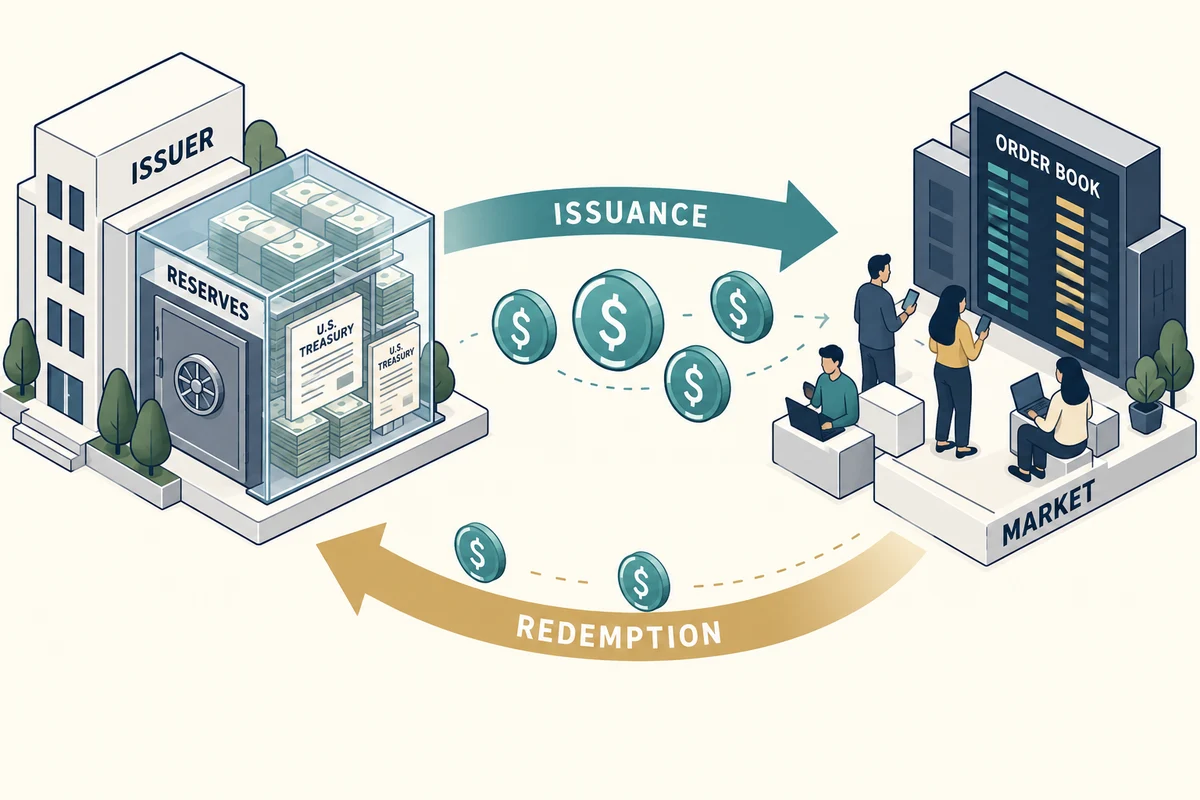
USDT and USDC are both stablecoins designed to be pegged to the value of the U.S. dollar, but they differ in issuer, reserve composition, redemption eligibility, and supported networks. What matters to users is not which name is more famous, but whether they can receive the exact asset on the exchange and in the wallet they plan to use, whether there is a route to sell or redeem it, and what the final amount received will be. A dollar peg does not guarantee a market price, principal, or immediate withdrawal.
Edited and verified by: CoinPop Editorial Team · Date official documents were last checked: October 12, 2026 (KST). This article explains the structure and how to verify information; it does not recommend buying or selling any particular asset or seeking returns. The cost examples below are assumptions for calculation, not actual exchange quotes.
1. How are USDT and USDC different?
A stablecoin is a digital asset designed to track the value of a specific reference asset. USDT (Tether’s USD₮) and USDC (issued by Circle entities) are both pegged to the U.S. dollar, but they are tokens issued by different entities. Seeing them in the same wallet app does not mean they represent the same liability, carry the same redemption rights, or are the same blockchain asset.
| Comparison category | USDT | USDC | Questions for readers |
|---|---|---|---|
| Issuer | Relevant issuance documents from Tether International, S.A. de C.V. | Circle-affiliated issuer. Terms differ for the EEA and other regions | Which entity and terms apply to my location and account? |
| Reserve information | The report for June 30, 2026, checked below, distinguishes short-term Treasury securities and repurchase agreements from gold, Bitcoin, collateralized loans, and other assets | The official transparency page describes a structure centered on cash, short-term U.S. Treasury securities, and overnight U.S. Treasury reverse repurchase agreements | Does it consist only of cash, or are there also price and credit risks from other assets? |
| Direct redemption | Tether’s requirements apply, including approved accounts, minimum amounts, and fees | Circle Mint eligibility and account requirements apply. A separate MiCA redemption process exists for EEA retail holders | Have I mistaken holding the token for being eligible to redeem directly? |
| Exchange use | Separately check quotes, liquidity, account fees, and deposit and withdrawal support for the relevant trading pair | What are the actual execution and receipt conditions for my order size? | |
| Transfer | The network, contract, and destination service support must match, not just the token name | Is this the exact asset that can be deposited directly at the destination? | |
Sources for the issuing entities and scope of applicability are Tether’s issuance information document dated February 20, 2026, Circle’s USDC terms, and EEA redemption policy. This table does not guarantee exchange availability or legal suitability in any particular region.
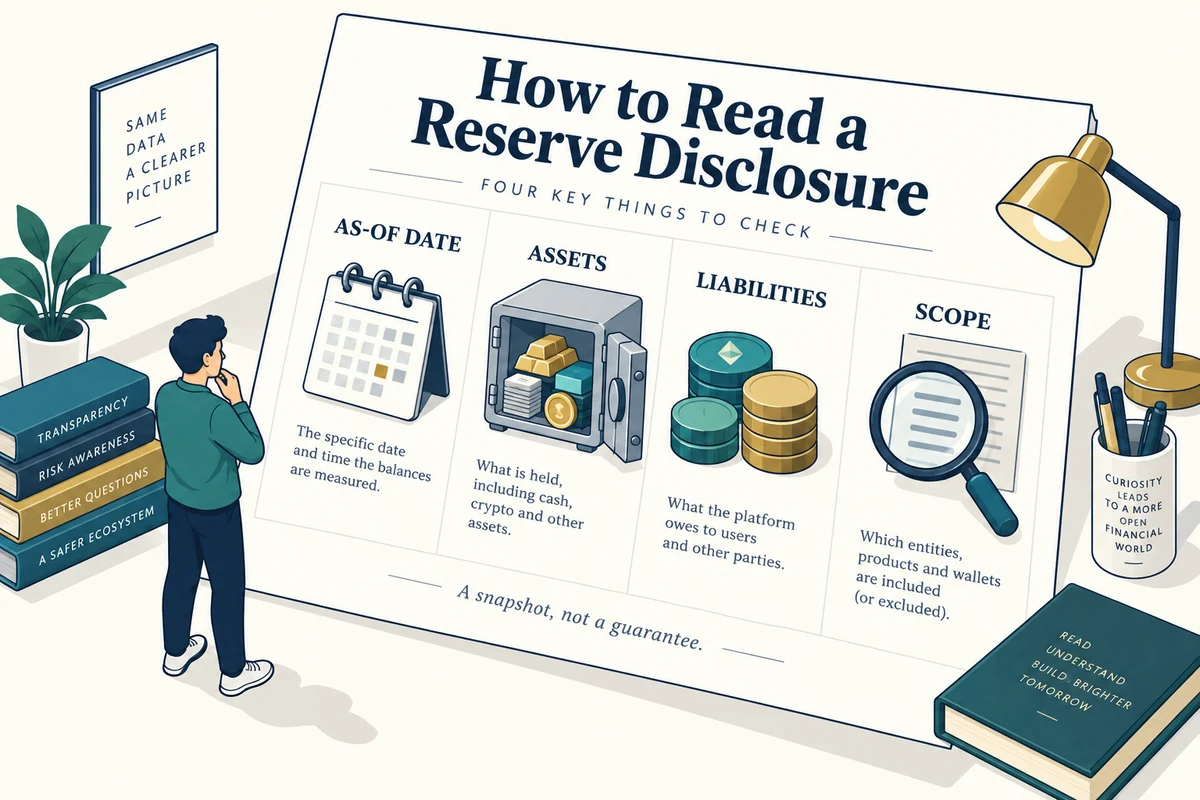
2. When reading reserve disclosures, start with the date, assets, and verification scope—not the balance
A report that reserves are sufficient is not a guarantee that they can be converted to cash immediately under all circumstances. The materials below are documents actually checked for this article, and balances from different reference dates are not placed side by side to rank safety. The report publication date must also be distinguished from the date on which the balance was measured.
| Material | What can be verified | What cannot be established from that material alone |
|---|---|---|
| Tether Financial Figures and Reserves Report | Balance as of June 30, 2026; approval and BDO opinion dated July 31. The report’s asset classifications and liabilities, and the scope of its ISAE 3000R reasonable assurance engagement | Balances on other dates, liquidity at all times, or the results of audits of the financial statements of all affiliates |
| Circle transparency page | Displayed date: October 8, 2026. Reserve structure and policies for weekly disclosures and monthly third-party verification | The latest balance figure, which was not collected from the page, or the solvency of a particular exchange |
The original Tether report and BDO opinion state that the report does not represent the company’s financial statements themselves and that the timing and scope of the verification are limited. The reserves reviewed distinguish cash and cash equivalents and short-term assets from gold, Bitcoin, listed equities, other investments, and collateralized loans. This describes the type of document; it does not make a claim about whether separate audits of the company as a whole exist.
Circle’s transparency page says reserves are segregated from operating funds and consist of cash and cash equivalents. The Circle Reserve Fund is a government money market fund managed by BlackRock and may hold short-term U.S. Treasury securities and overnight reverse repurchase agreements, among other assets. Monthly verification of reserves and an audit of the company’s financial statements have different scopes. This article does not estimate or fill in dynamic balance figures or asset proportions that were not collected.
- Reference date: Opening a page today does not mean that today’s balance has been verified.
- Assets: Cash, Treasury securities, loans, and assets subject to price fluctuations should not all be treated as cash.
- Liabilities and scope: Check which issuing entities and tokens are included, and which liabilities are compared with total assets.
- Opinion and limitations: Read the verification standards, excluded notes, and whether assurance is provided for other dates together.
3. Direct redemption with the issuer and exchange sales are different exit routes
Direct redemption is a process of returning tokens to the issuer under its terms and receiving fiat currency. An exchange sale is a transaction in which you sell tokens to another market participant and convert them into an account balance. Whether you can withdraw the proceeds from the exchange to a bank is a separate matter subject to additional regional, currency, and account conditions.
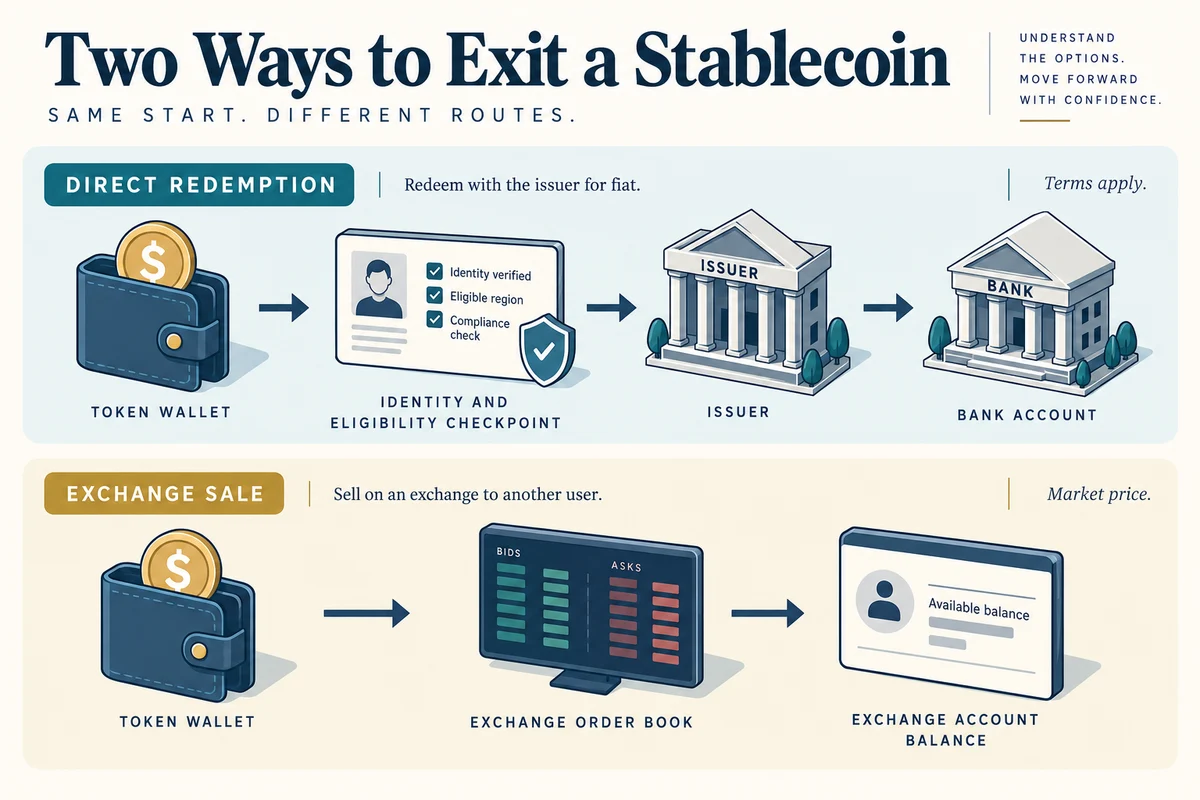
Tether’s minimum direct redemption amount and fees
Tether’s official fee schedule lists a minimum amount of 100,000 USD for direct acquisition and redemption, and a redemption fee of the greater of 1,000 USD or 0.1%. This is not the minimum trading or withdrawal amount on a regular exchange. Other requirements, such as account approval, residency restrictions, review, and bank fees, must also be met, so eligibility cannot be determined from the amount held alone.
| Assumed redemption amount | 0.1% calculation | Applicable fee | Percentage of amount |
|---|---|---|---|
| 100,000 USD | 100 USD | 1,000 USD | 1% |
| 1,000,000 USD | 1,000 USD | 1,000 USD | 0.1% |
| 2,000,000 USD | 2,000 USD | 2,000 USD | 0.1% |
The calculation above illustrates the published fee formula and does not guarantee approval of an actual redemption or the final amount deposited. It would be incorrect to interpret 1,000 USD as a maximum fee or to apply the same fee to exchange sales.
Distinguishing Circle Mint from the EEA retail redemption exception
Circle’s USDC information describes Mint as an institutional service and states that it is not offered to individuals or small businesses. Therefore, it would be inaccurate to say that an ordinary individual can receive dollars directly through a Mint account simply by holding USDC. However, Circle’s EEA redemption policy provides a redemption process for EEA retail holders, subject to separate registration, eligibility checks, KYC/KYT, and bank account requirements, so it would also be wrong to categorically say that “all individuals worldwide cannot redeem directly.”
Circle Mint redemption fee structure outlines terms by tier and daily and monthly net flows, effective March 15, 2026. Therefore, USDC redemption should not be described as unconditionally free. This article has not verified the actual tier or monthly activity of Mint customers, so it does not calculate the redemption costs for any particular individual. Nor does it assume that the EEA process and the terms applicable to users in Korea are the same.
4. Calculate USDT and USDC transfer costs using the same destination and outcome
Compare the asset and amount ultimately received, not just the token names. Sending an asset you already hold as is and exchanging it for another asset before sending involve different costs. If the price difference is already reflected in the actual execution price, do not add the spread again; likewise, do not double-count network costs included in the exchange withdrawal fee.
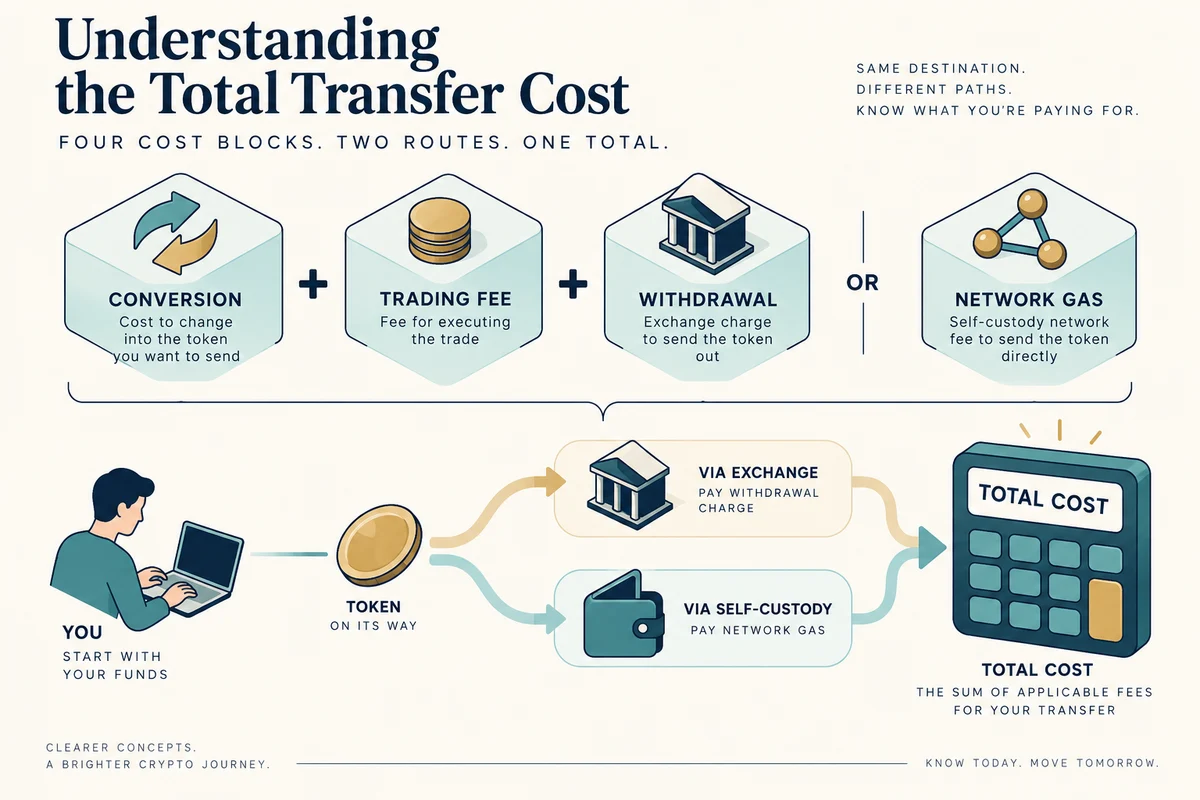
Assumptions for calculation: The starting balance is 1,000 USDT. Route A sends it as is, while Route B exchanges it for USDC before sending. For comparison, the destination valuation price of each token is fixed at 1 USD. These are not actual market prices or fees from any particular exchange; for a fair comparison in practice, the usable asset at the final destination and the need for an exchange must also be the same.
| Item | Route A: Send USDT as is | Route B: Exchange for USDC, then send |
|---|---|---|
| Starting amount | 1,000 USDT | 1,000 USDT |
| Assumed exchange execution price | No exchange | 0.999 USDC per 1 USDT → 999 USDC |
| Assumed trading fee | 0 | 0.1% deducted from the received asset → 0.999 USDC |
| Assumed withdrawal fee | 2 USDT | 1 USDC |
| Amount received at destination | 998 USDT | 997.001 USDC |
| Final value, assuming a valuation of 1 USD | 998 USD | 997.001 USD |
| Cost relative to starting value | 2 USD | 2.999 USD |
The amount received via Route B is 997.001 USDC, calculated by deducting the 0.999 USDC trading fee and 1 USDC withdrawal fee from 999 USDC. Although Route B has a lower withdrawal fee alone, its total cost under these assumptions is 0.999 USD higher than Route A’s. The result will also change if the execution price, fees, or valuation price changes. This does not mean USDT is always cheaper; it is an example of why comparison criteria must be consistent.
For an actual comparison, record the execution price for the order size, the account’s fee rate and the asset in which the fee is deducted, the final withdrawal cost, and whether the receiving platform supports the asset and its minimum deposit amount. If an additional bridge, intermediate transfer, or conversion to Korean won is required, account separately for those costs and risks. For the sequence of checks on exchange deposit and withdrawal screens, see Bybit Deposit and Withdrawal Checklist and OKX Network and Tag Verification Guide. Regional and account-specific restrictions on each exchange, as well as the latest official guidance and the actual screen, take precedence.
5. Even when USDC or USDT names match, separately verify that the asset can be transferred
Tokens directly supported by an issuer and third-party bridged or wrapped tokens may be different assets even if their names are similar. Circle’s terms explain that unsupported replicated or wrapped assets are not automatically supported. Do not determine the nature of every asset based only on a particular suffix; compare the issuer’s official information with the receiving platform’s guidance.
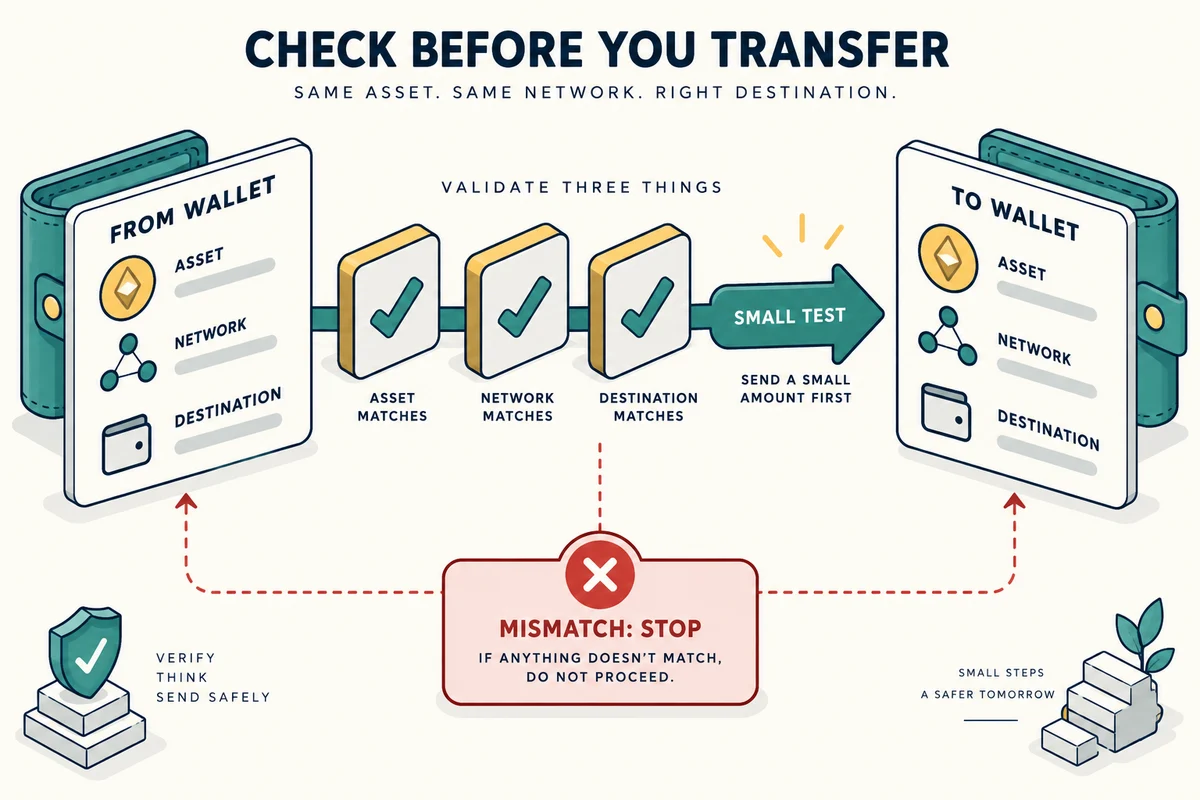
- Check the receiving end first: In the current deposit screen, verify the exact asset and network, address, any required Tag or Memo, minimum amount, and service status.
- Cross-check issuer information: Check Tether’s list of supported protocols and contracts and Circle’s USDC support information. Issuer support and exchange deposit support are not the same thing.
- Check the sending conditions: Verify that the asset and network match, and that the amount after deducting the withdrawal fee meets the minimum deposit amount. Do not assume compatibility just because the addresses look similar.
- Stop if anything does not match: If the network is unavailable or it is unclear whether the asset is bridged, do not guess which route is cheaper or faster and send anyway. Confirm the exact asset and network with the official support team.
- Test new routes and keep records: After a small test transfer that meets the requirements, check the deposit record and keep the TxID. Do not split transfers to evade regulations or review criteria.
Even when managing frequently used withdrawal addresses, recheck the asset, chain, and tag. Binance Withdrawal Address Whitelist and Waiting Period Guide can help manage addresses, but it cannot protect against incorrectly saved addresses or unsupported networks.
6. Conditions to check first based on your intended use
| Intended use | What to check first | When to stop and reconsider |
|---|---|---|
| Transfers between exchanges | Assets and networks supported by both sides, account and regional conditions, final amount received | Destination network unsupported, deposits suspended, address or tag unclear |
| Spot or derivatives trading | Actual quotes and execution conditions for the trading pair, margin asset and collateral eligibility requirements | Ignoring collateral risks or leveraged losses just because it is a stablecoin |
| Holding or using in a personal wallet | Official asset identification, wallet and service support, gas asset, and recovery and key management | Bridge or wrapped-token structure or contract cannot be verified |
| Converting back to dollars | Eligibility for direct redemption or the sale and bank withdrawal route, total costs and processing conditions | Assuming you can immediately exchange for dollars in your own bank account based only on the issuer’s 1:1 statement |
CoinPop’s perspective: The nature of reserves, access to an exit, and transfer compatibility are separate considerations. A single balance or market capitalization cannot stand in for all three. The risks of holding a stablecoin itself should also be distinguished from the risks of exchange custody, lending, or yield products, and the value in Korean won is also affected by the dollar exchange rate.
Frequently Asked Questions
Are USDT and USDC always worth one dollar?
They aim to maintain a peg to one dollar, but their market prices on exchanges may vary with supply, demand, and liquidity. The issuer’s redemption terms and the price at which you can sell immediately in the market are not the same thing.
Is it safer to exchange USDT for USDC?
It cannot be concluded that it is unconditionally safer. In addition to reserves, the issuer, and applicable terms, you should also consider exchange costs, the destination service, the custody platform, and network risks. This article does not provide a safety ranking or buy/sell advice.
Does USDT’s 100,000 USD minimum apply to exchanges too?
No. The figure in this article is an official requirement for acquiring or redeeming directly with Tether. Current exchange trading and deposit/withdrawal minimums must be checked separately on the relevant exchange screen for each exchange, asset, network, and account.
Can anyone receive dollars from Circle by holding USDC?
No. Mint is an institutional service with eligibility and account requirements. The EEA has a separate retail redemption process, but it is subject to conditions such as KYC/KYT and a bank account; it cannot be generalized as a right available in every region, including Korea.
If a USDT address looks the same, can I send it over a different network?
No. Similar address formats are not the same as compatibility between assets and networks. Check that the receiving platform supports the exact asset and network, and stop the transfer if they do not match.
Does a reserve verification report mean there is no risk of loss?
No. It does not guarantee situations beyond the report’s date, subject, or scope of verification. Other risks include market price deviations, redemption delays or restrictions, exchanges, custodians, smart contracts, loss of keys, and regulation.
Official Sources and Scope of Verification
- Tether Relevant Information Document — February 20, 2026: Issuing entity and legal and risk disclosures.
- Tether Financial Figures and Reserves Report and BDO Opinion: As of June 30, 2026; approved and issued on July 31.
- Tether Fees: Direct redemption minimum amount and fee formula.
- Tether Supported Protocols: Supported and discontinued protocols and asset identification.
- Circle Transparency: Information as of October 8, 2026, on reserve structure and verification policy. Dynamic balance figures are not used in the main text.
- Circle USDC: Eligibility and support information for USDC and Mint.
- Circle USDC Terms: Scope of application outside the EEA, redemptions, supported assets, and restrictions.
- Circle MiCA Redemption Policy: Separate redemption eligibility and procedures for retail holders in the EEA.
- Circle Mint USDC/EURC redemption structure: Structure effective March 15, 2026. Fees for individual accounts are not calculated.
The date on which official materials were checked may differ from the materials’ own as-of date. Specific exchange accounts, actual order execution, redemption approval, or transfers were not tested directly. The five images are illustrative diagrams created by CoinPop; they are not official screens, institutional certifications, or evidence of actual use. If terms change, check the relevant official materials and your actual account screen again.
Risk and conflict of interest disclosure: Stablecoins are not the same as bank deposits or principal-protected products, and involve risks related to depegging, issuers, custodians, exchanges, blockchains, and regulation. Assets sent incorrectly may not be recoverable. This article does not include direct signup affiliate links, but linked CoinPop exchange guides may contain affiliate links, and CoinPop may receive compensation for qualifying activity. This does not guarantee the comparison criteria in the article or the safety of any individual asset.